If Someone Collapses: What to Do Before the Ambulance Arrives
When someone collapses, the minutes before the ambulance arrives can decide the outcome. This practical guide explains how to recognise cardiac arrest, start hands-only CPR, and use an AED with confidence.
When someone collapses, what you do in the next sixty seconds can make a critical difference. This guide has been updated and follows the Resuscitation Council UK Guidelines 2025, including the change to when you should call 999.
If this is happening right now
If they do not respond when you speak to them and gently shake their shoulders, call 999 immediately. Do not wait until you have checked their breathing. Put the phone on speaker and assess their breathing while the call connects.
If they are not breathing normally, start CPR immediately and follow the 999 call handler's instructions.
For an adult: push hard and fast in the centre of the chest, about twice a second, and keep going.
For a baby, child or teenager: give five rescue breaths first if you can, then start chest compressions. If you cannot or will not give breaths, go straight to compressions.
If anyone else is there, send them for the nearest defibrillator while you carry on with compressions.
Do not leave the person on their own unless you have no other way of calling for help.
Most out-of-hospital cardiac arrests in the UK happen at home, most often to men, and most often to people over 65.4 The person who finds them is rarely a medic. They are a partner, a son or daughter, a colleague, a coach, or somebody who happened to be walking past.
Around 115,000 out-of-hospital cardiac arrests are reported to UK ambulance services every year, and resuscitation is attempted in roughly 43,000 of them. Just under 10 per cent of those people are still alive 30 days later in England and Scotland, and fewer in Northern Ireland.4 Those numbers look bleak until you look at what sits behind them. Bystander CPR rates vary widely across the four nations, from 41.5 per cent in Northern Ireland to 72.6 per cent in England. A defibrillator is used by a bystander in only around one in ten cases anywhere in the UK.4
That gap is the whole story. In a shockable cardiac arrest, early defibrillation is the intervention capable of restoring an effective heart rhythm, and it is the one bystanders reach for least. The other number worth holding onto is the wait. RCUK reports median ambulance response times to out-of-hospital cardiac arrest of 7.2 minutes in England, 8.9 minutes in Wales and 9.4 minutes in Northern Ireland.4 That is the window this article is about. What follows is what to do, in the order you need to do it, for adults and for children, with the parts most people get wrong flagged as they come up.
What changed in 2025
The Resuscitation Council UK published new resuscitation guidelines on 27 October 2025. One instruction changed in a way that affects everybody, trained or not: you now call 999 as soon as you find someone unresponsive, before you check whether they are breathing. Assess their breathing while the call is connecting.1
What is the first thing you should do if someone collapses?
Check that it is safe to approach, then check whether the person responds to you. If they do not respond, call 999 immediately, before you check their breathing.
Resuscitation Council UK sets this out as three steps to save a life: Check, Call, CPR.1 Check means two things at once. Is it safe for you to go to them, and is the person conscious? Speak to them loudly, ask if they are all right, and gently shake their shoulders. A person who does not react to your voice and to touch is unresponsive, and that is all you need to establish before you dial.
Do not spend time looking for a pulse. Feeling for a pulse is not part of the guidance for members of the public, and even experienced clinicians are unreliable at finding one under pressure. Responsiveness and breathing are the two things that decide what you do next.
At what point should you call 999?
As soon as you have established that the person is unresponsive. You no longer need to confirm that their breathing is abnormal first.
This is the most significant change in the 2025 adult guidelines, and it reverses the sequence a great many people were taught. The older approach was to check for danger, check for a response, shout for help, open the airway, check breathing for up to ten seconds, and only then call. The 2025 guidance is explicit that rescuers no longer need to confirm abnormal breathing before calling. You initiate the call first, then assess breathing while you wait for it to be answered.1
The reasoning is straightforward. Recognising cardiac arrest is genuinely difficult, and the 2025 guidelines say so openly. Every second spent deciding whether the breathing you are looking at counts as normal is a second before an ambulance is dispatched, before the call handler can point you at the nearest defibrillator, and before anybody talks you through compressions. The call handler is trained to help you work out what you are looking at. Bringing them in earlier removes the part of the process that people are worst at.1
If you have a mobile, put it on speaker so your hands stay free. If you are alone with no phone and no signal, shout for help and carry on assessing breathing. If you are certain nobody is coming, you will have to leave them to make the call, and you should do that as quickly as you can. When you get back, if they are still unresponsive and not breathing normally, start CPR straight away.1
If you want to understand what happens once the call connects, including why the operator asks the questions they do and why your location matters so much, we have covered that separately in what happens when you call 999.
How long should you take to check if someone is breathing normally?
No longer than ten seconds. In an adult, you now do that check while you are waiting for your 999 call to be answered rather than before you dial.
The ten second limit is stated explicitly in the paediatric guidance, where you open the airway and look for breathing and signs of life for no longer than ten seconds.2 It also remains the standard in RCUK's quality standards for community CPR and AED training, which state that assessment of breathing should take no more than ten seconds and should not delay the start of CPR.10 It is the right figure to hold in your head. The purpose of the limit is not precision. It is to stop you doing what almost everybody does under stress, which is to stand over someone for half a minute trying to talk yourself into a decision.
Look for the chest moving. Listen and feel for air at the mouth and nose. Ten seconds. If you have any doubt at all about whether the breathing is normal, act as though it is not.1,2
What does abnormal breathing actually look like?
Slow, laboured breathing, occasional noisy gasps, and panting are all abnormal. Any of them in an unresponsive person means you should assume cardiac arrest and start CPR.
Agonal breathing is the thing that catches people out. It is a reflex, and it can sound like snoring, gulping, gasping or snorting. It happens in the first minutes after the heart stops and it can look enough like breathing that a bystander decides the person is fine and waits. They are not fine. Agonal gasping is a sign of cardiac arrest, not a sign of life.1
The 2025 guidelines added a second warning that was not in the 2021 version. Exercise is a common trigger for cardiac arrest, and early after the onset of an arrest an athlete may show a near-normal or panting breathing pattern.1 Somebody who collapses on a pitch or in a gym has usually been breathing hard for the last twenty minutes, so a fast breathing pattern looks entirely unremarkable. This is precisely the situation where a bystander is most likely to wait and see.
A short period of seizure-like activity can also happen at the onset of cardiac arrest. If that occurs, wait for the movement to stop and then assess breathing.1 A collapse with jerking movements is not automatically a seizure.
What should you do if the person collapsed but is breathing normally?
Do not start CPR. Put them on their side in the recovery position, keep the airway open, call 999, and check their breathing at least every minute.
The 2025 first aid guidance is that adults and children with a reduced level of responsiveness who do not meet the criteria for CPR should be placed in a lateral, side-lying recovery position.3 The position keeps the tongue clear of the airway and lets vomit drain rather than being inhaled, which is the main risk to an unconscious person who is otherwise breathing.
There are two situations where you should not move them into it. If the breathing is agonal, this is a cardiac arrest and you start CPR. If trauma is suspected, from a fall, a road collision or a blow, do not routinely put them into the recovery position.3 Minimise movement of the head and neck, keep the airway open, and follow the instructions the 999 call handler gives you. Opening the airway always takes priority over holding the neck still, so if somebody is face down and cannot breathe effectively, they may still need to be rolled carefully.3
Once someone is in the recovery position, they still need watching. Check the breathing continuously, or at least every minute. If you are unsure whether the position is stable or whether the breathing is still normal, roll them onto their back and open the airway again.2
Do not put anything in the mouth of somebody who is not fully awake. That includes sugar, glucose gel and drinks, even if you know the person is diabetic. In an unresponsive person, oral sugar in any form carries a risk of aspiration. Call 999 and use the recovery position instead.3
A simple faint, where someone goes down and comes round within seconds, is usually not an emergency. But any collapse that involves chest pain, breathlessness, an injury from the fall, or that has no obvious explanation needs urgent medical assessment. If chest pain is part of the picture, read what to do if you think someone is having a heart attack. If it happened in hot conditions, heat illness is worth ruling out.
How do you do chest compressions on an adult?
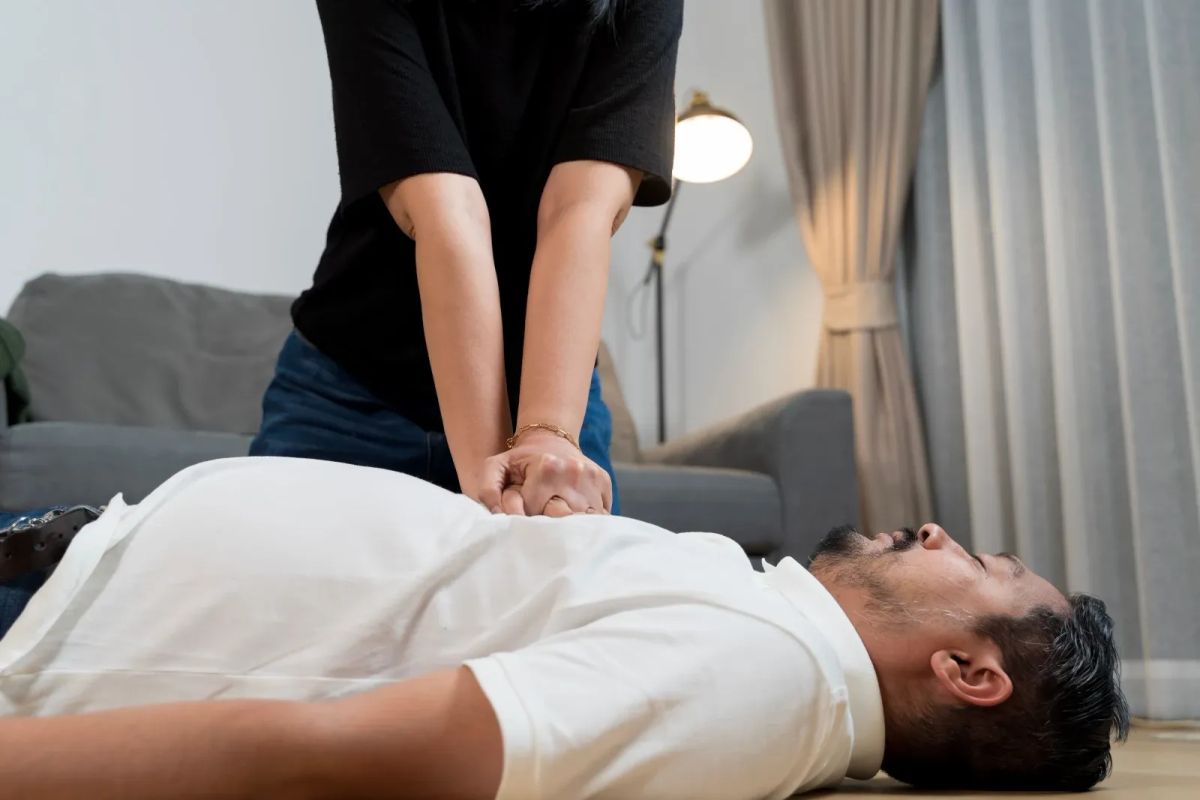
Place the heel of one hand in the centre of the chest, your other hand on top, and press down at least 5 cm but no more than 6 cm, at a rate of 100 to 120 compressions per minute.1
- Kneel beside them. Position yourself level with their chest, with your knees close in to their side.
- Find the spot. Put the heel of one hand on the lower half of the breastbone, which is the centre of the chest. If clothing stops you seeing the landmark, move it or remove it.
- Stack your hands. Place the heel of your other hand on top and interlock your fingers, so the pressure goes through the breastbone and not the ribs.
- Lock out. Keep your arms straight and put your shoulders directly above your hands. You are compressing with your body weight, not your arms.
- Press deep. At least 5 cm, and not more than 6 cm.
- Release fully. Let the chest come all the way back up between compressions and do not lean on it. Incomplete release is one of the most common faults and it stops the heart refilling.
- Keep the rate. Between 100 and 120 a minute, which is roughly two a second, with as few interruptions as you can manage.
One point here contradicts what a lot of people were taught. CPR does work better on a firm surface, but you should not move somebody from a bed onto the floor to do it. Start compressions on the bed and press deeper to compensate for the mattress.1 The time and the pause involved in dragging an adult onto the floor costs more than the soft surface does.
You will be pushing harder than feels reasonable. Ribs and cartilage sometimes give way under effective compressions. That is common, it is not a sign you have done something wrong, and it is not a reason to stop.
Do you need to give rescue breaths?
Only if you have been trained and are willing to. If not, give continuous chest compressions with no interruptions at all.1
If you are trained, alternate 30 chest compressions with 2 rescue breaths. Deliver just enough air to make the chest start to rise and no more, because over-inflating the lungs does harm rather than good. If you cannot get the chest to rise after two attempts, think about an obstructed airway.1
It is worth knowing how the ambulance service handles this. The call handler is instructed to assume you do not know how to perform CPR and to give you compression-only instructions by default. They will only move you to 30:2 if you tell them you know how to give rescue breaths.1 So if you are trained, say so early in the call.
This applies to adults. Children are different, and the difference matters. That is covered further down.
When should a defibrillator be used?
As soon as one is available, on anyone who is unresponsive and not breathing normally. You do not need any training to use one, and you cannot shock somebody who does not need it.1
An automated external defibrillator reads the heart rhythm before it does anything else, and it will only advise a shock if it finds a rhythm that a shock can correct. If the rhythm is not shockable, it tells you to carry on with compressions. This is the single most common reason people hesitate, and it is a misplaced worry. The 2025 guidelines are direct about it: anyone can use an AED, and the risk of harm from CPR and defibrillation is low.1
A shockable rhythm is found in 15 to 22 per cent of UK out-of-hospital cardiac arrests, and those are the cases where a defibrillator changes the outcome most dramatically.5 The 999 call handler can direct you to the nearest registered device through The Circuit, the national defibrillator database. You can also look up devices near any UK location on Defib Finder.
What should you do while you are waiting for the defibrillator to arrive?
Carry on with CPR and keep interruptions to an absolute minimum. If you are doing compression-only CPR, do not stop compressing until the defibrillator tells you it is analysing. Compressions are what keeps blood moving to the brain and heart, and every pause reduces the chance the shock will work.
This is the point at which well-meaning people most often make things worse. The instinct on hearing that a defibrillator is on its way is to pause, stand up, look around, or go and help fetch it. All three cost blood flow.
If there is somebody else with you, they go for the device and you stay on the chest. If you are on your own, calling 999 and starting compressions come first, and a lone rescuer should not abandon CPR to go hunting for a defibrillator unless the call handler directs you to one that is genuinely close. Where more than one bystander is present, the call handler will guide somebody to the nearest AED while you carry on.1
When the device does arrive, keep compressing while the pads are being put on. The 2025 guidance is explicit that where more than one rescuer is present, CPR continues while the pads are attached.1 The only point at which you take your hands off is when the machine tells you it is analysing.
How do you use a defibrillator?
Turn it on and do what it tells you. The device gives spoken or visual instructions that guide you through each step.
- Turn it on. Some open-and-go units switch themselves on when you lift the lid. Others have a power button. It starts talking immediately.
- Bare the chest. The pads need direct contact with skin. Dry the chest if it is wet.
- Attach the pads. Follow the diagram printed on the pads themselves. Standard adult placement is one pad below the right collarbone and one on the left side below the armpit.
- Stand clear for analysis. Make sure nobody is touching the person while the device reads the rhythm.
- Shock if advised. Check again that nobody is in contact. Some units are fully automatic and deliver the shock themselves. Others need you to press the button.
- Restart compressions immediately after a shock. The moment the shock is delivered, go straight back to chest compressions. Do not stop to check for breathing or a pulse first.
- Restart compressions immediately if no shock is advised. This is the step people miss. A no-shock decision does not mean stop. Resume chest compressions straight away and keep following the AED prompts, which will tell you when it wants to reanalyse.
On bras and clothing, the 2025 guidance addresses something that has cost lives. The priority is correct pad placement and skin contact. If that can be achieved quickly with the bra in place, leave it. If it gets in the way of positioning the pads properly, remove it. Rescuers should not be concerned about exposing a person's chest, and life-saving intervention comes first.1 That RCUK felt the need to write this down should tell you how often hesitation over it happens.
Is it different for a child or a teenager?
Yes. Children need five rescue breaths before compressions begin, because in children the heart usually stops as a consequence of a breathing problem rather than a primary heart problem.2
The 2025 guidelines define an infant as under 1, a child as 1 to 12, and an adolescent as 13 to 18.2 All three are treated as paediatric. If you genuinely cannot tell whether you are dealing with an adult or a child, use whichever algorithm you judge appropriate and get on with it. RCUK notes that little or no harm comes from resuscitating an adult using the paediatric approach.2
The paediatric sequence
Check for a response using voice and touch, but never a painful stimulus. Call 999, on speaker. If you are trained in paediatric basic life support, check breathing while the call connects, taking no longer than ten seconds. Give five initial rescue breaths, then start chest compressions.2
The compression to ventilation ratio is 15:2 if you are specifically trained in paediatric basic life support. If you are not, use 30:2. If you are unwilling or unable to give breaths at all, compression-only CPR is still far better than nothing and the call handler will encourage it.2
Depth, hands and pads
Compress over the lower half of the breastbone at 100 to 120 a minute, as with an adult, and depress the chest by at least one third of its front-to-back depth. In adolescents, use the adult figure of 5 to 6 cm. Do not exceed 6 cm at any age. For infants, use the two-thumb encircling technique. For children over 1, use one or two hands, whichever lets you compress properly.2
For the defibrillator, activate paediatric mode for infants and children under 25 kg, which is roughly under 8 years old. For larger children and adolescents, use the device in standard adult mode. If the AED has no paediatric setting at all, use it in adult mode anyway.2 A 15-year-old on a sports pitch gets standard adult pads and adult mode. That applies to the defibrillator setting only. The wider paediatric sequence still applies to them, including the five initial rescue breaths.
Who fetches what
If a second rescuer is available, they call the ambulance service while the first starts CPR, then bring and attach the defibrillator. If there is only one rescuer, calling 999 and starting CPR take priority over fetching an AED.2 A single rescuer with no mobile phone at all should perform one minute of CPR before going to seek help.2
Sport, clubs and coaches
Paediatric cardiac arrest is rare, with around 750 to 800 out-of-hospital cases across the UK each year where the ambulance service attempts resuscitation.4 Exercise-related paediatric arrests are rarer still, but they carry higher survival rates than other causes.2 That is an argument for coaches, clubs and school sports staff being trained and for having a defibrillator that is signed, unlocked and reachable in under a couple of minutes, not locked in an office.
If you work in childcare, education or a sports setting, the practical skills are covered in our paediatric first aid training and in the two-day paediatric and early years first aid course.
How long should you keep going?
Until the ambulance service takes over or tells you to stop, until the person becomes responsive, or until you are too exhausted to continue.3
Becoming responsive means something specific: speaking, opening their eyes, moving purposefully, or breathing normally.3 A single gasp is not recovery. Keep going.
Effective CPR is physically hard and the quality of compressions drops measurably within a couple of minutes, usually before the person doing them notices. If there is anybody else who can take over, swap regularly. Do not stop to reassess breathing between swaps, and do not interrupt compressions unless the defibrillator instructs you to.1
Cardiac arrest and a heart attack are not the same thing
The words get used interchangeably and the distinction matters at the moment you are deciding what to do. A heart attack is a blockage in a coronary artery. The person is usually conscious, often in pain, often frightened, and able to talk to you. A cardiac arrest is the heart failing to pump effectively at all. The person is unconscious within seconds and will stop breathing normally almost immediately.
The connection is that one can cause the other. Around 80 per cent of out-of-hospital cardiac arrests in the UK have a cardiac cause.4 This is why the correct response to a suspected heart attack always includes knowing what to do if the person collapses. We have covered recognising a heart attack and what to do in more depth separately.
What are the chances of someone surviving?
Just under 10 per cent of people whose out-of-hospital cardiac arrest is treated by the ambulance service in England or Scotland are alive 30 days later. Where the arrest is witnessed by a bystander and the initial heart rhythm is shockable, around 29 per cent are alive 30 days later in England and Scotland.4
The detail behind that is worth sitting with, and the picture is not the same across the UK. The national figures cover different reporting periods, so they show the broad UK picture rather than a direct comparison between the four nations. Around 115,000 out-of-hospital cardiac arrests are reported to ambulance services each year and resuscitation is attempted in about 43,000. The heart is in a shockable rhythm in 15.5 to 21.7 per cent of cases. Bystander CPR rates range from 41.5 per cent in Northern Ireland to 72.6 per cent in England. Bystander defibrillator use sits between 8.0 and 10.3 per cent.4
Read those figures together. Bystander CPR is far more common than bystander defibrillator use. Across the reported national datasets, a bystander uses an AED in only around one in ten cases. That is not really a training failure. It is a question of where devices are placed, whether they are registered so a 999 call handler can find them, whether the cabinet is locked, and whether anybody on site knows the thing exists at all. Access to registered devices is also unequal, with density varying several-fold across UK health boards and deployment falling as deprivation rises.4
For children, paediatric out-of-hospital cardiac arrest runs at approximately 750 to 800 cases a year across the UK, with 30-day survival of 13.2 per cent in England.4
Can you do harm by starting CPR?
The Resuscitation Council UK position is unambiguous. Saving a person's life is the priority, and first aiders should not be concerned about causing harm to the person they are helping.3
The 2025 guidelines address the specific fears people have, one by one. Lay people should start CPR for a suspected cardiac arrest without worrying about harming someone who turns out not to be in cardiac arrest. The risk of infection to a rescuer performing CPR is low. The risk of an accidental shock from an AED is low. The risk of physical injury to the rescuer is low.1
The guidelines put it more bluntly than a training provider usually would: no greater harm can occur than failing to act when someone requires CPR and defibrillation.1 The risk of serious harm from attempting CPR is low. Failing to act removes the person's chance of resuscitation altogether.
What happens to you afterwards
The 2025 guidelines added something that no previous version contained. They recognise that finding a person in cardiac arrest and attempting resuscitation is a potentially traumatic experience for many lay rescuers, and that bystanders may benefit from support afterwards.1
This is not a footnote. The guidance goes further and says first aid courses themselves should include measures to help bystanders, lay rescuers and professionals overcome fear, anxiety and moral distress both during and after providing first aid.3
It needs saying plainly, because the statistics above make it likely. Most people who perform CPR on a stranger, a colleague or a family member will not get that person back. Doing everything correctly and having the person die anyway is the common outcome, not the exceptional one. That is not a failure on your part, and people who have been through it frequently need to hear that from somebody. Resuscitation Council UK maintains a support page for anyone affected by cardiac arrest.
Organisations that put staff in a position where they may have to attempt resuscitation, whether that is a leisure centre, a care setting, a school or a factory floor, should think about what support looks like the day after, not just what the training certificate says. That sits alongside physical first aid provision rather than separately from it, and it is part of what our mental health first aid training covers.
Getting trained
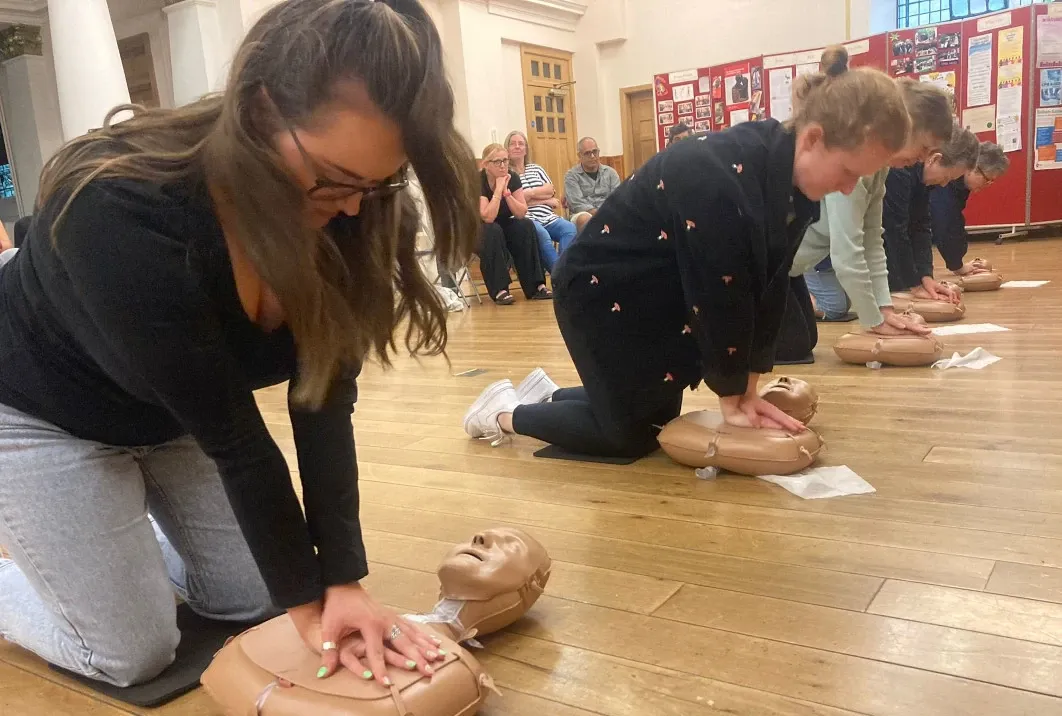
Reading this and doing it are not the same thing. Hands-only CPR is simple enough that written guidance can get somebody to act, and if this article is all you ever read, it will have done its job. But compression depth is almost impossible to judge without having felt it on a manikin, and the difference between hesitating for thirty seconds and starting immediately is largely a matter of having done it before under instruction.
A short course covers recognition, hand placement and depth with feedback, defibrillator use in a practical setting, the paediatric differences, and what to do when it goes wrong. Workplace first aid certificates commonly remain valid for three years, but the Health and Safety Executive strongly recommends annual refresher training during that period to keep CPR and other practical skills current.9

Train your team with Constellation Training
Our Basic Life Support and AED course covers exactly what is described in this article, with hands-on practice on manikins and defibrillator trainers. If you need broader workplace cover, the one-day Emergency First Aid at Work and three-day First Aid at Work courses include CPR and AED alongside the full first aid syllabus. Courses are delivered by experienced trainers and built around the risks in your workplace rather than a fixed template.
See all first aid courses or get in touch to discuss in-house delivery.
The part worth remembering
If somebody is on the floor and will not respond to you, call 999 before you do anything else. Check their breathing while the call connects. If the breathing is absent, gasping, laboured or panting, start CPR. For an adult, push hard and fast in the centre of the chest and keep going. For a baby, child or teenager, give five rescue breaths first if you can, then start compressions. Send somebody for the nearest defibrillator and do not stop compressions while you wait for it. Put the pads on, follow the voice, and go straight back to compressions after the shock.
That is the whole thing. The people who do it are not braver or better qualified than the people who do not. They have usually just decided in advance that they will.
References and Further Reading
1. Resuscitation Council UK. Adult Basic Life Support Guidelines 2025. Published 27 October 2025. resus.org.uk
2. Resuscitation Council UK. Paediatric Life Support (basic and advanced) Guidelines 2025. Published 27 October 2025. resus.org.uk
3. Resuscitation Council UK. First Aid Guidelines 2025. Published 27 October 2025. resus.org.uk
4. Resuscitation Council UK. Epidemiology of Cardiac Arrest Guidelines 2025. resus.org.uk
5. Resuscitation Council UK. Executive Summary of the Main Changes Since the 2021 Guidelines. resus.org.uk
6. Resuscitation Council UK. Support After Cardiac Arrest. resus.org.uk
7. Defib Finder. Find a defibrillator near you. defibfinder.uk
8. NHS. First aid: CPR. nhs.uk
9. Health and Safety Executive. First aid at work: your questions answered (INDG214). hse.gov.uk
10. Resuscitation Council UK. Quality Standards: CPR and AED training in the community. resus.org.uk