First aid needs assessment: what employers must do and how to do one
Every employer must make adequate and appropriate first aid provision. This practical guide explains how to carry out a first aid needs assessment, choose suitable training and equipment, and decide how many first aiders your workplace needs.

Every employer in Great Britain has a legal duty to make first aid provision for their employees. The duty comes from the Health and Safety (First-Aid) Regulations 1981, and it applies to every workplace, including those with fewer than five employees.1,2 Northern Ireland has its own equivalent regulations, made in 1982.7
What the law does not do is tell you how much to provide, how many people to train, what qualification they need, or how many kits to stock. Those decisions belong to the employer. The mechanism for making them is the first aid needs assessment.
It is often treated as a compliance formality. It is not. Under-provide and someone may suffer a worse outcome from a preventable injury. Over-provide, or provide the wrong thing, and you may end up with trained first aiders who hold a qualification that does not cover the risks they will actually face. Both failures start in the same place, which is an assessment that was never properly carried out.
This guide sets out what the assessment is, what the law and HSE guidance actually require, the factors you need to work through, how many first aiders the guidance suggests, how to decide between Emergency First Aid at Work and First Aid at Work, and what HSE expects you to check before you buy training from anyone.
What is a first aid needs assessment?
A first aid needs assessment is a structured review of your workplace, your workforce and your working patterns, carried out to decide what first aid equipment, facilities and personnel are adequate and appropriate for your specific circumstances.
The legal basis is regulation 3 of the Health and Safety (First-Aid) Regulations 1981, which requires employers to provide equipment and facilities that are adequate and appropriate for first aid to be given to employees who are injured or become ill at work, and to provide a suitable number of suitably trained people to give it.2
HSE guidance L74 explains how that duty should be discharged.1 It states that an employer should make an assessment of first aid needs appropriate to the hazards and risks of each workplace, so that sufficient equipment, facilities and personnel are available at all times, taking account of alternative working patterns, to give immediate assistance to casualties and to summon an ambulance or other professional help.1
It is worth being clear about what the assessment is not. It is not your general risk assessment, although it draws on it. The Management of Health and Safety at Work Regulations 1999 require you to assess risks and control them; the first aid needs assessment asks what happens when those controls fail.1 It is not a document produced to justify the number of first aiders you already have. And it is not a one-off exercise that gets filed and forgotten.
Does the assessment have to be in writing?
No. L74 states there is no requirement for the assessment of first aid needs to be formal or written down, although it may be useful to retain a written record.1
The practical argument for writing it down is that a record lets you demonstrate to a safety representative, or to an HSE or local authority inspector, how you arrived at your level of provision.1 Without one, you are relying on recollection to justify a decision that may be scrutinised after something has gone wrong.
Is a first aid needs assessment a legal requirement?
The assessment itself is not named as a duty in the Regulations, but the duty it discharges is. Regulation 3 requires provision that is adequate and appropriate in the circumstances, and there is no way to determine what is adequate and appropriate for your circumstances without assessing them.2 HSE guidance treats the assessment as the expected route to compliance, and an employer who cannot show how they decided on their provision would find that decision more difficult to justify.
One point matters more than most employers realise. L74 has not been an Approved Code of Practice since 2013. The first aid ACOP was withdrawn that year, and the associated guidance was strengthened instead, specifically to help employers select first aid training providers.1 L74 is guidance. Following it is not compulsory and you are free to take other action, but if you follow it you will normally be doing enough to comply, and inspectors may refer to it.1
This is not a technicality. A great deal of first aid content still online describes L74 as an ACOP and presents the suggested numbers of first aiders as legal minimums. They are not. They are suggestions, and the judgement remains yours.
The Regulations apply to all workplaces in Great Britain, including those with fewer than five employees.1 There are limited exceptions set out in regulation 7, covering diving operations, certain merchant shipping regulations, vessels registered outside the United Kingdom, the armed forces, and offshore installations, which have their own first aid regime.2 Mines and offshore work are dealt with separately under regulations 8 and 9.2
The position for self-employed people changed in 2015 and is widely misreported. Regulation 5 was substituted with effect from 1 October 2015 and now applies only to a relevant self-employed person, meaning a self-employed person who conducts an undertaking of a prescribed description for the purposes of section 3(2) of the Health and Safety at Work etc. Act 1974.2,8 A relevant self-employed person must provide such equipment, if any, as is adequate and appropriate to enable them to give first aid to themselves while at work.2
The prescribed undertakings cover agriculture including forestry, asbestos, construction, gas, genetically modified organisms and railways, plus a catch-all for any activity that may pose a risk to the health and safety of someone other than the self-employed person or their own employees.9 A self-employed person whose work falls outside all of those categories is not caught by regulation 5. Note that the current edition of L74 still reproduces the pre-2015 wording and describes the duty as applying to self-employed people generally.1 Where the guidance and the consolidated Regulations diverge, the Regulations are authoritative.
Where self-employed people work on premises controlled by an employer, or alongside other self-employed people, joint first aid arrangements can be made. Any such arrangement should make clear who provides the equipment and what cover is available.1
How do you carry out a first aid needs assessment?
Work through eight steps: map the workplace, gather what you already know, identify the foreseeable emergencies, look at who your people are and when they work, decide the personnel and training levels, decide the equipment and facilities, plan cover for absence and off-site work, then record it and tell people. Each step is expanded in the sections below.
The sequence matters, because the decisions at the end are only as good as the information gathered at the start. In practice:
- Map the workplace. Divide it by site, building, floor, work area and shift. Different activities and hazards in different parts of an establishment need separate consideration rather than a single site-wide conclusion.1
- Gather what you already have. Your general risk assessment, COSHH assessment, accident book, incident records and RIDDOR reports. Information from the risk assessment feeds directly into the first aid assessment.1
- Identify the foreseeable emergencies. The injuries and illnesses that could plausibly occur given what people actually do, including any life-threatening events such as severe bleeding.1
- Look at who your people are and when they work. Workforce characteristics, young workers and trainees, known health conditions, shift patterns, site distribution, lone and travelling workers, and non-employees on site.1
- Decide the personnel and the training level. Appointed person, EFAW, FAW, or additional training on top, and how many of each and where.1
- Decide the equipment and facilities. Kit contents and locations, any additional or specialist equipment, whether an AED is warranted, and whether a first aid room is needed.1
- Plan cover. Annual leave, sickness, training absence, shift handovers, lone working and work away from the main site.1
- Record it, communicate it and set review triggers. Write down the conclusions, tell employees what the arrangements are as regulation 4 requires, and decide what will prompt a review.1,2
Steps one to four gather the evidence. Steps five to seven convert that evidence into decisions about provision. Step eight records, communicates and reviews those decisions. Most of the provision failures described later in this guide come from starting at step five.
Employees, contractors and members of the public
The Regulations impose a duty in respect of employees. They do not require you to provide first aid for anyone else.1
HSE nevertheless strongly recommends that non-employees are included in your assessment and that provision is made for them, noting that many organisations such as schools, places of entertainment, fairgrounds and shops provide a service to others.1 For most workplaces this is not merely good practice. A shop, a leisure centre, a school, or a construction site with contractors from several firms, where the first aider covers only directly employed staff, falls well short of what any reasonable person would expect.
Including non-employees can change the training you need, not just the numbers. L74 notes this may require first aiders to receive training above the legal minimum so they can act competently, giving paediatric first aid in a school and the management of life-threatening bleeding as examples.1
There is also an insurance point that is easy to miss. Where provision is intended to cover both employees and non-employees, HSE advises employers to check that their liability insurance covers all the activities of their first aiders, and to make sure the level of provision for employees does not fall below the standard the Regulations require.1
What does a first aid needs assessment need to consider?
L74 sets out eleven factors: the nature of the work and the workplace hazards and risks, the nature of the workforce, the organisation’s history of accidents, the size of the organisation, the needs of travelling, remote and lone workers, work patterns, the distribution of the workforce, the remoteness of the site from emergency medical services, employees working on shared or multi-occupied sites, annual leave and other absences of first aiders and appointed persons, and first aid provision for non-employees.1
These are not optional extras. They are the working parts of the assessment, and each one can push your conclusions in a different direction from the headcount alone.
The nature of the work and its hazards
This is the single most significant factor. Start with your general risk assessment, your COSHH assessment and your incident records, and work out what kinds of injury and illness could plausibly occur given what people actually do.
L74 gives worked examples of common workplace hazards and the injuries that follow from them: chemicals causing poisoning, burns, eye injuries and respiratory problems; electricity causing shock, burns and cardiac arrest; machinery causing crush injuries, amputations, fractures and lacerations; manual handling, slips and trips causing fractures, sprains and strains; work at height causing head, spinal and limb injuries; and workplace transport causing crush and head injuries.1
Where higher level hazards such as chemicals or dangerous machinery are present, or special hazards such as hydrofluoric acid or confined spaces, HSE says first aid requirements will be greater, and employers may need to provide enough qualified first aiders that someone is always available immediately, arrange additional training, consider additional equipment, provide a first aid room, and inform the local emergency services in writing where hazardous substances or processes are in use.1
Where a site contains different kinds of work, for example a production area and an office, L74 expects separate risk assessments for those areas, with the results carried across into the first aid needs assessment.1 A single site-wide conclusion is rarely the right answer.
The nature of the workforce
Headcount tells you very little about who your people are. L74 asks employers to address the particular needs of young workers, trainees, pregnant workers and employees with disabilities or known health problems, giving asthma, diabetes, peanut allergy, epilepsy, mental ill health and a history of heart disease as examples.1 It also suggests using the age profile of the workforce as a rough indicator of the likelihood of employees being at greater risk of developing heart conditions, and confirms that provision should extend to work experience trainees.1
Each of those conditions has first aid implications that a generic course may or may not cover in the depth your workplace requires.
The size of the organisation
Generally the larger the workforce, the greater the provision required, but L74 is explicit that employee numbers should not be the sole basis for determining first aid needs.1 It gives the example that a greater level of provision may be required where fewer people are at work but are undertaking higher risk tasks such as maintenance work.1
The guidance also notes that even in workplaces with a small number of employees, particularly where significant hazards are present, there is still the possibility of an accident or sudden illness, and employers may wish to consider providing a qualified first aider rather than relying on an appointed person.1
Work patterns and the distribution of the workforce
First aid provision has to be available at all times people are at work. L74 notes that requirements may vary where employees work shifts or out of hours, and that separate arrangements may have to be made for each shift.1
If your trained first aider works Monday to Friday and you run a night shift, you do not have adequate provision, and it is a common practical gap.
Site layout matters as much as timing. L74 asks employers to consider whether additional provision is needed on a site with more than one building, how many first aiders or appointed persons are needed to give adequate cover on each floor of a multi-floor building, and how the needs of employees working in self-contained areas are assessed and met.1 Cover concentrated in one location on a spread-out site is cover on paper only.
Travelling, remote and lone workers
Employers are responsible for meeting the first aid needs of employees working away from the main site.1 The assessment should determine whether those who travel long distances or are continuously mobile should carry a personal first aid kit, and organisations with employees in remote areas should consider special arrangements such as issuing personal communicators and providing additional training.1 Where employees work alone, L74 points to other means of summoning help, such as a mobile phone.1
The underlying problem with lone working is that the premise of workplace first aid, which is that a trained colleague can respond, does not hold. A field technician, a lone retail keyholder, a home visitor and a remote site worker present different risk profiles, but all of them need to appear in the assessment by name of role rather than be swept into a site-wide figure.
L74 also suggests considering whether mobile staff should undertake an EFAW course, particularly where they are involved in higher hazard activities.1
History of accidents and ill health
Your incident records are direct evidence of what goes wrong in your workplace rather than in workplaces generally. L74 asks what injuries and illnesses have occurred, including any life-threatening events such as severe or life-threatening bleeding, and where and how they happened, so that provision caters for those types of event.1
For larger or multi-site organisations, the same information helps determine where first aiders should be located, what area each should cover, and what equipment is needed.1 A clean record is not evidence of absent risk, but a record of incidents is concrete grounds for targeting provision.
Mental health
The third edition of L74 was updated in 2024 to emphasise employers’ responsibilities to take account of employees’ mental health in their first aid needs assessment.5 The guidance now states that the hazards and risks determining how much provision an employer needs can be both physical and related to mental health.1
What the guidance actually asks for is measured. It says it may be helpful to have people trained to identify and understand mental ill health symptoms who are able to support someone experiencing a mental health issue, and that an employer may decide someone holding FAW or EFAW is already able to provide initial support and reassurance to a worker experiencing an acute mental health episode, but should consider whether further training is required.1 Where such people are in place, the employer should be satisfied that they know how to access professional help if necessary and can act promptly, safely and effectively until that help is available.1
The 2024 checklist also asks whether there are inexperienced workers on site, or employees who are disabled or have particular physical or mental health problems, and points towards additional training for first aiders where there are.1
This does not turn a first aider into a counsellor, therapist or clinician, and nothing in L74 suggests it does. It asks whether your workplace has any considered mental health response at all, and whether it is adequate for your workforce.
What a trained mental health responder actually does, and where the limits of the role sit, is covered separately in our guide to mental health first aiders at work.
Life-threatening bleeding
The same 2024 amendment replaced the term catastrophic bleeding with life-threatening bleeding throughout L74, and added guidance on what employers should do where they identify it as a risk.5 This change is frequently overlooked because attention went to the mental health wording, but it has more immediate equipment and training consequences.
L74 lists the application of haemostatic dressings, wound packing and tourniquets for life-threatening bleeding as additional training that may be relevant in sectors such as agriculture, forestry and construction, and in remote working locations.1 It also lists haemostatic dressings, tourniquets and wound packing materials among the additional materials a needs assessment may indicate are required.1
If your assessment identifies life-threatening bleeding as a foreseeable risk, HSE expects you to make sure your training provider includes it on the FAW course rather than assume a standard syllabus covers it.1
Remoteness from emergency medical services
How long will an ambulance realistically take to reach you, and to reach the part of your site where an incident is most likely? In an urban location with clear access, professional help may arrive quickly. On a rural site, a remote industrial estate, or premises with restricted access, the gap can be considerable.
L74 says employers on remote sites may need special arrangements to ensure appropriate transport is available, may need to consider whether the contents of the first aid kit are adequate given a delay in the emergency services attending, and should inform the emergency services in writing of their location and any particular circumstances including specific hazards.1
The longer the gap, the more your on-site provision has to sustain a casualty rather than simply summon help. That may mean more first aiders, a first aid room, additional equipment, or a defibrillator. Where a defibrillator is in scope, see our guide to workplace defibrillators
Shared and multi-occupied sites
Where several employers share a site, one employer can take responsibility for providing first aid cover for all the workers. L74 supports this and says a full exchange of information about the hazards and risks involved should help make sure the shared provision is adequate, that all employers should agree the arrangements, that employees should be kept informed, and that a written agreement between employers is strongly recommended to avoid misunderstandings.1
Where an employment business contracts out employees to another employer, the employment business should make sure by arrangement with the user employer that those employees have access to first aid provision.1
If you rely on a shared arrangement, confirm in writing what it covers, what qualifications the relevant first aiders hold, how cover is maintained across shift patterns, and how the emergency services are summoned. Assuming somebody else on the site has it in hand is not provision.
Cover for absence
L74 treats this as a factor in its own right. It says it is essential that adequate provision is made to cover all times people are at work, that employers need to ensure there is cover for annual leave, holiday and other planned absences of first aiders or appointed persons, and that they should also consider cover for unplanned and exceptional absences such as sick leave or bereavement leave.1
There is a specific trap here. The Regulations allow a person to be appointed to provide emergency cover in the absence of a first aider, but only where the absence is due to exceptional, unforeseen and temporary circumstances.2 L74 states plainly that absences such as annual leave do not count, and that if the assessment indicates first aiders are required, there should be a first aider on duty at all times during the working day.1
One trained first aider and no cover plan is therefore not a thin arrangement. For the fortnight they are on leave, it is no arrangement at all.
How many first aiders do I need?
There are no fixed legal ratios. L74 states there are no standard rules on exact numbers, because employers need to take into account all the relevant circumstances of their particular workplace, and that the numbers given in its suggested-numbers guidance are suggestions only.1
The tiered figures most often quoted are set out in table form in HSE’s leaflet INDG214, and appear as a flow chart at Appendix 3 of L74.1,3 They are as follows.
| Degree of hazard | Employees | Suggested first aid personnel |
|---|---|---|
| Low hazard For example offices, shops, libraries |
Fewer than 25 | At least one appointed person |
| 25 to 50 | At least one first aider trained in EFAW | |
| More than 50 | At least one first aider trained in FAW for every 100 employed, or part thereof | |
| Higher hazard For example light engineering and assembly work, food processing, warehousing, extensive work with dangerous machinery or sharp instruments, construction, chemical manufacture |
Fewer than 5 | At least one appointed person |
| 5 to 50 | At least one first aider trained in EFAW or FAW, depending on the type of injuries that might occur | |
| More than 50 | At least one first aider trained in FAW for every 50 employed, or part thereof |
Three things about that table are routinely got wrong.
There are two hazard categories, not three. Warehousing, food processing, construction and chemical manufacture sit in the same higher hazard row. Content that separates manual work from heavy industry and gives them different ratios is inventing a distinction HSE does not make.
The phrase "or part thereof" changes the arithmetic. Under the table, a low hazard workplace with 120 employees produces a suggested figure of at least two FAW-trained first aiders, not one and a bit. A higher hazard workplace with 60 employees also produces a suggested figure of at least two.
The figures are a baseline guide for a workplace with no complicating features, and almost every workplace has factors that may increase the provision required. Shift patterns, multiple buildings, lone workers, remoteness from emergency services and absence cover all push the number up. INDG214 says as much: where there are special circumstances such as shift work or sites with several buildings, there may need to be more first aid personnel than the table sets out, and provision will also need to increase to cover absences.3
There is one figure in L74 that reads closer to an expectation than a suggestion. Where 25 or more people are employed, even in low hazard environments, the guidance says at least one first aider should be provided.1
A worked example
A distribution business employs 60 people across two warehouse units on the same estate, running an early shift and a late shift with roughly 30 people on each.
Start with the table. Warehousing sits in the higher hazard category, and with more than 50 employees the guidance suggests at least one FAW-trained first aider for every 50 employed or part thereof. Sixty employees therefore gives a starting figure of two.
Now apply the other factors. Provision has to be available at all times people are at work, and separate arrangements may be needed for each shift, so the two first aiders cannot both work the early shift.1 That establishes a need for cover on each shift.
Next consider the two units. L74 asks employers to consider whether additional provision is needed on a site with more than one building, which is a question rather than an automatic answer; it turns on distance, access and whether first aid could be given without delay.1 If the units are separated enough that a first aider cannot reach an incident in the other unit without delay, the employer may conclude that each unit needs cover on each shift. That would require four trained people for normal operational cover.
The employer must then test that arrangement against annual leave, sickness and training absence, which cannot be met by appointing a person where the assessment has identified that first aiders are required.1 Depending on how employees rotate between shifts and units, one or two additional trained people may be needed to maintain the required cover.
The table gives two as a starting point. In this example, the full assessment may raise the practical requirement to four, five or six. That gap is the point of doing the assessment rather than reading the table.
Should first aiders be trained in EFAW or FAW?
The findings of your needs assessment decide this, not headcount alone and not the price of the course. EFAW training enables a first aider to give emergency first aid to someone who is injured or becomes ill at work. FAW training includes everything in EFAW and also equips the first aider to deal with a range of specific injuries and illnesses.1
In practical terms, FAW adds the management of casualties with injuries to bones, muscles and joints including suspected spinal injuries, chest injuries, burns and scalds, eye injuries, sudden poisoning and anaphylactic shock, together with the recognition of major illness including heart attack, stroke, epilepsy, asthma and diabetes.1 EFAW covers the role of the first aider, assessment of the situation, the unconscious casualty including seizure, CPR and use of an automated external defibrillator, choking, wounds and bleeding, shock, and minor injuries.1
L74 describes an optional four-layer framework that has been in place for many years: appointed person, EFAW, FAW, and additional training.1 Employers may use an alternative approach, but the framework is a useful way to think about where your assessment lands.
The fourth layer matters more than it gets credit for. L74 gives examples of scenarios where additional training may be required.
| Additional training | When it may be relevant |
|---|---|
| Hypothermia and hyperthermia management | Extensive outdoor exposure, for example trackside rail work or forestry |
| Hydrofluoric acid burns | Glass industry, chemical manufacture, industries using pickling pastes |
| Cyanide poisoning | Chemical manufacture |
| Oxygen administration | Confined space work such as tank cleaning and sewer work, and where there is a risk of exposure to hydrogen cyanide |
| Drowning casualty management | Swimming pools, fish farms |
| Haemostatic dressings, wound packing and tourniquets for life-threatening bleeding | Agriculture, forestry, construction, and remote working locations. Also relevant in hospitality and events, where HSE suggests preparing for injuries to colleagues or the public resulting from violent incidents |
| Recognition and first aid for major illness, including heart attack, stroke, epilepsy, asthma and diabetes | Low hazard environments where a risk has been identified from the known health profile, age and number of employees, or from the presence of members of the public |
| Paediatric first aid | Schools and nurseries, as required by the Department for Education or local authorities |
L74 also notes that where you work in an area with significant exposure to members of the public but are classified as low hazard, EFAW training and training in the management of major illness are worth considering even though the hazard category alone would not indicate them.1
One exemption is worth knowing. Doctors registered and licensed with the General Medical Council, nurses registered with the Nursing and Midwifery Council, and paramedics registered with the Health and Care Professions Council are qualified by their training and experience to give first aid in the workplace without holding FAW or EFAW, provided they can demonstrate current first aid knowledge and skills.1
EFAW and FAW are not interchangeable
If your assessment concludes that FAW-level training is necessary, providing only EFAW-trained personnel would not match the provision you identified as adequate and appropriate. Regulation 3(2) requires people with such training and such qualifications as are appropriate in the circumstances of the case, and your assessment is what establishes those circumstances.2
The same applies at renewal. Someone in a role that required FAW cannot requalify at EFAW level and remain appropriate for that role.
And where the assessment identifies a specific risk, such as life-threatening bleeding, HSE expects you to make sure the training provider includes it in the course rather than assume the standard syllabus covers it.1
Training that matches what your assessment found
Constellation Training delivers FAIB-accredited Emergency First Aid at Work and First Aid at Work courses, along with requalification and annual refresher training, built around the hazards in your workplace rather than a generic syllabus. If your assessment has identified specific risks, tell us and we will confirm how the course covers them. View First Aid at Work courses
Turning the assessment into provision
Working through the factors should give you enough to make decisions in three areas: personnel, equipment and facilities. L74 is clear that once the assessment is complete, the employer should provide the materials, equipment and facilities needed to make sure the level of cover identified as necessary is actually available at all relevant times, suitably marked and easily accessible in all places where working conditions require it.1
Personnel: first aiders and appointed persons
Where the assessment identifies a need for first aiders, they should be provided in sufficient numbers and at appropriate locations so that first aid can be given without delay.1 L74 also says that where an employer provides first aiders, it should ensure they have undertaken suitable training, hold an appropriate first aid qualification, and remain competent to perform the role.1
Who you pick matters. L74 lists the factors to weigh when selecting someone: reliability, disposition and communication skills; aptitude and ability to absorb new knowledge and learn new skills; ability to cope with stressful and physically demanding emergency procedures; and normal duties that allow them to respond immediately and rapidly to an emergency.1 That last one quietly rules out a number of people who would otherwise volunteer.
Where the assessment does not identify a need for a first aider, the minimum requirement is an appointed person to take charge of first aid arrangements, look after the equipment and facilities, and call the emergency services when required, available at all times when people are at work.1 An appointed person does not need first aid training, though L74 notes they may benefit from an EFAW course, and that given the remaining possibility of an accident or sudden illness, employers may wish to provide qualified first aiders instead.1 Appointed persons are not necessary where there is an adequate number of first aiders.1
Equipment and first aid kits
The minimum level of first aid equipment is a suitably stocked and properly identified first aid container, and every employer should provide at least one for each work site with a sufficient quantity of materials suitable for the particular circumstances.1 Containers should be easily accessible, preferably near hand-washing facilities, protected from dust and damp, and identified by a white cross on a green background.1 Contents should be examined frequently, restocked soon after use, and disposed of safely at expiry.1
There is no mandatory contents list. L74 gives a suggested minimum stock for low hazard work, then says employers may wish to refer to British Standard BS 8599, and that whether you use a kit complying with BS 8599 or an alternative, the contents should reflect the outcome of the first aid needs assessment.1 The current workplace standard is BS 8599-1:2019+A1:2026, which came into effect on 30 April 2026 and carries the expanded title Workplace first aid kits: contents of first aid kits and provision of Automated External Defibrillators (AEDs) in the workplace.6 It specifies kit contents and containers, gives recommendations in Annex A on kit quantities and sizes by risk category and the number of persons on site, gives guidance in Annex B on personal issue kits for lone and mobile workers and critical injury packs, and now also addresses the provision and placement of workplace AEDs.6 It does not supersede BS 8599-2, which covers vehicle first aid kits.6
Use of the standard is not mandatory, and the equipment you provide still has to reflect what your needs assessment found rather than what a kit label says.1,6
So a BS 8599-1 kit is a sensible default rather than a compliance requirement, and buying one does not close out the equipment question. Your assessment may indicate additional items. L74 gives examples including foil blankets, haemostatic dressings, tourniquets, wound packing materials, disposable aprons, individually wrapped moist wipes, hypoallergenic microporous tape, shears capable of cutting through clothing and sterile disposable tweezers.1 Where mains tap water is not readily available for wound and eye irrigation, at least one litre of sterile water or sterile normal saline in sealed disposable containers should be provided.1 Specialist items such as calcium gluconate for hydrofluoric acid burns should be stored securely near the container or in the hazard area, with access restricted to people trained in their use.1
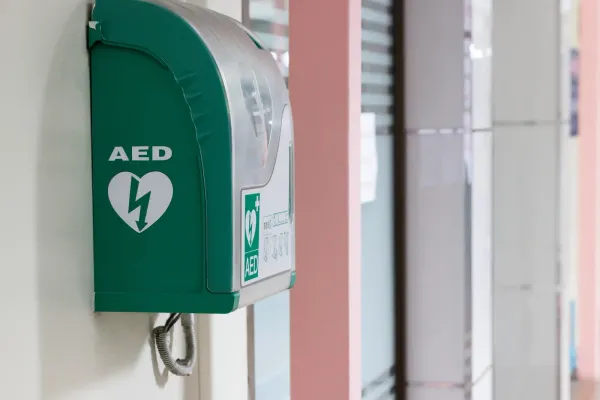
On defibrillators, L74 notes that where a needs assessment identifies that an employer wishes to provide an AED, the Provision and Use of Work Equipment Regulations 1998 apply, and the employer should provide information and written instructions on how to use it, although fuller training is likely to make the user more confident and AED use is now an integral part of the FAW and EFAW syllabus.1 Since the 2026 amendment, BS 8599-1 also addresses the provision and placement of workplace AEDs, so the standard is now a reference point for the AED question and not only for kit contents.6 Read more at our post on AEDs
First aid at work generally does not include giving tablets or medicines to treat illness. HSE identifies aspirin for a casualty with a suspected heart attack as the usual exception, and recommends that tablets and medicines are not kept in the first aid container.1
There is a further exception that L74 does not spell out. HSE’s current guidance confirms that the restriction does not apply to the administration of prescription only medicines specified in Schedule 19 of the Human Medicines Regulations 2012 where this is for the purpose of saving life in an emergency, giving adrenaline 1:1000 up to 1 mg for intramuscular use in anaphylaxis as an example.10 Where the needs assessment identifies that a Schedule 19 medicine may need to be administered in an emergency, HSE says the employer should consider providing first aiders with additional training in its use.10
Where a worker carries their own prescribed medication, the first aider’s role is generally limited to helping them take it and contacting the emergency services as appropriate.1
Equipment also has to be reachable. A kit locked in a manager’s office is not accessible provision.
First aid rooms
A first aid room should be provided where the assessment identifies one as necessary, and L74 says one will usually be necessary where there are higher hazards such as chemical industries or large construction sites, and in larger premises at a distance from medical services.1 Regulation 3(5) requires any first aid room to be easily accessible to stretchers and to other equipment needed to move patients, and to be signposted.2
L74 expects the room to be large enough for an examination couch with working space either side, a chair and any additional equipment; to have washable surfaces and adequate heating, ventilation and lighting; to be kept clean, tidy, accessible and available whenever employees are at work; to be positioned as near as possible to a point of access for transport to hospital; and to display a notice on the door giving the names, locations and where appropriate telephone extensions of first aiders.1 Typical contents include a sink with hot and cold running water, drinking water and disposable cups, soap and paper towels, a store for first aid materials, foot-operated clinical waste containers, an examination couch with waterproof protection and clean pillows and blankets, a chair, a telephone or other communication equipment, and a record book.1
Where the room cannot be reserved exclusively for first aid, L74 asks employers to consider whether the activities normally carried out there can be stopped immediately, whether furnishings can be moved quickly out of the way, and whether storage allows first aid equipment to be brought out fast.1 Requiring a room your assessment does not justify creates cost for nothing, but a conclusion that one is unnecessary on a large or remote higher hazard site should be supported by reasoning recorded in the assessment.
Records
L74 recommends providing first aiders and appointed persons with a book in which to record the incidents they attend, kept in line with data protection requirements, and where there are several first aiders under one employer, using one central book where practicable.1 The information recorded should include:1
- Date, time and place of the incident
- Name and job of the injured or ill person
- Details of the injury or illness and what first aid was given
- What happened to the person immediately afterwards, for example returned to work, went home, went to hospital
- Name and signature of the person who dealt with the incident
This is not the statutory accident book, though the two can be combined.1 The value of it is that it shows accident trends, highlights where controls are failing, and gives you evidence for the next needs assessment.1
Separately, remember that RIDDOR duties sit alongside all of this. Certain work-related injuries, cases of ill health and dangerous occurrences must be reported, and RIDDOR applies to all work activities although not all incidents are reportable.1
Telling employees what the arrangements are
Regulation 4 places a separate duty on employers to inform employees of the arrangements made in connection with first aid, including the location of equipment, facilities and personnel.2 It is a duty in its own right, not a courtesy that follows the real work of the assessment.
L74 notes that first aid arrangements operate efficiently in an emergency only where everyone in the workplace is aware of them, understands them and accepts them, and suggests developing procedures for informing staff in consultation with employees or safety representatives, including who provides first aid information to new and transferred employees.1
Where you have decided to have people trained to identify and understand mental ill health symptoms, L74 says it is important that everyone is aware of who is involved in your first aid provision and the different types of incident they have the training or competence to respond to.1 In other words, if you have both physical first aiders and a mental health response, employees need to know which is which.
Practically, at least one notice should be displayed in a prominent position at each site, including the base for travelling employees, with additional notices where the workplace layout makes them necessary.1 Take steps to cater for those with reading or language difficulties, and include first aid information in induction so new and transferred employees are covered.1 Keep it current, particularly when first aiders change or kit locations move.
Keeping qualifications current: requalification and annual refreshers
All first aid training certificates, whether FAW, EFAW or another appropriate qualification, are valid for three years, and employers need to arrange retraining before certificates expire.1 If a first aider does not requalify before the expiry date, they are no longer considered competent to act as a first aider in the workplace.1
The FAW requalification course lasts two days and should cover the same content as the initial three-day FAW course.1 An EFAW requalification course should be the same duration and content as the initial EFAW course.1 A lapsed first aider can requalify at any time after expiry by taking the requalification course, though L74 suggests it may be prudent to complete the full three-day FAW course where a considerable period, in excess of one month, has passed since expiry, and leaves the decision to the employer.1
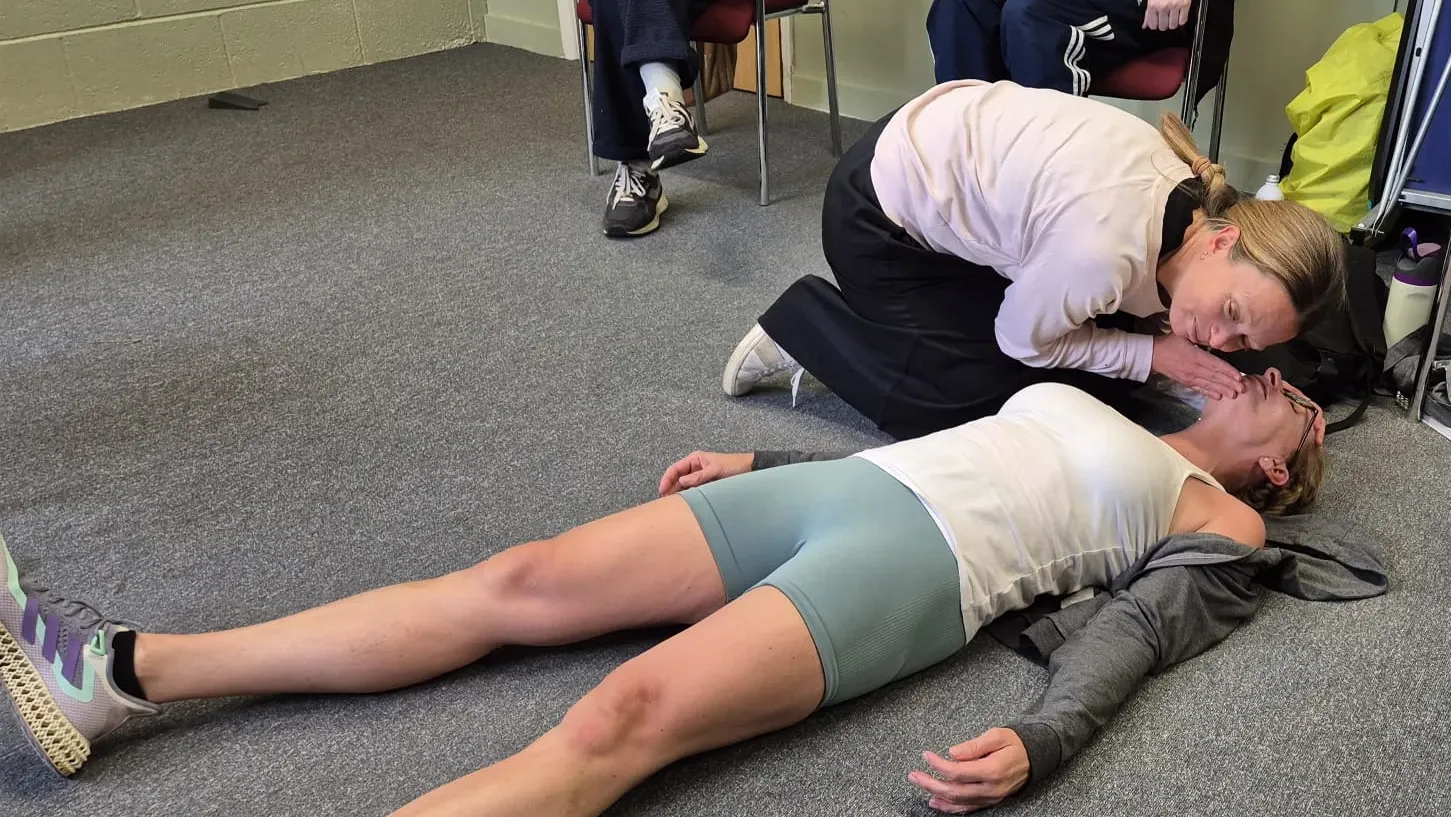
The part most employers miss is refresher training. HSE strongly recommends that first aiders undertake annual refresher training during each three-year certification period.1 It is not mandatory, but it is how skills and current procedures are maintained across a three-year gap, and L74 sets out suggested content: assessing the situation and acting safely, promptly and effectively; the unconscious casualty including seizure; CPR; wounds and bleeding; and shock.1 HSE also encourages employers to have first aiders review their course manual and instructional materials, and to allocate them time to do it.1
L74 asks employers to keep a record of first aiders and certification dates to help arrange further training in good time.1 Gaps in cover caused by an expired certificate are entirely avoidable and entirely the employer’s responsibility to prevent.
How do I choose a first aid training provider?
You choose one you have checked. Keeping a record of those checks is sensible, because it lets you demonstrate how you carried out your due diligence. HSE does not approve, endorse or maintain a list of FAW or EFAW training providers, so that due diligence sits with you as the employer.
This is the change most employers have never been told about.
HSE stopped approving FAW and EFAW training providers in 2013
Regulation 3(2) was amended in 2013 to remove the requirement for HSE to approve the training and qualifications of appointed first aid personnel, and the first aid Approved Code of Practice was withdrawn at the same time. The associated guidance was strengthened specifically to help employers select training providers.1
Any provider claiming to be HSE-approved for FAW or EFAW is describing something that has not existed for over a decade. Treat the claim as a reason to look harder, not a reassurance.
There is one narrow exception, and it does not apply to ordinary workplaces. HSE still approves training providers for offshore first aid and offshore medic qualifications under the Offshore Installations and Pipeline Works (First-Aid) Regulations 1989, issues certificates of approval, and publishes a list of approved organisations.13 Offshore installations are outside the scope of the 1981 Regulations in any case.2
L74 describes the landscape as it now stands. Some providers operate through voluntary accreditation schemes intended to set and maintain standards; these are not mandatory, and employers may choose an independent training organisation, but the schemes can help employers identify training with appropriate content, suitable trainers and assessors, and relevant and robust quality assurance systems.1 Some providers offer nationally regulated qualifications through recognised awarding organisations. In England the regulator is Ofqual. In Wales it is Qualifications Wales, the independent statutory regulator of non-degree qualifications, established by the Qualifications Wales Act 2015 and operational since September 2015.11 In Scotland, awarding bodies are approved and their qualifications accredited by Qualifications Scotland Accreditation. Qualifications Scotland replaced the Scottish Qualifications Authority, and SQA Accreditation became Qualifications Scotland Accreditation, in February 2026.12 L74 still names the Scottish Qualifications Authority and the Welsh Government, so both references are now out of date.1 Employers may also obtain training from the Voluntary Aid Societies, which HSE acknowledges as one of the standard-setters for currently accepted first aid practice.1
The route a provider takes is less important than what you verify. L74 states that when an employer selects a provider, they need to be confident the provider will deliver training with appropriate content, use suitable trainers and assessors, and has relevant and robust quality assurance systems in place, and that all training providers should be able and prepared to demonstrate how they satisfy these criteria.1,4 It adds that the same quality standards are expected of all providers, including non-affiliated independent organisations.1
There is also a content standard. Training organisations should teach the first aid management of injuries and illness in accordance with current guidelines published by the Resuscitation Council UK and the current edition of the first aid manual of the Voluntary Aid Societies, or other published guidelines in line with those or supported by a responsible body of medical opinion.1
If a provider offers blended learning, which HSE accepts as a delivery method, L74 sets out additional checks: that the trainee knows how to use the technology, that the provider can support them during training, that there is a robust system to prevent identity fraud, that sufficient time is allocated to classroom-based learning and assessment of practical elements, and that the e-learning component is properly assessed.1 HSE strongly recommends that syllabus elements requiring practical demonstration are assessed by direct observation.1
When the certificate arrives, check it. L74 sets out the minimum information it must contain:1
- Name of the training organisation
- Name of the qualification
- Name of the individual
- A validity period of three years from the date of course completion
- An indication that the certificate has been issued for the purposes of complying with the Health and Safety (First-Aid) Regulations 1981
- A statement that teaching was delivered in accordance with currently accepted first aid practice
- Where the qualification is neither FAW nor EFAW, an outline of the topics covered
As with the needs assessment itself, there is no requirement for these checks to be formalised or written down, but L74 notes it may be useful to retain a written record so you can demonstrate to an inspector how you selected a provider.1 HSE’s information sheet GEIS3, updated in 2024, sets out the process in more detail.4
One last point that costs employers money more often than it should: tell the provider about the particular hazards at your workplace so training can be tailored to them.1 A competent provider should ask about your workplace, but the responsibility for telling them what the assessment identified stays with the employer.
A first aid needs assessment checklist and template
The table below can be used as a simple first aid needs assessment template. There is no prescribed format, and L74 confirms the assessment does not have to be written down at all, but a record is what lets you show how you reached your conclusions.1 Copy it, complete one for each site, building or work area with materially different hazards or working patterns, and keep it with your health and safety file.
| What to record | What to consider |
|---|---|
| Workplace or work area | Site, building, floor or department. Complete separately where activities or hazards differ. |
| Hazards and likely injuries | Findings from the general risk assessment and COSHH. Foreseeable injuries and illnesses, including life-threatening bleeding where relevant. |
| Workforce | Headcount in this area. Young workers, trainees and work experience placements. Any health conditions relevant to first aid provision, recorded as the provision required rather than as individual diagnoses. See the note on health information below. |
| Non-employees | Members of the public, contractors, clients, visitors, children. Volume, frequency and nature of their presence. |
| Work patterns and distribution | Shifts, out-of-hours and weekend working. Number of buildings and floors. Self-contained areas. Lone, remote and travelling workers. |
| Access to emergency services | Realistic ambulance response time. Site access constraints. Whether the emergency services have been informed of the location and any specific hazards. |
| Personnel required | Appointed person, EFAW or FAW, and how many. Names and locations. Certificate expiry dates. |
| Additional training identified | Any specialist requirement arising from the hazards, for example life-threatening bleeding, hydrofluoric acid, oxygen administration, paediatric first aid, or recognition of major illness. |
| Absence cover | How cover is maintained for annual leave, sickness, training and unplanned absence, on every shift. |
| Equipment and locations | Number, type and position of kits. Additional or specialist equipment. Eye and wound irrigation. AED, if provided. Restocking arrangements. |
| Facilities | Whether a first aid room is required, where it is, and who supervises it. |
| Communication | How employees are told who the first aiders are, where equipment is, and how to summon help. How new and transferred staff are informed. |
| Review | Date of this assessment, name of the person who carried it out, next scheduled review, and the triggers that would prompt an earlier one. |
This is a working record, not a submission. Nothing is filed with HSE, and no one approves it. Its only job is to make your reasoning visible, to you now and to someone else later.
A note on health information
Take care with the workforce row. Record the provision required rather than unnecessary detail about any individual’s diagnosis. A line reading that additional training in the recognition of major illness is needed does the job; a named list of employees and their conditions does not, and creates a problem you did not have.
Information about a worker’s physical or mental health is special category personal data under Article 9 of the UK GDPR. Where you do process it, you need both a lawful basis under Article 6 and a separate Article 9 condition, and you must determine and document that condition before you begin.14 Any identifiable health information used in the assessment should be kept secure, limited to what is necessary, and accessible only to people who need it.14
When should the assessment be reviewed?
L74 says employers should periodically review their first aid needs, particularly after any operating changes, to make sure provision remains appropriate.1 It does not set an interval, so the trigger-based approach below is the practical way to apply it.
Review the assessment:
- After any significant change in the size of the workforce
- After a change in the nature of the work or the hazards present
- Following a serious incident or a near miss that exposes a gap in provision
- When working patterns change, including new shifts, new sites, or changes to lone working arrangements
- When a first aider leaves and cover has to be reconsidered
- When a first aider’s certificate is approaching its three-year expiry
- When the incident record book shows a pattern your current provision does not cater for
In the absence of a specific trigger, a stable low hazard office with a settled workforce might reasonably review every two to three years. A higher hazard or more dynamic environment warrants a shorter cycle. The test is not the calendar; it is whether the assessment still describes the workplace you actually have.
Where first aid needs assessments most often go wrong
Treating headcount as the deciding variable. L74 says explicitly that employee numbers should not be the sole basis for determining first aid needs.1 A small maintenance team working with dangerous machinery can need more provision than a much larger office.
Having no plan for absence. A single first aider provides cover only while present, and an appointed person cannot legitimately cover planned leave.1 This is the most common gap and the easiest to close.
Choosing the shorter course on price. Where the assessment points to FAW, providing EFAW leaves both a compliance gap and a skills gap, and the skills gap is the one that matters at the moment it is tested.
Buying a British Standard kit and stopping there. The standard is a sensible baseline, not an answer to the equipment question. Your assessment may indicate haemostatic dressings, eye irrigation, burn provision or substance-specific items that no off-the-shelf kit contains.1
Taking a provider’s claims at face value. HSE has not approved first aid training providers since 2013, and expects you to verify content, trainers, assessors and quality assurance yourself.1,4
Never revisiting the document. An assessment carried out five years ago, for a different workforce, doing different work, in a different building, is a historical record rather than a current assessment.
Leaving out non-employees. If visitors, contractors, clients or members of the public are regularly on site, omitting them may not breach the Regulations, but it is a significant practical gap that may leave foreseeable needs unaddressed, and it may point to additional training requirements.1
Not telling anyone. Regulation 4 is a duty.2 An employee who does not know where the kit is, or who the first aider is, cannot use provision that exists.
In short
The Health and Safety (First-Aid) Regulations 1981 require every employer to provide first aid equipment, facilities and personnel that are adequate and appropriate in the circumstances.2 What adequate and appropriate means for your business depends on your hazards, the size and nature of your workforce, your working patterns, your site layout, your distance from emergency services, and the cover you have for absence.
HSE guidance gives you a checklist, a set of suggested numbers and a framework of training levels, but it deliberately stops short of prescribing an answer, and since 2013 it has been guidance rather than an Approved Code of Practice.1 The judgement is yours, and so is the responsibility for showing how you reached it.
Work through the factors, record the conclusions, act on them, check the provider you buy training from, and review the whole thing when the workplace changes. Do that and you have provision that protects people. Skip it and you have paperwork that may not survive the one occasion it gets read closely.

Turn your assessment into training that stands up to scrutiny
Constellation Training provides FAIB-accredited Emergency First Aid at Work, First Aid at Work, requalification and annual refresher courses, delivered by experienced trainers using practical workplace scenarios. FAIB accreditation provides independent inspection against published standards, supporting the quality assurance element of the due diligence described in L74 and GEIS3. Tell us what your needs assessment found and we will confirm how our courses map to it.
References
1. Health and Safety Executive, First aid at work: The Health and Safety (First-Aid) Regulations 1981, Guidance on Regulations, L74 (third edition, 2013, reissued with amendments in 2015, 2018 and 2024). hse.gov.uk
2. The Health and Safety (First-Aid) Regulations 1981, SI 1981/917. legislation.gov.uk
3. Health and Safety Executive, First aid at work: your questions answered, INDG214(rev2). hse.gov.uk
4. Health and Safety Executive, Selecting a first-aid training provider: a guide for employers, GEIS3(rev2), 2024. hse.gov.uk
5. Health and Safety Executive, First aid at work: Guidance on regulations, publication page and amendment history. hse.gov.uk
6. BSI, BS 8599-1:2019+A1:2026 Workplace first aid kits: contents of first aid kits and provision of Automated External Defibrillators (AEDs) in the workplace. Specification. bsigroup.com
7. The Health and Safety (First-Aid) Regulations (Northern Ireland) 1982, SR 1982/429. legislation.gov.uk
8. The Deregulation Act 2015 (Health and Safety at Work) (General Duties of Self-Employed Persons) (Consequential Amendments) Order 2015, SI 2015/1637, which substituted regulation 5 with effect from 1 October 2015. legislation.gov.uk
9. The Health and Safety at Work etc. Act 1974 (General Duties of Self-Employed Persons) (Prescribed Undertakings) Regulations 2015, SI 2015/1583. legislation.gov.uk
10. Health and Safety Executive, Frequently asked questions on first aid. hse.gov.uk
11. Qualifications Wales, Regulation. qualifications.wales
12. Qualifications Scotland Accreditation, About us. qualifications.gov.scot
13. Health and Safety Executive, Offshore first aid, including the list of approved training organisations, and MS39(rev1) Offshore first aid and medic qualifications. hse.gov.uk
14. Information Commissioner’s Office, Data protection and workers’ health information. ico.org.uk