Heart Attack: What to Do
What should you do if you think someone is having a heart attack? Learn the key symptoms, when to call 999, how aspirin may help, and what to do if they collapse.

A plain guide to recognising the signs and responding before an ambulance arrives
Most people who witness a heart attack do not know what to do. They freeze, they wait, or they assume someone else will act. That delay costs lives.
This is a short, practical guide to what you should know, what you should have ready, and what you should do if someone near you has a heart attack, at home or at work.
Recognise It
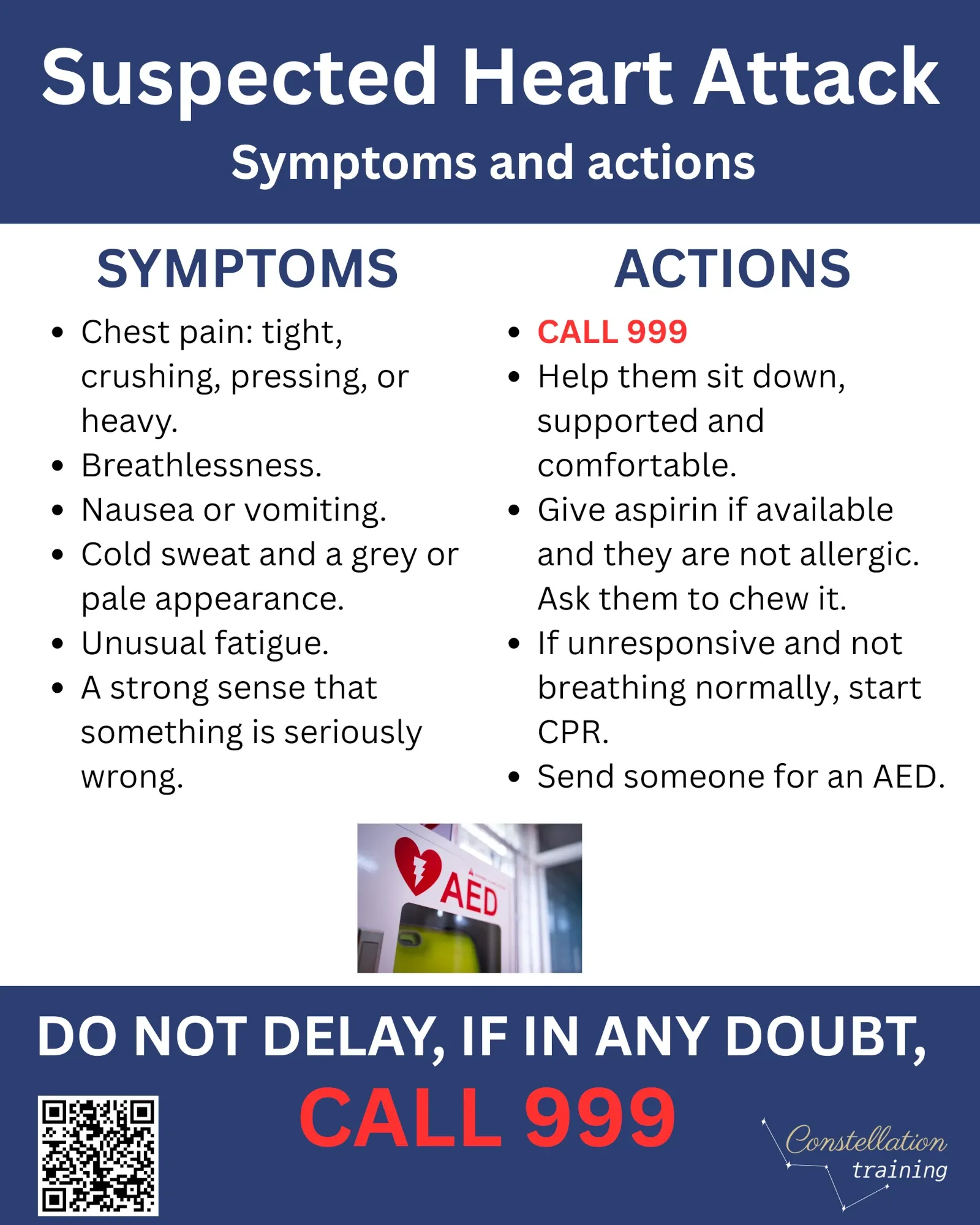
The classic sign is chest pain: tight, crushing, pressing, or heavy. It may spread to the arm, jaw, neck, or back. But not every heart attack announces itself that way.
Also watch for:
- Breathlessness with no obvious cause
- Nausea or vomiting, particularly alongside other symptoms
- Cold sweat and a grey or pale appearance
- Dizziness or light-headedness
- Unusual fatigue, sometimes for hours or days beforehand
- A strong sense that something is seriously wrong
Women, people with diabetes, and older adults are more likely to experience atypical symptoms. They may have little or no obvious chest pain. Do not wait for the textbook presentation before acting.
Do not drive yourself or the person to hospital. Do not wait to see if it improves. Tell the operator you suspect a heart attack and follow their instructions.
What to Do
Follow these steps in order. Do not skip ahead.
1. Call 999
Do this first, before anything else. Tell the operator you think someone is having a heart attack. They can guide you while help is being arranged. An ambulance will be dispatched as a priority.
2. Keep the person still and as calm as possible
Sit them down in a comfortable position, ideally with their knees bent and their back supported. Loosen any tight clothing around the neck and chest. Do not let them walk around. Do not give them food or water.
3. Aspirin, if available
If the person is conscious, able to swallow, and not known to be allergic to aspirin, the 999 call handler may advise them to chew a single 300mg aspirin tablet. Chewing gets it into the bloodstream faster than swallowing whole. Do not delay calling 999 to look for aspirin.
4. Stay with them and monitor
Keep talking to them. Watch for any change in their condition. Be ready to act immediately if they lose consciousness or stop breathing normally.
5. If they become unresponsive and stop breathing normally: start CPR
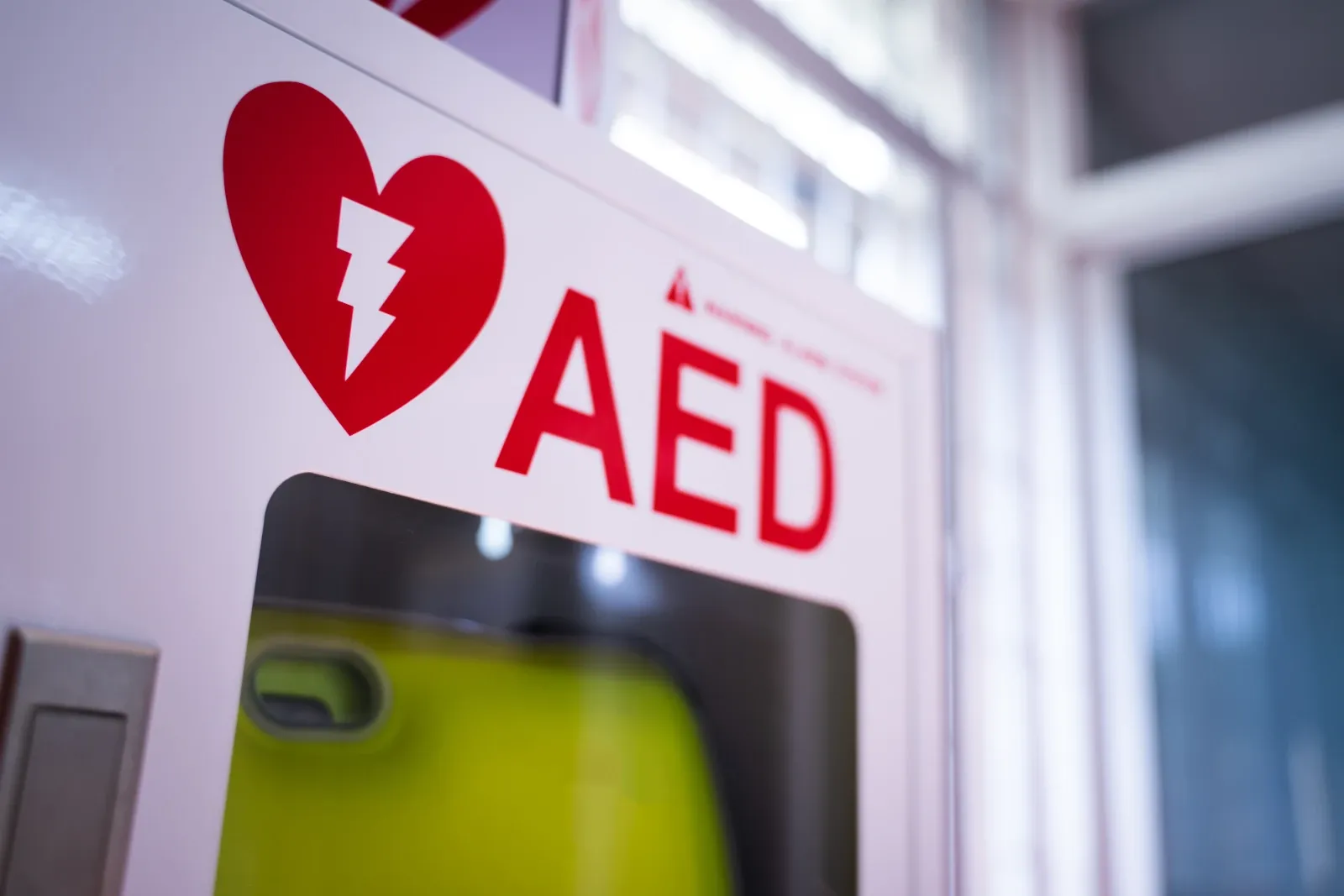
Kneel beside them. Place the heel of one hand on the centre of their chest, place your other hand on top, and push down hard and fast. Aim for 100 to 120 compressions per minute, pressing down around 5 to 6 centimetres each time. Do not stop unless a defibrillator instructs you to pause, another rescuer takes over, or the ambulance crew tells you to stop. If a defibrillator is nearby, send someone to get it immediately. AEDs give clear voice instructions and are safe to use without training. Using one as soon as possible significantly increases the chance of survival.
At home: one extra step
If you are alone with the person, unlock the front door before the ambulance arrives so paramedics can get in without delay.
At work: use what is there
If your workplace has a trained first aider, call for them immediately while someone else calls 999. If there is a defibrillator on the premises, send a colleague to retrieve it now. Do not wait until you need it to find out where it is.
What to Know Before It Happens
Most of the things that help in a cardiac emergency are things you can sort out now, not in the moment.
Know where the nearest defibrillator is
Do this now, not in an emergency. At work, ask someone in facilities or management. At home, check defibfinder.uk to find your nearest publicly accessible AED. A defibrillator retrieved in two minutes instead of ten can be the difference between life and death.
If you are already in an emergency and do not know where the nearest defibrillator is, the 999 call handler can tell you. Do not stop compressions to search for one yourself.
If your workplace does not have a defibrillator, raise it with management. They are not legally required in most settings, but they save lives and the case for having one is straightforward.
Know the atypical signs
Heart attacks in women often present without dramatic chest pain. They are more likely to involve nausea, breathlessness, unusual fatigue, or jaw and back pain. Someone having a heart attack may not look like they are having a heart attack. Act on the pattern, not the expectation.
Do not self-diagnose your way out of acting
The most common reason people delay calling 999 is that they are not sure. Indigestion, they think. Muscle strain. Anxiety. The cost of being wrong is embarrassment. The cost of waiting is potentially fatal. CALL.
Keep aspirin accessible
Standard 300mg aspirin tablets are worth keeping at home and at work. Aspirin is the one exception to the rule that first aiders do not administer medication: a first aider can offer 300mg aspirin to a conscious adult with a suspected heart attack, provided an ambulance has been called and the person is not known to be allergic. Ask them to chew it rather than swallow it whole.
Aspirin must never be given to anyone under 16. It should not be stored inside the first aid kit or box, but kept separately on the premises. At home, a supply in a kitchen cupboard is sufficient.
CPR and Defibrillators: Learn Before You Need To
Reading about CPR is not the same as being able to do it under pressure. If you have never had hands-on training, the moment a person collapses in front of you is not the time to be learning technique.
For a full guide to hands-only CPR and how to use a defibrillator, including the technique in detail, see our post: If Someone Collapses: What to Do Before the Ambulance Arrives.
For the full picture on what a heart attack is, how it develops, and what puts people at risk, see: The Heart Attack: What It Is, What It Feels Like, and What to Do.
First Aid Training

If you want to be genuinely prepared rather than hoping you will remember what you read, first aid training is the difference.
Constellation Training offers FAIB-accredited first aid courses covering cardiac emergency response, CPR technique, and AED use in a practical, hands-on setting.
This post is for information and general guidance only. It does not replace professional medical advice, diagnosis, or treatment. In an emergency, call 999.
References
[1] Resuscitation Council UK. Adult basic life support guidelines, 2025. Available at: https://www.resus.org.uk/professional-library/2025-resuscitation-guidelines/adult-basic-life-support-guidelines [Accessed May 2026].
[2] NHS. Heart attack. Available at: https://www.nhs.uk/conditions/heart-attack [Accessed May 2026].
[3] British Heart Foundation. Heart attack symptoms. Available at: https://www.bhf.org.uk/informationsupport/conditions/heart-attack [Accessed May 2026].
[4] NICE Guideline NG185. Acute coronary syndromes. NICE, 2020. Available at: https://www.nice.org.uk/guidance/ng185 [Accessed May 2026].
[5] Mehta LS et al. Acute myocardial infarction in women: a scientific statement from the American Heart Association. Circulation. 2016;133(9):916–947.