What Happens When You Call 999? The UK Emergency Number Explained
The UK’s 999 service looks simple, but the system behind it has changed dramatically. Here is how emergency calls work today, why location still matters, and what everyone should know before they need urgent help.
From a 1935 fire to satellite-pinpoint location data: the story of the world's oldest emergency number, and what really happens when you dial.
Most of us have called 999 perhaps once or twice in our lives. We dial three digits, a calm voice asks which service we need, and within seconds the wheels are turning. It feels simple.
Behind that simplicity sits an extraordinary system: nearly ninety years of engineering, regulation and quiet improvement, layered with technology that can now find you, almost anywhere in the country, to within a few metres of where you stand.
This is the story of how that system came to exist, how it works today, and the location services running silently in the background of every modern smartphone call. If you teach first aid, manage health and safety, or simply want to feel more confident in an emergency, knowing how 999 works changes the way you use it.
Where 999 came from
On the night of 10 November 1935, a fire broke out at 27 Wimpole Street, the surgery of an aural surgeon in central London. Five women died.[1] A neighbour had tried to telephone for the fire brigade but was held in a queue at the local Welbeck telephone exchange. Furious, he wrote to The Times. The letter prompted a government inquiry, and the Belgrave Committee was set up to ask a deceptively simple question: how should an operator know that a call is an emergency?[2]
The committee's answer became the foundation of every emergency line in the world. It recommended a single number, easy to remember, that could be dialled from a public telephone box without inserting any money. Whatever number was chosen, the exchange equipment had to be able to recognise it instantly and divert the call.[2]
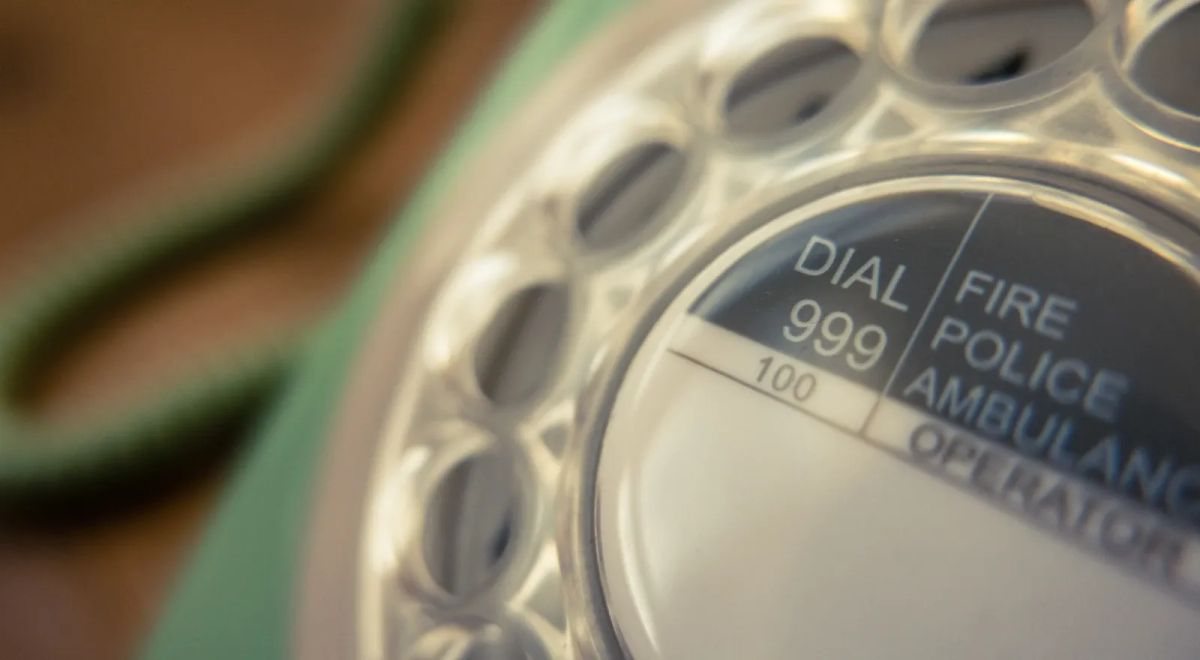
They settled on 999, and the reasoning is more interesting than it first looks. On a rotary dial, 0 sat at the finger stop, with 9 in the position immediately next to it. The two were easy to find by touch, which mattered in the dark or in a panic. More importantly, public call boxes already had a mechanism that allowed the operator (reached by dialling 0) to be called without inserting any money. The same mechanism could be extended one position to cover 9 as well, so 999 could be dialled free from any phone box without rebuilding the entire network.[4]
The obvious alternative, 111, was considered and rejected. In the pulse dialling era, every digit was sent as a series of electrical pulses: 1 was a single pulse, 9 was nine pulses. Three single pulses could be generated accidentally by line noise, by overhead wires touching in the wind, or by a fault somewhere on the network, producing a flurry of false 111 calls into already busy exchanges. Nine pulses, with the gap between them, was much harder to generate by accident.[1] The combination of free dialling from call boxes and resistance to false alarms made 999 the practical choice, even though 111 would have been easier to remember.
When 999 was dialled, a buzzer sounded and a red light flashed at the exchange, drawing an operator's immediate attention.[5]
The service launched on 30 June 1937, initially covering only a twelve mile radius of Oxford Circus.[1] [3] Within days, a Hampstead burglar named Thomas Duffy became the first person caught as a result of a 999 call. The Second World War delayed the rollout, but city by city the network expanded. By 1976 the whole of the United Kingdom was covered.[5]
The UK's 999 service is the oldest emergency telephone number in the world. The American 911 came thirty one years later, in 1968. Even the European 112 number, which now works alongside 999 in every UK call box and on every UK mobile, was a creation of the 1990s.
Why 112 also works in the UK
Dial 112 from any UK phone and you reach exactly the same operators as 999. Neither number is faster than the other and neither has priority over the other.[6] The two simply coexist.
112 was adopted by the European Union as a single emergency number in 1991, and it was introduced alongside 999 in the UK in 1993. The aim was practical. A traveller from Spain visiting London should not have to remember a different number, and a British traveller in Greece should not be left guessing.[5] In the UK, the rule is simple: dial 999 or 112. Either reaches the same operators, equally fast. If you are travelling abroad, learn the local emergency number before you go. In many countries 112 or 911 will also connect from a mobile, but you should not rely on that as your only plan.
What actually happens when you dial 999
All UK 999 and 112 calls, from any network, are routed through BT, which operates the national emergency call handling service on behalf of every UK communications provider before transferring calls to the relevant local emergency service control room.[6] In 2024, those centres handled 37.7 million calls between them.[6]
When you dial, your phone network identifies the call as an emergency and forwards it to BT free of charge, regardless of who your provider is. A trained BT operator picks up with the standard greeting:
What you will hear first
“Emergency. Which service?”
That single question does a lot of work. The operator is gathering your voice, your background sounds, and any obvious clues about what is happening, while the system pulls up your phone number and your location. Roughly thirty per cent of calls are filtered out at this stage as misdials, repeat calls or hoaxes, never reaching the emergency services themselves.[7]
Once you say which service you need, the operator transfers you to one of 142 local emergency service control rooms.[6] Your number and location go with the call so the next call handler does not have to start from scratch. From that moment, the clock starts on getting help to your door.
Who actually answers
The split of where calls go has been broadly stable for years. In 2024:[6]
| Service | Share of calls |
|---|---|
| Police | 52% |
| Ambulance | 45% |
| Fire and Rescue | 3% |
| HM Coastguard | Less than 1% |
Cave Rescue and Mountain Rescue do not have their own 999 line. They are summoned by the police, who hold the contact details and coordinate the response on their behalf.[1]
The problem of finding you
For most of the twentieth century, an emergency call was made from a fixed line. The operator could see the address registered to that line. If you were calling from a phone box, the box itself had a fixed location. If you were calling from home, a directory entry told them where to send help.
Mobile phones changed everything. By the time the smartphone era arrived, more than three quarters of UK 999 calls came from a mobile.[6] In 2024, 77.3 per cent of all calls were from mobile, against 22.7 per cent from a landline.[6] That shift created a new and serious problem.
A mobile phone is not an address. It is a device that moves.
Until relatively recently, the only way to locate a mobile caller was through cell tower triangulation. The system worked out which mast the call was using, and roughly how far from it the phone was. In a dense urban area this might narrow you down to a few hundred metres. In rural areas the answer was often measured in kilometres. If you were unconscious, lost on a hillside, or unable to describe your surroundings, that wasn't always good enough.
Two parallel solutions emerged: one built into the phone itself, and one built around how we describe places.
AML: the system that finds you, automatically
Advanced Mobile Location, usually shortened to AML, is one of the most important developments in emergency call handling since 999 itself. It is not an app. It does not need to be downloaded, switched on or set up. It is built into the operating system of virtually all current Android phones and iPhones, and it activates only when you dial an emergency number.[8]
The technology was developed in the United Kingdom in 2014, in a collaboration between BT, EE and HTC. The aim was straightforward: solve the mobile location problem without making the caller do anything different.[8] Trials began on the EE network that year, and Google announced in July 2016 that all Android phones running version 2.3.7 or later would include AML support.[8] Apple followed shortly afterwards on iOS. AML is now standardised by the European Telecommunications Standards Institute and is in use across the UK, EU and a growing list of countries worldwide.[8]
How AML works in plain English
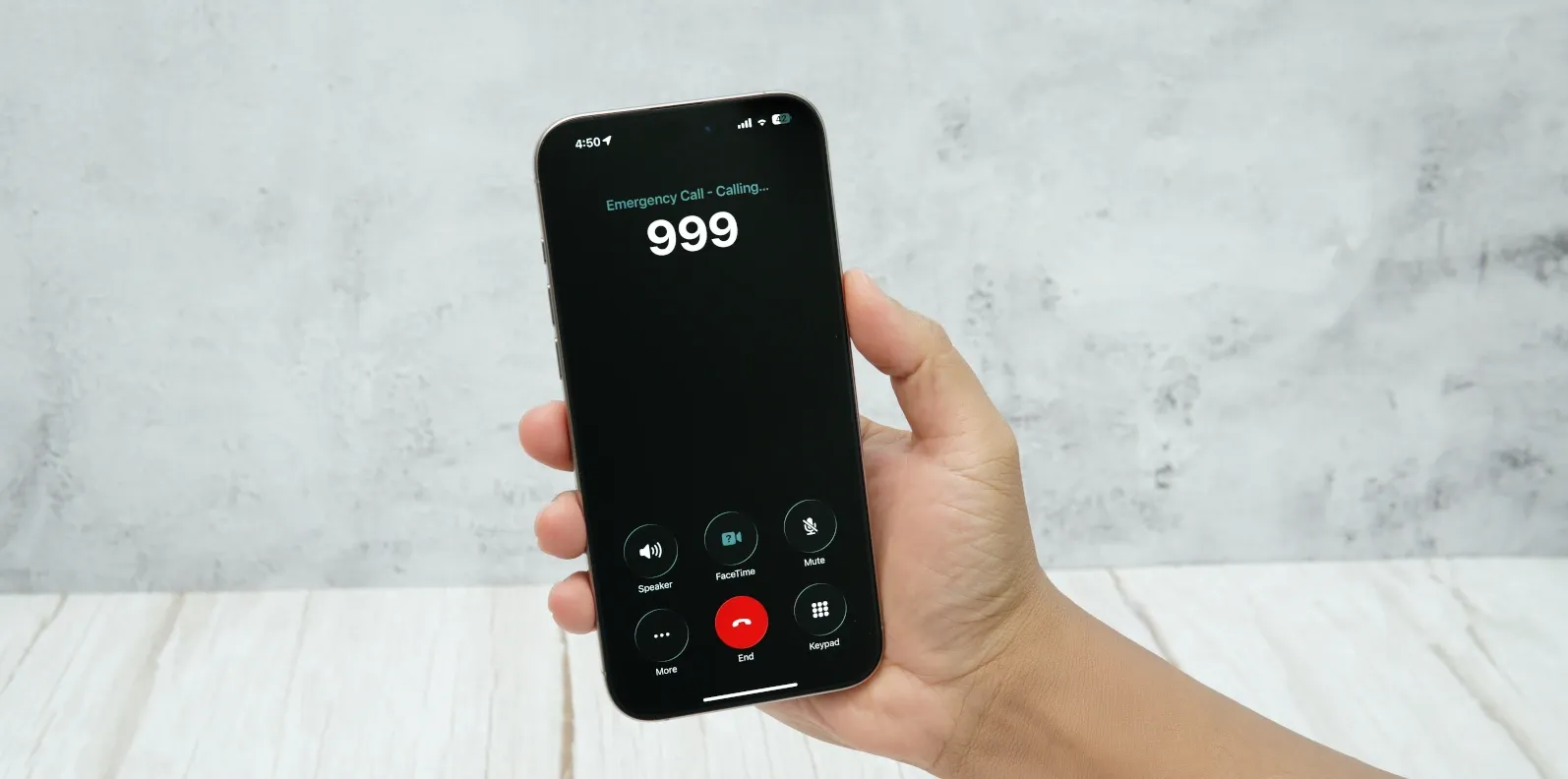
The moment you dial 999 or 112, your handset wakes up its location services in the background. It uses whichever combination of GPS satellites, Wi-Fi networks and mobile cell data gives the most accurate position at that moment. Once it has a fix, the phone sends the coordinates and an estimated accuracy radius to BT as a free SMS message and, on supported networks, an HTTPS data packet.[8]
This happens in seconds, in parallel with your voice call. The call handler sees a pin appear on a map. They can read out the location to confirm it, and they can see how confident the system is about the position. The voice line is unaffected, so you keep talking to the operator as normal.
In good conditions, AML places the caller within five to fifty metres of their actual position.[9] BT has reported accuracy down to three metres in some circumstances.[10] Compare that with the cell tower system that came before it, which could be up to four thousand times less accurate.[8] On a motorway, that is the difference between knowing which carriageway you are on and knowing only the junction.
For an air ambulance landing on a hillside, it is the difference between finding you and searching for you.
Does: Activates only when you dial 999 or 112, sends a one off location reading, then deactivates. Your phone does not store the message, and you will not see it in your sent items.[11]
Does not: Track you in normal use, share data with anyone other than the emergency services, or work without a SIM and a registered network connection.[11]
Where AML still struggles
AML is a dramatic improvement, not a replacement for telling the call handler where you are. Indoors, GPS signals weaken, and the phone has to fall back on Wi-Fi positioning. In remote rural areas, both GPS and Wi-Fi can be patchy, and the accuracy radius widens. If you are calling from abroad, AML may not function in the way it does at home. And if you have a phone old enough to predate AML, or you have switched location services off entirely on Android, the system may have nothing to send.[9]
The practical lesson is simple. AML is a brilliant safety net, but always state your location aloud as well, even if you assume the system has already found you. Belt and braces saves time.
what3words: a different way to describe a place
Postcodes were never designed for emergencies. A rural postcode can cover several square miles. A field, a footpath or a layby may not have an address at all. Even in urban areas, telling a call handler that you are “somewhere on the canal towpath” is rarely enough to dispatch help quickly.
what3words is a private addressing system that divides the entire surface of the earth into three metre squares, each given a unique combination of three random words. A specific spot in a field next to the River Ouse in York is ///kite.chats.dine.[12] A viewpoint on Llangennith Beach is ///refreshed.enjoy.jumbled.[13] Three words, anywhere in the world, identifying a square no bigger than a small room.
The system has been adopted by more than 85 per cent of UK emergency services.[12] It is particularly useful in three situations: when you are in an unaddressed area such as a national park or a beach; when you are inside a large complex such as an industrial estate or shopping centre, where the postcode is technically correct but unhelpful; and when describing a precise meeting point, such as a path entrance or a specific gate, to crews who are already en route.
There are limits. The free what3words app needs to be installed in advance to find your three word address, and the call handler needs to be using a service that accepts it. Some services can also send you an SMS link that opens a web page showing your location in three word form, which works without the app. Three random words can also be misheard or mistyped over a poor phone line. If you can give an OS grid reference, road name, landmark, postcode, gate number or nearby business as well, give that too. As with AML, what3words is a tool that complements speaking clearly to the call handler, not a substitute for it. Always gather as much location information as you can; if the service does not accept three word addresses, your description still has to do the job.[12]
AML happens automatically. The handset sends the location; the caller does nothing.
what3words is something you do. You read three words to the call handler from the app on your phone.
They work well together. AML gives the control room a pin on a map within seconds. what3words confirms the pin in human language and lets the caller describe a precise spot, such as which side of a stream or which gate of a field.
eCall: when your car dials 999 for you
Since 31 March 2018, every new model of car or light van type approved for sale in the UK and EU has been required to carry an automatic emergency call system known as eCall.[14] In 2024, 146,619 of the 999 calls handled by BT were eCalls.[6]
The system has two routes to triggering. If a serious collision deploys the airbags, eCall fires automatically. The car places a 112 call, opens a voice channel through its own speakers and microphone, and transmits a Minimum Set of Data to the call handler. That data includes the precise GPS location, the direction of travel, the time of the incident and the vehicle identification number. If the airbags do not fire, or the driver wants to call for someone else, there is a manual SOS button, usually red, in the roof lining or near the rearview mirror.[14]
Privacy is a reasonable question to ask, and the answer is reassuring. eCall sits dormant. It does not register to a network, track location or transmit data unless and until it is activated. When it activates, only the data needed for the emergency response is sent, and it is not retained beyond what the response requires.[14] Some manufacturers offer additional private services on top of eCall, such as concierge or tracking features. Those are separate, optional, and run on a different SIM.
The simple advice in a serious crash is unchanged: get yourself and any passengers out of immediate danger if you can do so safely, and check that emergency services have actually been alerted. If you are unsure whether eCall fired, dial 999 from a phone. There is no penalty for a duplicate call.
When you cannot speak: the Silent Solution
Many people believe that if you dial 999 and stay silent, the police will automatically be sent to your location. This is not true.
The Silent Solution exists precisely because of this misunderstanding, and it has been in use since 2001.[15]
When you call 999, the BT operator will ask which service you need. If you cannot speak, they will listen carefully for sounds: breathing, background voices, traffic, struggle. If they hear something that suggests a genuine emergency, they will transfer you to the police regardless. If they hear nothing identifiable, the call is forwarded to an automated service that asks you to press 55 to confirm there is a real emergency. Pressing 55 transfers you to police call handling. If you do not press 55 when prompted, and you do not make any audible response such as a tap or a cough, the call may be ended.[16]
Pressing 55 alone does not, in itself, give the police your location.[17] If you are on a landline, your address will already have been identified. If you are on a mobile, AML will usually have given the call handler a fix to within a few metres, but they cannot guarantee that they have a precise location. Once transferred, the police call handler will try to communicate using yes and no questions, asking you to press a number on the keypad, tap the handset, or make any sound to indicate your circumstances.
- Dial 999.
- Listen carefully.
- If asked, press 55, or cough, tap, or make any sound you can.
- Stay on the line. The police call handler will try to communicate with simple yes and no questions you can answer with a tap or a key press.
Texting 999, and the BSL service
Voice calls are not always possible. The UK provides two further routes for people who cannot make a standard call: emergencySMS, which has been part of the 999 service since 2009, and 999 BSL, the British Sign Language video relay service launched on 17 June 2022.[18]
emergencySMS
The emergencySMS service lets you send a text message to 999 and have it relayed to the police, ambulance, fire or coastguard. It is designed primarily for people who are deaf, hard of hearing, or have a speech impairment, although anyone in a situation where speaking aloud is impossible can use it. There is one critical condition: you must register your mobile number with the service in advance. Without registration, the system will not work when you need it.[19]
- Text the word register to 999.
- Read the reply you receive.
- Reply with yes to confirm you have read and understood the instructions.
- You will receive a confirmation that your number is registered.
Registration takes less than a minute. If there is any chance you may need to contact 999 without speaking, register your number now. The service is slower than a voice call, so when you do use it, send a clear, structured message: which service you need, where the emergency is, and what is happening. Do not assume your text has been received until you get a reply.[19]
If you are deaf, hard of hearing or speech-impaired, the Relay UK service on 18000 may be faster than emergencySMS where it is available to you. It uses a relay assistant who types what the operator says and speaks what you type, in real time, through the Relay UK app or a textphone.[19]
999 BSL
999 BSL is the UK's first emergency video relay service in British Sign Language. It is available as a free smartphone app for iOS and Android and as a web platform at 999bsl.co.uk. A deaf BSL user opens the app, presses a single button, and is connected to a BSL interpreter who relays the conversation in real time to a 999 call handler. The service runs 24 hours a day, 365 days a year, and is provided free at the point of use.[18]
999 or something else? Knowing which number to call
999 exists for genuine emergencies. Inappropriate use is more than a nuisance; it ties up call handlers and slows the response to people in real danger. The UK now has a layered system of non-emergency numbers, each with a specific purpose.
| Number | When to use it |
|---|---|
| 999 or 112 | An immediate threat to life, serious injury, a crime in progress, a fire, or anyone in serious distress at sea or on the coast. |
| 111 | Urgent medical advice when it is not life threatening: high fever, persistent pain, out of hours GP access, and urgent mental health support in areas where local 111 services offer it. Available 24/7 in England, Scotland and Wales. In Northern Ireland, NHS 111 is not used; contact your GP out of hours service or local urgent care provider, and call 999 for life threatening emergencies. |
| 101 | Non emergency police matters: reporting a theft after the event, a damaged property, antisocial behaviour, or general police advice. |
| 105 | Power cuts and reporting damage to the electricity network. Useful particularly for people whose medical equipment depends on mains power. |
| 0800 111 999 | The National Gas Emergency Service. Smell gas? Step outside, then call from a safe distance. |
If you genuinely cannot tell whether something is an emergency, call 999 and let the call handler decide. Operators are trained to assess and redirect. They would rather you called and were redirected than not called at all.
What to say, and how to help the call handler help you
Call handlers are trained to take the lead. You do not need to remember a script, and you do not need to keep your voice steady. What you can do is give them what they need, in roughly the order they will ask for it.
- Which service. Police, ambulance, fire or coastguard. If you are not sure, say so; they will direct you.
- Where you are. A street name, a house number, a road junction, a what3words address, or any landmark that helps. If AML has placed you, the handler may already have the location and will read it back to you for confirmation.
- What is happening. A short, direct description. “Man collapsed in the street, not breathing.” “Fire on the second floor of a block of flats.” “Car off the road, two people inside, one bleeding heavily.”
- Who is involved. Numbers, ages where you can estimate them, and any specific risks: a weapon, a known medical condition, a child, a pregnant woman.
- Stay on the line. Do not hang up until the call handler tells you to. They may give you instructions, including how to perform CPR, how to stop bleeding, or how to keep someone safe until help arrives.
The call handler may also send you a what3words FindMe link by SMS while you are still talking, especially if you are in an unfamiliar location. Open the link, read out the three words, and they will pin your position.
If you are looking after a casualty, do not let the phone come between you and the casualty. Put the phone on speaker, set it down where you can hear it, and follow the call handler's instructions. They are working with you.
Why this matters in first aid training
The first link in the Chain of Survival, in every guideline you will see taught on a first aid course, is to recognise the emergency and call for help. Every minute matters: in cardiac arrest, the chance of survival falls by around ten per cent for each minute that defibrillation is delayed. Knowing how to call 999, what the call handler will need, and how location services like AML and what3words can shorten that delay, is part of being effective in an emergency.
Most people do not think about the 999 system until they need it. By then it is too late to learn how it works.
Spending five minutes registering for emergencySMS, downloading what3words, and finding out where the eCall button is in your car turns a system that already exists for your benefit into one you can actually use under pressure.
Constellation Training delivers FAIB accredited first aid courses across the UK, including First Aid at Work, Paediatric First Aid, Outdoor First Aid and Mental Health First Aid through Nuco Training. Calling for help, giving an accurate location, and bridging the gap until the emergency services arrive are taught on every one of those courses, because they are the steps that turn a bystander into a first aider.
In short
- 999 has been answering UK emergency calls since 30 June 1937, making it the oldest emergency telephone number in the world. 112 was added in 1993 and reaches the same operators.
- BT operates the network on behalf of every UK communications provider, answering 37.7 million calls in 2024 and routing them to 142 local control rooms.
- Advanced Mobile Location (AML) is built into virtually all current Android phones and iPhones. It activates only when you dial 999 or 112, sending a precise location to the call handler within seconds. No app, no setup.
- what3words is accepted by more than 85 per cent of UK emergency services and gives every three metre square in the world a unique three word address. The free app is worth installing before you need it.
- eCall is fitted to every new car and light van type approved since 31 March 2018, automatically calling 112 in a serious collision and sending the vehicle's location.
- The Silent Solution lets you reach the police without speaking, but a silent 999 call is not enough on its own. You must press 55, tap, cough, or make some audible response when prompted.
- emergencySMS lets you text 999, but you must register your mobile number first. Text the word register to 999, then reply yes when prompted. Do it now.
- 999 BSL provides a free 24/7 video relay service for British Sign Language users, available as an app or at 999bsl.co.uk.
1. Register for emergencySMS. Text register to 999.
2. Download the free what3words app. Open it once, practise finding your current three word address, and check you know how to read it aloud clearly.
3. Locate the eCall SOS button in your car if you have one. Most are in the roof lining.
The information in this article is for general guidance only. In any genuine emergency, dial 999 immediately and follow the instructions of the call handler.

First aid skills are best learned through practical, accredited training. Constellation Training delivers nationally recognised first aid qualifications through FAIB and mental health first aid qualifications through Nuco Training (Ofqual regulated).
References
1. Wikipedia. 999 (emergency telephone number). https://en.wikipedia.org/wiki/999_(emergency_telephone_number)
2. London City Hall. 999 celebrates its anniversary. https://www.london.gov.uk/city-hall-blog/999-celebrates-its-77th-birthday
3. BT Newsroom. More than 2 million adults don’t know when to call 999 (BT 999 Day press release with historical service data). https://newsroom.bt.com/more-than-2-million-adults-dont-know-when-to-call-999/
4. Wikipedia. Rotary dial. https://en.wikipedia.org/wiki/Rotary_dial
5. Wikipedia. Emergency telephone number. https://en.wikipedia.org/wiki/Emergency_telephone_number
6. GOV.UK. 999 and 112: the UK's national emergency numbers (statistics for 2024, last updated 1 April 2025). https://www.gov.uk/guidance/999-and-112-the-uks-national-emergency-numbers
7. GOV.UK. Public Emergency Call Service disruption, Sunday 25 June 2023: post-incident review. https://www.gov.uk/government/publications/public-emergency-call-service-disruption-sunday-25-june-2023-post-incident-review/public-emergency-call-service-disruption-sunday-25-june-2023-post-incident-review
8. Wikipedia. Advanced Mobile Location. https://en.wikipedia.org/wiki/Advanced_Mobile_Location
9. Derbyshire Police / EENA. Emergency Call Handling Guidance: EISEC and AML.
10. BT, quoted in Ross-shire Journal. 999 Day coverage. https://www.ross-shirejournal.co.uk/news/confusion-continues-over-when-to-ring-999-survey-reveals-182732/
11. European Emergency Number Association (EENA). AML FAQ. https://eena.org/wp-content/uploads/2018/12/2018_12_11_AML_faq-1.pdf
12. what3words. Which UK Emergency Services accept what3words. https://what3words.com/news/emergency/uk-emergency-services-rollout-what3words-in-control-rooms-to-save-resources-time-and-lives
13. what3words. UK emergency services and the AA recommend downloading what3words. https://what3words.com/news/emergency/uk-emergency-services-and-the-aa-recommend-downloading-what3words
14. National Highways. eCall SOS. https://nationalhighways.co.uk/road-safety/ecall/
15. Full Fact. Dialling 55 in a silent 999 call does not let the police track your location. https://fullfact.org/online/dialling-55-doesnt-track-location/
16. Independent Office for Police Conduct (IOPC). Silent Solution. https://www.policeconduct.gov.uk/our-work/key-areas-of-work/silent-solution
17. Thames Valley Police. Silent Solution. https://www.thamesvalley.police.uk/silentsolution
18. 999 BSL. About the service. https://999bsl.co.uk/about/
19. Relay UK. Contact 999 using Relay UK. https://www.relayuk.bt.com/how-to-use-relay-uk/contact-999-using-relay-uk.html