
Would You Like to Buy a Defibrillator Today, or in Your Memory?
An AED can save a life only if it can be found and used quickly. This guide explains workplace legal duties, placement, maintenance, training and registration with The Circuit.
Why workplace defibrillator provision is a decision made before the emergency, not after
Ask a room of employees on a first aid course whether their building has a defibrillator and the answers tell you more than an equipment inventory would.
One organisation answered yes. They had bought one in memory of their managing director, who died of a cardiac arrest at work. The device existed because a man had already died. It was a tribute, not a precaution.
At a private equity firm occupying floors 7, 8 and 9 of a city-centre building, the answer was also yes. There was a defibrillator, in reception.
That sounds like provision, and for the ground floor it may well be. Whether it establishes adequate provision for the eighth floor is a question nobody in that building had asked. For employers, automated external defibrillator (AED) provision is not a question of whether the building owns a device. It is a question of whether that device can reach a collapsed person in time.
The question that changed a boardroom’s mind
During the lunch break on that course, one of the personal assistants attending walked into the board meeting taking place upstairs and put the question to the room directly.
“Gentlemen, would you like me to buy the defibrillator today to save your life, or in your memory?”
That afternoon she reported back. The chief executive had instructed her to purchase three defibrillators and place one on each floor.
It was a better question than the one asked in the training room, because it could not be deferred. Every employer is answering it already, whether or not they have noticed. The only variable is when the answer arrives.
How many people have a cardiac arrest at work?
There is no current, routinely published annual count of cardiac arrests occurring specifically in UK workplaces. What is established is the national picture. Around 115,000 out-of-hospital cardiac arrests are reported to UK ambulance services each year, and resuscitation is attempted in approximately 43,000 of those cases. In the UK nations for which current 30-day figures are reported, fewer than one in ten people survive.1
That is not a statistic about frailty or old age. Cardiac arrest strikes people in meetings, at desks, on warehouse floors and in car parks. It is also frequently confused with a heart attack, which is a different emergency with a different response, and the confusion costs time at the exact moment time is the resource in shortest supply.
The arithmetic is unforgiving. A person’s chance of survival falls by about 10 per cent for every minute that defibrillation is delayed.2 RCUK’s 2025 epidemiology summary reports median ambulance response times for out-of-hospital cardiac arrest of 7.2 minutes in England, 8.9 minutes in Wales and 9.4 minutes in Northern Ireland, although the underlying reporting periods differ.1 Defibrillation within three to five minutes of collapse, by contrast, can produce survival rates of 50 to 70 per cent.3 The difference between those two outcomes is measured in the distance between a collapsed person and a device.
The most telling figure is not about ownership at all. More than 110,000 defibrillators are now registered on The Circuit, the national defibrillator network,4 yet reported bystander AED use remains around one in ten cardiac arrests across the UK nations, ranging from 8.0 per cent in Northern Ireland to 10.3 per cent in Scotland.1 The number of registered devices is not translating into frequent AED use at cardiac arrests. Ownership alone is not solving the access problem.
How many defibrillators does a workplace need?
There is no fixed number. The right level of provision depends on realistic retrieval times, the size and layout of the site, occupancy patterns across the working day, and the findings of your first aid needs assessment. A single device can be entirely adequate for a small single-storey unit and entirely inadequate for a three-floor office of the same headcount.
This is the point the private equity firm had missed, and it is the most common gap in otherwise well-run workplaces. Provision gets treated as a binary question. Do we have one, yes or no. The useful question is different.
The measurement that matters is the round trip. From the furthest occupied point of your site, how long does it take for someone to recognise what is happening, decide to act, leave the casualty, navigate a lift or a stairwell, locate the cabinet, and get back? Not the walking distance on a floor plan. The realistic time, including the hesitation at the start and the fumbling with a cabinet catch in the middle.
Measure it. Walk it, with a stopwatch, from the far end of the largest floor plate, from the outbuilding, from the loading bay, from the top of the stairwell. Then compare the result against the survival window above. Do not assume the measured time will match the estimate, and record whichever figure you get.
HSE guidance already points employers in this direction for first aid provision generally. Its needs assessment checklist asks whether premises are spread out across several buildings or multiple floors, and advises employers to consider the need for provision in each building or on each floor.5 The same logic applies to dispersed sites as much as stacked ones. A distribution centre with a device in the office block may not adequately cover the yard.
If you are working through what your own site needs, our post on recognising a heart attack and what to do next covers the related emergency that staff most often confuse with cardiac arrest.
Is a defibrillator a legal requirement in UK workplaces?
No. Health and safety legislation does not require an employer to provide an automated external defibrillator. That is where most articles stop, and it is the wrong place to stop.
The Health and Safety (First-Aid) Regulations 1981 require employers to provide equipment and facilities that are adequate and appropriate in the circumstances. What counts as adequate is not set by a national minimum. It is determined by your first aid needs assessment, which means the standard is specific to your site, your headcount, your building and your risk profile.
It is worth being precise about the status of the guidance here, because it is routinely misdescribed. L74, the HSE publication that accompanies the Regulations, has not been an Approved Code of Practice since 2013. It is guidance on regulations. The third edition has been amended more than once, including an update to the guidance on the use of automated external defibrillators, and a 2024 amendment emphasising employers’ responsibilities to take account of employees’ mental health in their first aid needs assessment.5
There is a second legal point that is often missed. L74 states that where an employer has identified through their needs assessment that they wish to provide an AED, the Provision and Use of Work Equipment Regulations 1998 apply. To comply, the employer should provide information and written instructions on how to use it, for example from the manufacturer.5 Buying the device is the beginning of a duty, not the discharge of one.
What changed in the 2026 British Standard
On 30 April 2026 the British Standards Institution published BS 8599-1:2019+A1:2026. The amendment retitled the standard to “Workplace first aid kits. Contents of first aid kits and provision of Automated External Defibrillators (AEDs) in the workplace”, and its scope now specifies requirements for the provision and placement of AEDs for use in a workplace environment.6 The previous version dealt with kit contents. Workplace defibrillator placement now sits inside the scope of the recognised national standard for workplace first aid equipment.
A caution is warranted about what is currently circulating. Specific figures for retrieval times and headcount thresholds are being repeated widely across supplier and training provider websites, attributed to this amendment. Those figures do not appear in the publicly available scope statement, and the clauses themselves sit behind the standard. We have not reproduced them here because we have not read them in the source. Employers who want to align their provision should obtain the standard from BSI and work from the actual text rather than from secondary commentary, including ours.
The status of the standard also needs stating plainly. Compliance with a British Standard is not automatically a legal requirement. HSE’s own guidance frames BS 8599 as something employers may wish to refer to, and is explicit that whether you use a kit complying with the standard or an alternative, the contents should reflect the outcome of your needs assessment.5 That HSE wording predates the 2026 AED amendment and relates specifically to first aid kit contents, but it confirms the advisory status in which HSE currently treats BS 8599. Following the standard may help demonstrate that an employer considered recognised good practice, but it does not by itself establish that every legal duty has been met. Equally, departing from it is not necessarily wrong where the needs assessment supports a different and properly documented approach.
Where an AED fits into your first aid needs assessment
Resuscitation Council UK publishes dedicated guidance on exactly this question, and it treats the risk of a cardiac arrest occurring at a location, and the case for investing in AEDs, as an appropriate part of the assessment rather than an optional extra.7 The process is less complicated than employers tend to assume. At its simplest it is a record of the steps taken to keep people at a particular site safe.
HSE has already built the prompt into its own paperwork. The record of first-aid provision template at Appendix 1 of L74 includes a specific line for a defibrillator, alongside the first-aid container, additional equipment and the first-aid room, prompting employers to consider whether one is needed.5
The practical discipline is to record the reasoning, whichever way the decision goes. A written assessment showing that cardiac arrest risk, site layout and retrieval times were considered provides evidence of how the organisation reached its decision. Documentation does not make an unreasonable conclusion defensible, but it makes the decision-making process visible. Note that HSE does not require the needs assessment to be formal or written down at all, though it says retaining a written record lets employers demonstrate to an inspector how they decided on their level of provision.5 Where an employer does keep a written assessment, omitting cardiac arrest makes it harder to demonstrate that the issue was considered.
One argument to discount: proximity to an ambulance station is not a substitute. Ambulances are deployed to where they are needed, which is frequently nowhere near the station on the day it matters.
Our detailed guide to the first aid needs assessment for employers works through the full process, including how AED provision is assessed alongside first aider numbers and equipment.
Constellation Training delivers First Aid at Work and Emergency First Aid at Work courses built around your site, your risks and your staff, with practical CPR and AED training included. If your needs assessment is due for review, that is the point at which defibrillator provision is easiest to get right.
Do you need training to use a defibrillator?
No. Resuscitation Council UK is unambiguous that AEDs are designed to be used by people with little or no training, that the device gives clear spoken instructions and visual illustrations, and that a lack of training should not be a barrier to anyone using one.8 An AED analyses the heart rhythm and will not advise or deliver a shock unless it detects a shockable rhythm.
That answers the wrong question, though, and it is the wrong question employers keep asking. The issue is not whether an untrained person could use one. It is whether anyone will use one at all. The failure mode in a real cardiac arrest is not incorrect operation. It is hesitation, deference, and the assumption that someone more qualified is about to arrive.
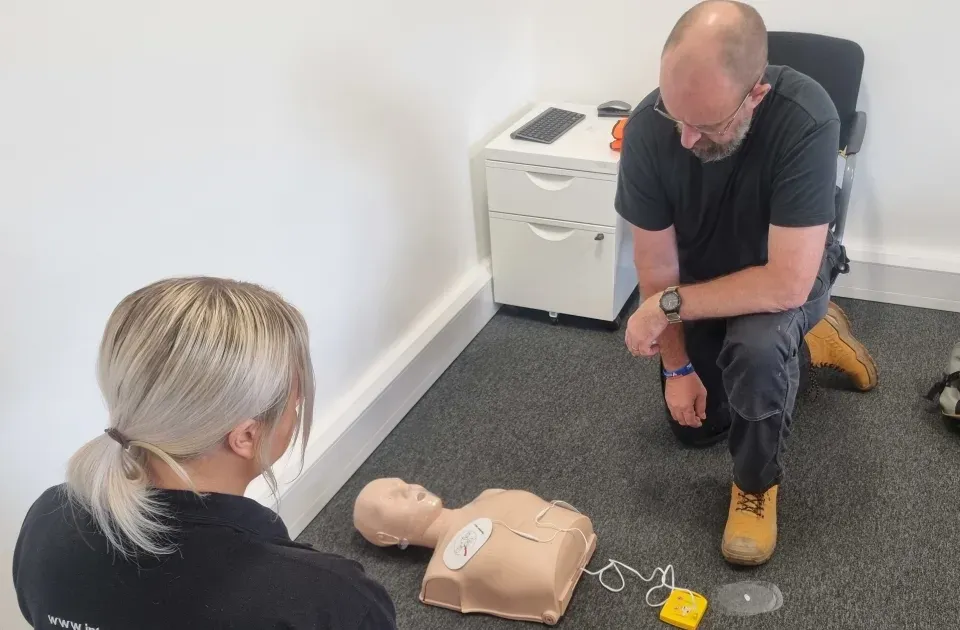
The employer position is more specific than the bystander position. HSE says that an employer providing an AED should supply suitable information and written instructions, and notes that fuller training is likely to make the user more confident and is now an integral part of the syllabus for FAW and EFAW courses.5 Resuscitation Council UK is the reference point HSE names for AED training itself.5 The practical steps take minutes to learn. What takes longer, and what only rehearsal provides, is the confidence to open the cabinet in front of colleagues while a person is on the floor.
Both First Aid at Work and Emergency First Aid at Work include CPR and AED use in the syllabus, which HSE sets out for EFAW.5 On our courses, staff practise those skills using training devices. Cover should be sized to your shift pattern and your building, not to headcount alone, because a trained first aider on the ground floor at 9am may not provide timely cover for the eighth floor at 6pm.
Does a workplace defibrillator have to be registered on The Circuit?
Registration is voluntary. There is no legal obligation to register a defibrillator, and no penalty for not doing so. An unregistered device is simply invisible to the ambulance service, which makes the decision less about compliance and more about whether you want your equipment to be findable.
The Circuit is the national defibrillator network. It maps devices across the UK and connects them to the ambulance services, so that when a bystander calls 999 the call handler can see the nearest registered defibrillator and direct someone to it while the ambulance is still on its way.4 A call handler cannot direct anyone to a device that is not in the system. More than 110,000 defibrillators are registered, and tens of thousands more are estimated to be unregistered.4
One misconception is worth correcting because it stops employers registering. Registration does not oblige you to open your device to the public. A defibrillator can be registered on The Circuit even where it is not publicly accessible.9 The access information you supply tells the ambulance service what the constraints are, which is precisely the point. Registration is free and takes a few minutes. You can check whether a device is already listed at defibfinder.uk.
Who is responsible for maintaining a workplace defibrillator?
The Circuit calls the person responsible for maintaining its record and readiness a defibrillator Guardian. Whether or not your organisation uses that title, the responsibility should be assigned to someone specific and documented. The Circuit sends maintenance reminders to the registered Guardian, covering readiness checks and the expiry of pads and batteries.9
This is where workplace provision quietly fails, and it fails in a way that produces no symptoms. The Guardian is a facilities manager, an office manager, a long-serving PA. They leave. The reminder emails route to a disabled mailbox. Nobody notices, because a defibrillator that is never used never announces that its pads expired two years ago. The device is still on the wall. The sign is still up. It is on the register. It may no longer be emergency-ready, and reliable operation cannot be assumed.
Three practical fixes, none of which cost anything:
- Assign the Guardian role to a post rather than a person, so it survives a departure.
- Add the Guardian handover to your leavers checklist, alongside keys, passes and system access.
- Name a deputy, so that a single absence does not stop the checks.
Record the checks as you go. A maintenance history is the evidence that provision was real rather than decorative, and it is the first thing anyone will ask for afterwards.
Can anyone reach your defibrillator outside office hours?
In a great many workplaces the honest answer is no, and that limitation needs to be recorded on The Circuit rather than discovered during an emergency. A device inside a swipe-controlled reception is available to the people who hold passes, during the hours the building is open. HSE guidance asks employers directly whether staff work shifts or out of hours, and expects adequate first aid provision at all times people are at work.5
Work through who is actually on your site and when. Cleaners early and late. Security overnight. Contractors at weekends. Shift teams outside core hours. Then consider the people immediately outside your walls, because a cardiac arrest in the street in front of a locked office is a device sitting metres away and completely unavailable.
Where appropriate, relocate the device to a permanently accessible point, or install it externally in a suitable cabinet. Current resuscitation guidance strongly favours unlocked cabinets. Resuscitation Council UK, supported by the British Heart Foundation, advises that public access defibrillators should be placed in unlocked cabinets allowing immediate access.10 The reason is practical rather than theoretical. NHS England has reviewed cases where members of the public directed to a defibrillator could not obtain the unlock code, or where the ambulance control centre held the wrong code.11
The usual employer objection is theft, and the consensus statement meets it directly. Despite the widespread use of unlocked cabinets, instances of theft and vandalism are uncommon, and reports from ambulance services and data from The Circuit provide no evidence that defibrillators in locked cabinets are less likely to be stolen or vandalised. A lock arguably signals that the contents are worth taking. Where security is a genuine concern, the recommended measures are a supervised or CCTV-covered location, tracking technology, and clear signage explaining that the device is lifesaving equipment with no resale value.10
External mounting can also make the device available to the wider community, although cabinet, installation and electrical costs may apply. If a cabinet is locked, its access code must be recorded accurately on The Circuit and updated whenever it changes. A code that changed at the last office refit is worse than no code at all, because it produces a confident instruction that wastes the minutes that matter.
What good workplace provision looks like
There is no universal formula, because the whole point of a needs assessment is that provision is specific to the site. A considered approach usually covers the following:
- Enough AEDs to meet the organisation’s measured retrieval time objective. In some multi-storey or dispersed workplaces that will mean one on each floor or in each distinct operational area.
- A measured and recorded round trip retrieval time from the furthest occupied point of the site, tested rather than estimated.
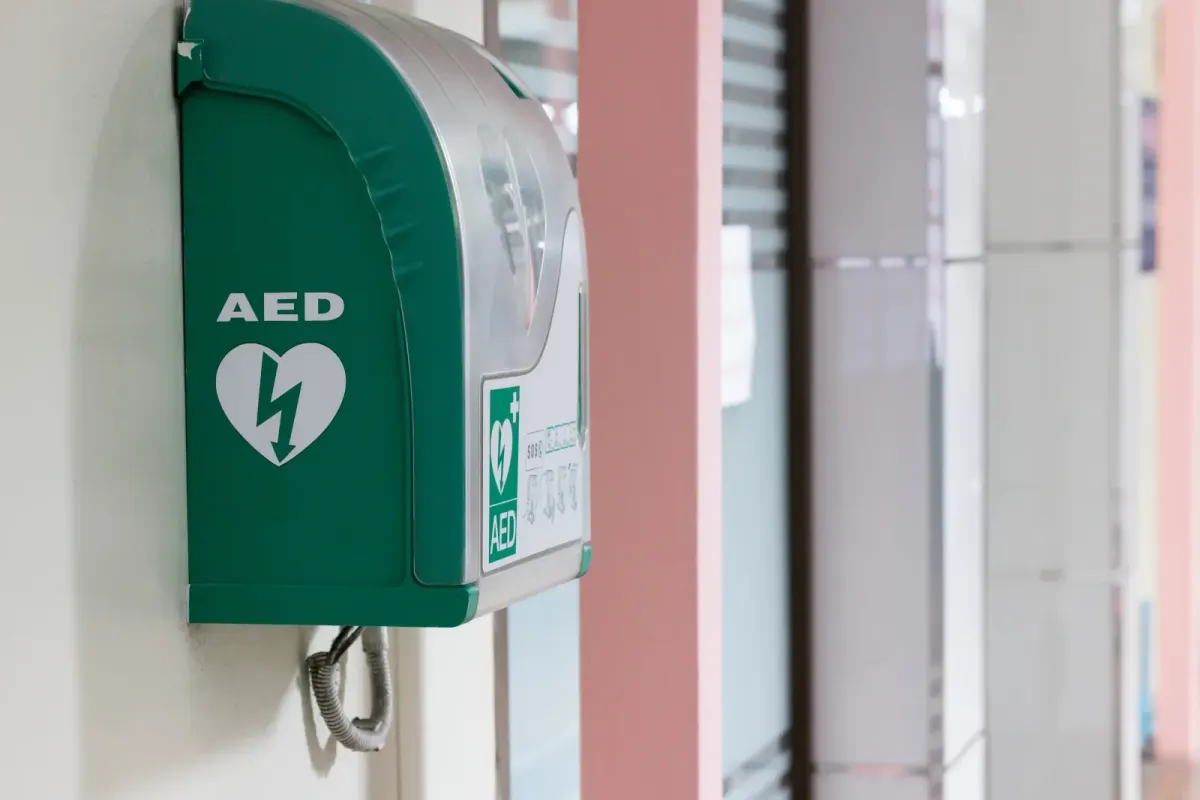
- Clear signage using the standard AED symbol, positioned so a visitor who has never been in the building can find the device.
- Registration on The Circuit, with accurate access information and any code kept up to date.
- An unlocked cabinet for any AED intended for public access.
- A named defibrillator Guardian and a named deputy, with handover built into the leavers process.
- Documented readiness checks covering pad and battery expiry dates.
- Staff trained in CPR and AED use in sufficient numbers to cover every shift and all occupied areas identified by the needs assessment, not simply enough to satisfy a headcount ratio.
- The reasoning behind all of the above recorded in the first aid needs assessment.
On cost, published local authority reporting puts standalone defibrillators at roughly £800 to £2,500, with external cabinets, installation, training, maintenance and replacement pads or batteries adding to the total.12 For a multi-floor office that is a small capital decision measured against the alternative, and it is a decision that becomes considerably more expensive to explain after an incident than to fund before one.
The decision is made before the emergency
The personal assistant in that boardroom had no medical background and no health and safety remit. She had listened to a morning of training, thought about the building she worked in, and asked a question that could not be filed for later consideration.
Every employer is answering the same question. It can be answered now, deliberately, with a measured retrieval time, a registered device, a named Guardian and a documented line in the needs assessment. Or it can be answered later by circumstance, at which point the defibrillator still gets bought. It just arrives as a memorial.

Train your team to use it
Knowing where the defibrillator is matters. Knowing how to use it, and being willing to, matters more. Constellation Training delivers workplace first aid courses including practical CPR and AED training, built around your site and your first aid needs assessment. Contact us to discuss the right level of provision and training for your organisation.
References
[1] Resuscitation Council UK. 2025 Resuscitation Guidelines: Epidemiology of cardiac arrest. Available at: resus.org.uk
[2] Resuscitation Council UK, British Heart Foundation and St John Ambulance. Public Access to Defibrillators, joint briefing. Available at: resus.org.uk
[3] Perkins GD, Lockey AS, de Belder MA, Moore F, Weissberg P, Gray H. National initiatives to improve outcomes from out-of-hospital cardiac arrest in England. Emergency Medicine Journal 2016;33(7):448-451. Available at: ncbi.nlm.nih.gov
[4] Resuscitation Council UK. The Circuit, the national defibrillator network. Available at: resus.org.uk
[5] Health and Safety Executive. First aid at work. The Health and Safety (First-Aid) Regulations 1981. Guidance on Regulations, L74 (Third edition, published 2013, amended 2018 and 2024). Available at: hse.gov.uk
[6] British Standards Institution. BS 8599-1:2019+A1:2026. Workplace first aid kits. Contents of first aid kits and provision of Automated External Defibrillators (AEDs) in the workplace. Specification. Published 30 April 2026. Available at: knowledge.bsigroup.com
[7] Resuscitation Council UK. Do I need an AED? The first aid needs assessment. Available at: resus.org.uk
[8] Resuscitation Council UK. Guidance: Defibrillators. Available at: resus.org.uk
[9] British Heart Foundation. The Circuit, the national defibrillator network. Guidance for defibrillator Guardians. Available at: bhf.org.uk
[10] Resuscitation Council UK. A consensus statement on AED cabinets. Reviewed and updated August 2024. Available at: resus.org.uk
[11] NHS England. Accessing Community Public Access Defibrillators (CPADs). Available at: england.nhs.uk
[12] Rushmoor Borough Council. Defibrillator and bleed kit provision, committee minutes. Available at: democracy.rushmoor.gov.uk