Seven Things To Remember From Your First Aid Course
Finished a first aid course but worried you'll forget what you learnt? These seven practical reminders cover CPR, choking, severe bleeding, burns, seizures and more, helping you remember what matters when someone needs help.
Every one-day first aid course at Constellation ends the same way. Seven things. If you remember nothing else from the day, remember these, because they cover the situations where quick, simple action is most likely to save a life.
This is a deliberately simplified version, written so that anyone can follow it, whether or not you have ever been on a course. The key actions really are simple. If you want the detail behind them, and the chance to practise with your own hands, book onto a course.
The advice below is for adults. First aid for babies and children differs in places, particularly for CPR and for choking. Both adult and paediatric CPR are taught on our one-day courses.
What do you do if someone is unconscious but breathing normally?
Call 999, check their breathing, and if they are breathing normally, put them on their side. Taking those in order: if you find someone who is unresponsive, call 999 straight away. You do not need to work out whether their breathing is normal before you make the call. Check their breathing while you wait for the call to be answered, and the call handler will help you if you are unsure.1
Look and listen for normal breathing. Occasional gasps are not normal breathing, and neither is slow, laboured breathing, which is the one people most often mistake for someone simply breathing badly. If their breathing is not normal, they need CPR, not the recovery position.1
If you suspect a serious injury, from a fall, a crash, or a blow to the head or neck, do not move them into the recovery position. Leave them as they are, keep watching their breathing, tell the call handler what has happened, and follow what they tell you.2 If their airway cannot be kept open, protecting their breathing takes priority. Follow the 999 call handler's instructions about moving them.
If they are breathing normally, roll them onto their side. This is the recovery position, and it helps keep their airway open. If someone is unconscious on their back, their tongue or vomit can block the airway. On their side, the airway stays clearer and anything in the mouth can drain out. Stay with them and keep checking that they are still breathing normally until help arrives.
What do you do if someone is unresponsive and not breathing normally?
Make sure 999 has been called, put both hands in the middle of their chest, and push hard and fast. This is CPR, and for an untrained rescuer, pushing on the chest on its own is what matters. Do not stop to worry about anything else. The risk of doing harm is low, so do not hold back for fear of hurting someone who turns out not to need it.1
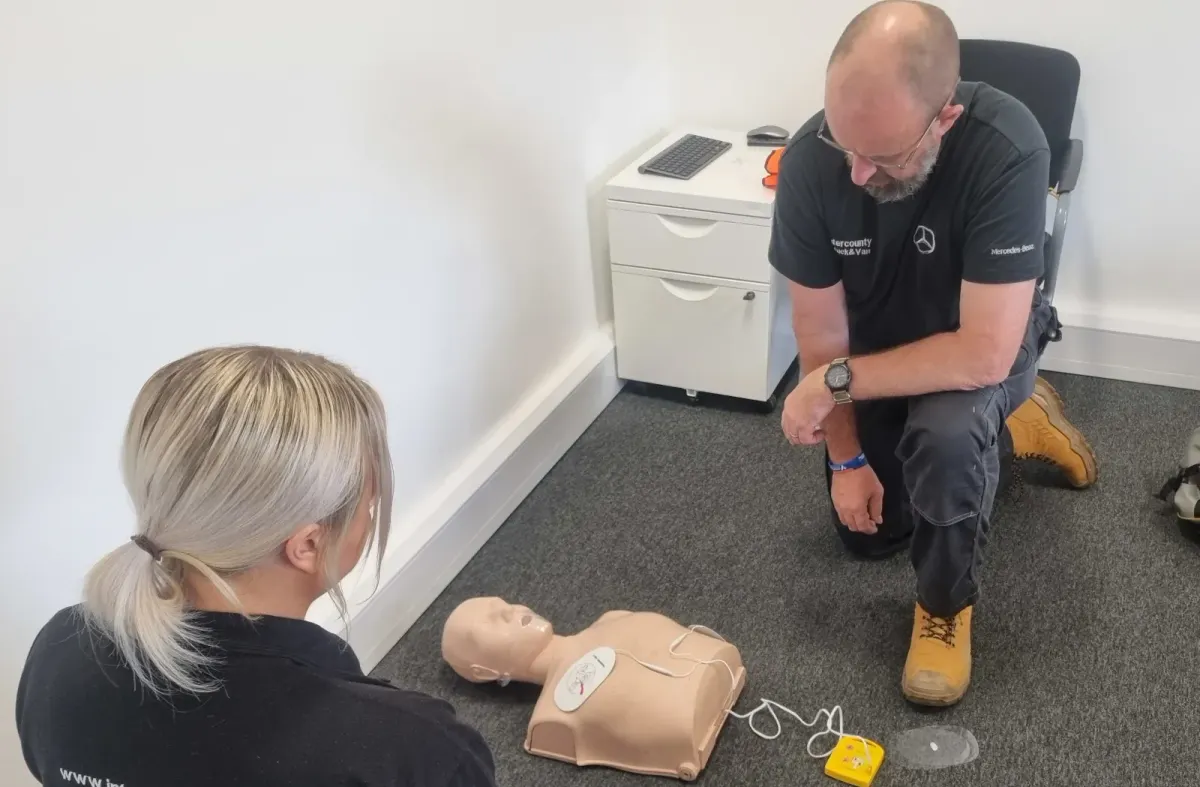
At the same time, send someone else to fetch the nearest defibrillator while you keep pushing.
Defibrillator, switch on and follow instructions
When it arrives, switch it on and follow its spoken instructions and the diagrams on the pads. No training is needed to use one. It will tell you exactly what to do at each step, and it will not deliver a shock unless one is needed. Make sure nobody is touching the person while it checks the heart rhythm or delivers a shock.1
What do you do if someone is choking?
If they can cough effectively, encourage them to keep coughing and watch closely. A strong cough is the most effective way of shifting a blockage, and back blows or thrusts are not needed at this stage.2
If they cannot cough, or the cough becomes weak and ineffective, lean them well forwards and give up to five sharp back blows between the shoulder blades with the heel of your hand. Check after each one, because the aim is to clear the blockage, not to complete all five.2
If the back blows do not work, stand behind them, place your fist just above the belly button with your other hand on top, and pull sharply inwards and upwards, up to five times. Stop the moment the blockage comes out.2
If it still has not cleared, call 999 and keep alternating five back blows with five abdominal thrusts. If they become unresponsive at any point, start CPR and make sure 999 has been called. Anyone who has been treated with abdominal thrusts should be checked over by a healthcare professional afterwards, because the thrusts themselves can cause injury.2
What do you do if someone is bleeding heavily?
Stop the blood coming out of them by pressing firmly and directly onto the wound. Use a dressing if you have one, or a clean non-fluffy cloth, or your hands, and keep the pressure on. Wear gloves if any are to hand. For heavy bleeding, call 999 straight away rather than waiting to see whether the pressure works.3
If blood comes through the dressing, take it off and reapply pressure with a fresh dressing or pad. Once the bleeding is under control, secure it in place with a bandage, firm enough to keep the pressure on but not so tight that it cuts off the circulation.3
If there is an object stuck in the wound, do not pull it out. It may be plugging the bleed. Press on either side of it instead, to push the edges of the wound together.3
What do you do if someone has burnt themselves?
Cool the burn under cool running water for 20 minutes. A full 20 minutes matters, so do not stop early even if it seems to be feeling better. This applies to burns and scalds caused by heat. Chemical burns are different and are covered below.4
While it is cooling, gently remove any jewellery or tight clothing near the burn before it starts to swell, but leave anything stuck to the skin alone. Do not use creams, butter or ice, and do not break any blisters.4
Once it has cooled, lay cling film over the burn lengthways. Do not wrap it around a limb, because the area needs room to swell. For a burn to a hand or a foot, a clean clear plastic bag works instead.5
Get urgent medical help for any burn that is large or deep, any burn to the face, hands, feet, or genitals, and any burn caused by electricity. Burns to babies, young children and older people also need checking. If you are not sure, call NHS 111.4
For a chemical burn, call 999. Wear gloves if you can, carefully remove any clothing with the chemical on it, brush off any dry chemical, and then run cool or lukewarm water over the area for about an hour. This is much longer than for a heat burn.6
What do you do if someone is having a seizure?
Let it run its course. Your job is to keep the person safe while it happens, not to stop the movements. Protect their head, move anything hard or sharp out of the way, and note the time it starts. Never put anything in their mouth, including your fingers, and never try to restrain them.7
When the movements stop, check whether they are breathing normally. If they are unconscious and breathing normally, roll them onto their side into the recovery position. If they are unresponsive and not breathing normally, start CPR and call 999, because seizure-like movements can happen at the start of a cardiac arrest.1
If they are awake but confused and not yet themselves, stay with them, talk to them calmly, and make sure they do not come to any harm until they have fully recovered. Do not give them anything to eat or drink until they are properly back with you.7
When should you call an ambulance for a seizure?
Call 999 if any of the following apply:7
- It is the first time the person has had a seizure.
- The seizure lasts longer than is usual for them.
- It lasts more than five minutes and you do not know how long their seizures usually last.
- They do not regain full consciousness afterwards.
- They have several seizures without regaining consciousness in between.
- They are seriously injured during the seizure.
- They have difficulty breathing afterwards.
Many people with epilepsy have seizures that pass without needing an ambulance, and they often have a care plan agreed with their doctors that says what to do. If you know the person, you know their plan, and you have been trained to carry it out, follow it. If you do not know them, or you are in any doubt at all, call 999.7
Learn this properly, in a day
Reading these seven points is a start, but there is no substitute for practising them with your own hands. Constellation Training runs public one-day Emergency First Aid at Work, Emergency Paediatric First Aid and Blended 12 hour Paediatric First Aid courses across London and the South East. Book a place and give yourself the confidence to act when it counts. To see our latest courses, visit constellationtraining.co.uk/upcoming-courses
References
1. Resuscitation Council UK, Adult Basic Life Support Guidelines 2025. resus.org.uk
2. Resuscitation Council UK, First Aid Guidelines 2025. resus.org.uk
3. St John Ambulance, severe bleeding. sja.org.uk
4. NHS, burns and scalds. nhs.uk
5. St John Ambulance, burns and scalds. sja.org.uk
6. NHS, acid and chemical burns. nhs.uk
7. NHS, what to do if someone has a seizure (fit). nhs.uk