Someone You Love Is Experiencing Psychosis: What to Do
Worried someone you love may be experiencing psychosis? Learn what to say, what to avoid, who to contact and when to seek urgent help in England.

There is a particular kind of fear that comes with realising that someone you love is not making sense anymore. Not tired, not stressed, not being difficult. Something else. Most people who reach that point have no idea what to do next, and the internet is not much help, because most of what is written about psychosis is written for clinicians or for the person experiencing it, not for the person standing in the kitchen wondering whether to ring someone.
This article is for you. It covers how to tell what you might be looking at, what to say and what not to say, who to contact and in what order, what happens next, and what your rights are. It also covers the part that gets left out of almost every guide, which is what happens to you while all of this is going on.
If you want the full clinical picture, our detailed guide to schizophrenia covers symptoms, causes, treatment and recovery. This one is about what to do.
One note on scope. The services, crisis routes and legislation described here are those in England. Mental health law and urgent care arrangements differ in Wales, Scotland and Northern Ireland, so if you are elsewhere in the UK, check your own nation’s crisis route.
If something is happening right now: if there is an immediate risk to life or of serious harm, call 999. For urgent mental health help in England that is not immediately life-threatening, call NHS 111 and select the mental health option. The rest of this article can wait until the immediate danger has passed.
What is psychosis, and is it the same as schizophrenia?
Psychosis is the broader term for losing contact with shared reality, usually through hallucinations, delusions or badly disordered thinking. Schizophrenia is one specific diagnosis within that group. They are not the same thing.
This distinction matters practically. Psychosis has many possible causes, including bipolar disorder, severe depression, physical illness, brain injury, extreme sleep deprivation, and drug or alcohol use. Some people experience a single episode of psychosis and never have another. So if someone you love is experiencing psychosis right now, nobody yet knows what it means long term, and neither do you. Do not diagnose them, and do not let anyone else in the family do it either.
Do not diagnose them, and do not let anyone else in the family do it either
How do I know if what I am seeing is psychosis?
You do not, and you are not supposed to. What you can recognise is a sustained change: someone who has become withdrawn, whose sleep has fallen apart, who has stopped looking after themselves, who seems to be responding to something you cannot hear, or who has become convinced of something that is not true and cannot be talked out of it.
The signs the NHS describes include hearing, seeing or feeling things that do not exist outside the person’s mind, holding beliefs with complete conviction despite clear evidence against them, becoming suspicious that they are being watched, followed or plotted against, and finding it hard to hold a train of thought so that speech becomes jumbled and difficult to follow.1
What often comes first, though, is quieter and easier to miss. Withdrawal from friends. Losing interest in things they cared about. Neglecting personal hygiene. Seeming flat and disconnected from their own emotions. These are what clinicians call negative symptoms and they frequently appear months or years before anything dramatic happens.1 They are also the ones most likely to be mistaken for laziness or rudeness, including by the people closest to the person.1
One thing worth flagging if the person you are worried about is a teenager or in their early twenties. First symptoms most often appear at that age, and the NHS notes that early signs such as social withdrawal and changes in sleep are easily mistaken for an adolescent phase.1 If that is your situation, our guide on what parents can do to support a child’s mental health covers the earlier conversations.
Your job is not to work out which condition this is. Your job is to notice that something has changed and to get it looked at.
Should I say something, or wait and see?
Say something. The single most useful thing you can do is shorten the time between someone becoming unwell and someone getting them help, and waiting to be certain is how that time gets long.
The threshold for referral is lower than most people assume, and it differs by age. For adults, NICE says a person should be referred without delay to a specialist mental health service or an early intervention in psychosis service if they are distressed, have a decline in social functioning, and have any one of the following: brief or partial psychotic symptoms, other experiences or behaviour suggestive of possible psychosis, or a first-degree relative with psychosis or schizophrenia.2
For children and young people the wording is different and comes from a separate guideline. It says that a child or young person with transient or attenuated psychotic symptoms, or other experiences suggestive of possible psychosis, should be referred without delay to a specialist service such as CAMHS, or an early intervention in psychosis service from the age of 14.3
The practical point is that families should not wait for unmistakable hallucinations. For adults, distress and declining social functioning together with any one of the indicators above justify referral without delay. For children and young people, transient or partial psychotic symptoms, or other experiences suggestive of possible psychosis, are enough to warrant referral.
How do I start the conversation?
Privately, unhurried, and by describing what you have noticed rather than what you think it means.
"I have noticed you have not been sleeping and you have not been out in a few weeks. How are you doing?" works. "I think you might be having a breakdown" does not, and neither does opening with a diagnosis you found online.
A few things help. Pick a moment with no time pressure and no audience. Sit alongside rather than opposite if you can, because it is less confrontational. Ask an open question and then leave the silence alone. Most people need a long pause before they say the real thing, and most of us fill that pause out of discomfort.
You will probably not get everything in one conversation. That is normal. The point of the first conversation is not to solve it. It is to establish that you have noticed, that you are not frightened of them, and that you are not going anywhere.
What do I say when they tell me something that is not true?
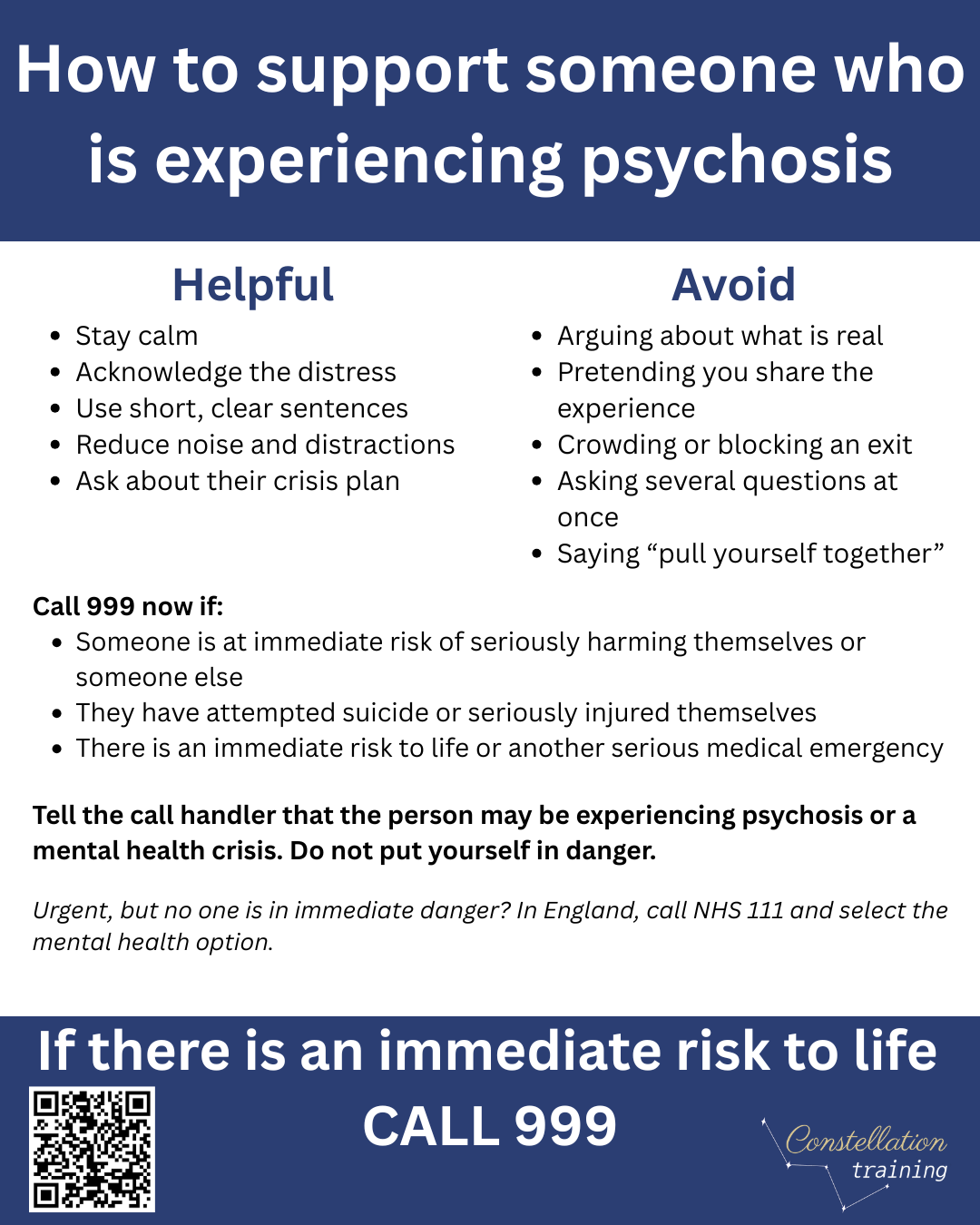
Do not argue with it, and do not pretend to believe it. Be honest that you do not experience it yourself, take seriously how frightening it is for them, and stay with them.
It helps enormously to understand that this is not a matter of them being mistaken. Brain imaging shows activity in the speech areas of the brain when people with schizophrenia hear voices.1 The experience is genuinely perceptual. Telling someone that the voice is not real is roughly as useful as telling someone with a migraine that the light is not really bright. It will not change what they are experiencing, and it will establish you as one more person who does not believe them, at exactly the moment they most need someone who does.
Pretending to agree is no better. Confirming that you can also hear the voices is dishonest, and once they realise it, you have lost the trust you were trying to build.
The workable position sounds something like: "I do not hear it. I believe that you do, and I can see how frightening that is. I am staying here with you." That is truthful and it is on their side at the same time.
Wherever possible, respond to the feeling rather than the content. Fear, exhaustion and isolation are real regardless of what is causing them, and they are things you can actually do something about. Asking "what would help right now?" usually gets you further than asking them to explain what is happening.
What should I avoid saying?
Avoid telling them to pull themselves together, blaming them, or blaming anyone else. The NHS explicitly advises against all three.4 Whatever it is meant to convey, it lands as contempt.
Also worth avoiding:
- "You are not making any sense." They usually know. It adds humiliation to fear.
- "Everyone feels like that sometimes." Minimising an experience this frightening tells them you have not understood it.
- "You just need to get out more" or any other single-cause explanation. It implies the problem is a failure of effort.
- Talking about them in the third person while they are in the room. This happens constantly once professionals are involved, and it is dehumanising.
- Threats or ultimatums about getting help. They rarely work, and they cost you the relationship you will need later.
Practical things help too. Reduce noise, reduce the number of people talking at once, use short sentences, and give them time to answer. Confused thinking makes complicated conversation genuinely hard work.1 Do not stand too close or block the doorway. Feeling trapped makes fear worse.
Who do I contact, and in what order?
It depends on how urgent things are.
If there is an immediate risk to life, or someone has seriously harmed themselves, or there is an immediate risk of serious harm to another person, call 999. Ambulance services deal with mental health emergencies routinely.
If it is urgent but not immediately life-threatening, call NHS 111 and choose the mental health option. Every area of England has a 24-hour urgent mental health helpline reachable this way, and it is staffed by people who do this all day. If you are in Wales, Scotland or Northern Ireland, the equivalent route differs, so look yours up before you need it.
If they are already under the care of a mental health team, their care plan should contain a crisis section and emergency contact numbers.4 Use those first. The crisis resolution and home treatment team is designed to be the single point of entry to acute services in the community.2
If this is new and not an emergency, start with their GP, who can refer to an early intervention in psychosis service. You may also be able to contact an early intervention in psychosis service directly. NICE allows referrals from the person themselves or from a carer,2 although local access arrangements vary. You do not necessarily need to wait for a GP appointment before asking the service for advice.
One thing worth knowing when you make that call: the national access and waiting-time standard in England says that people aged 14 to 65 experiencing a first episode of psychosis should begin NICE-recommended treatment within two weeks of referral.5 Knowing the standard exists is useful when you are trying to convey urgency to someone who has not grasped it.
What happens at an assessment?
It is much broader than most families expect, and it takes time.
Both NICE guidelines, the one for adults and the separate one for children and young people, require a comprehensive multidisciplinary assessment. The exact professionals involved and the process differ by age, but the assessment should cover mental health history and risk, possible physical causes and the effects of any prescribed medicines, physical health, trauma and other psychological factors, developmental history, relationships and social circumstances, education or work, and quality of life.2,3
There is no blood test and no brain scan that diagnoses psychosis. Scans are specifically not recommended as a routine part of the first investigation.2 If someone tells you a scan will settle the question, they are wrong.
A care plan should be developed with the person and, for a child or where the person agrees, their parents or carers. The person should receive an up-to-date copy, and so should the primary healthcare professional who made the referral.2 If the person is willing, ask them to share the crisis section with the people supporting them. That section can become one of the most useful pieces of information in the household.
What if they refuse to get help?
This is the hardest situation, and there is no clean answer. A few things genuinely help.
Separate the goal from the label. Someone who will absolutely not see a psychiatrist may agree to see a GP about not sleeping. Sleep is a real and honest reason to go, and it gets them into a room with a clinician.
Ask what they are afraid of rather than assuming. Fear of being detained, of losing their job, of losing custody of children, or of being put on medication that will change who they are, are all common and all specific. Some can be addressed directly.
Do not make it a battle you have to win today. Ultimatums damage the relationship that is your only real leverage. Keep the door open and keep turning up.
You can also seek advice yourself without them present. GPs, early intervention services and charity advice lines will talk to family members about how to approach the situation, even where they cannot discuss the person’s own information with you.
Where someone is seriously unwell and at risk, and will not accept help, assessment under the Mental Health Act may become the route. That is not something you arrange yourself, but you can raise concerns with their GP, with the crisis team, or with the local authority’s adult social care service, who can arrange for an approved mental health professional to consider whether an assessment is needed.4
If you are the person’s nearest relative under the Act, you have a specific right to ask the local approved mental health professional service for a Mental Health Act assessment. If the approved mental health professional decides not to make an application, they must give you their reasons in writing.6
What if I think they might harm themselves?
Take it seriously, ask directly, and, if it is safe to do so, do not leave them alone while you get help.
Suicide risk is raised in people with schizophrenia, and is higher after an acute episode or a hospital stay.4 Warning signs the NHS describes include talking about death or suicide either directly or in indirect ways, making final arrangements such as giving away possessions or saying goodbye, self-harm, and a sudden unexplained lifting of mood after a long period of being very low.4
Asking someone directly whether they are thinking about suicide does not put the idea in their head. It can give them permission to say what they are experiencing, and being asked plainly is often a relief.
If you believe there is immediate danger, stay with them if it is safe to do so, or arrange for someone else to, and get professional help involved straight away, through the crisis team, NHS 111 or 999.4
Samaritans can be reached free on 116 123 at any hour, and that number is for you as well as for them.
What happens if they are detained under the Mental Health Act?
Detention means a person can be admitted to hospital and treated without their consent where the statutory criteria are met. It is frightening to witness and it is frequently traumatic for the person, but it is not a punishment. Different sections authorise detention for different periods, and some can be renewed.
A few things are useful to know in the moment. Ask staff which section is being used, how long it lasts and what rights come with it. People detained under the main assessment and treatment sections have access to an independent mental health advocate and to routes for challenging their detention, though the shortest emergency and holding powers work differently.7 The person legally identified as their nearest relative has specific rights under the current Act, although that is not necessarily the same person as their next of kin, and the care team should be discussing with you what information will be shared and how, ideally negotiated early rather than in the middle of a crisis.
The law here is changing. The Mental Health Act 2025 received Royal Assent on 18 December 2025 and will, among other things, raise the threshold for detention, shorten detention periods, strengthen rights of appeal and advocacy, and replace the current nearest relative role with a nominated person chosen by the patient themselves.8 Be careful about anything you read on this, though, including from otherwise reliable sources. Most of the Act is not yet in force. A small number of provisions commenced automatically on 18 February 2026, and two further sections were brought into force on 6 April 2026 by the first commencement regulations,9 but the substantive reforms will follow gradually through further regulations, secondary legislation and a revised Code of Practice. The new detention criteria and most of the new patient protections are not among them, so the existing Mental Health Act 1983 framework still governs the great majority of detentions.
What rights do I have as a family member or carer?
More than most people realise, and services do not always volunteer them.
NICE says carers should be given written and verbal information, in an accessible format, about diagnosis and management, about recovery and positive outcomes, about the support available to carers, about the role of the different teams, and about how to get help in a crisis. Carers should also be offered a carer-focused education and support programme as early as possible.2 If none of that has been offered to you, ask for it by name.
Family intervention is part of the recommended treatment, not an optional extra. NICE says it should be offered to the families of everyone with psychosis or schizophrenia who lives with or is in close contact with them, should run for between three months and a year, and should include at least ten planned sessions.2 Ask whether it is available locally.
Confidentiality is the flashpoint. Services will often decline to share the person’s information with you, which can feel like being shut out. NICE says the sharing of information should be negotiated with the person and their carer as early as possible, and reviewed regularly, particularly where communication is difficult.2 Two things are worth holding on to: even where a team cannot tell you things, there is nothing stopping you telling them things, and you should say so clearly. And confidentiality does not prevent a team giving you general information about the condition and about crisis routes.
If you are an adult caring for another adult, you can request a carer’s assessment from your local authority under the Care Act 2014, regardless of how much care you provide or what your income is.10 If you are a parent caring for a disabled child under 18, ask your local authority for a parent carer’s needs assessment instead, under section 17ZD of the Children Act 1989, added by the Children and Families Act 2014.11 If you are employed, you also have a day-one right to a week of unpaid carer’s leave in each rolling twelve-month period under the Carer’s Leave Act 2023, which came into force on 6 April 2024, and it can be taken in half days or full days rather than one block.12
What does the long haul look like?
Better than the version in your head right now, and different from what you are probably bracing for.
The NHS position is that most people with schizophrenia make a recovery, though many experience the occasional return of symptoms.4 The research supports a version of that. A meta-analysis of long-term outcomes after a first episode of psychosis found a pooled remission rate of 58 per cent and a pooled recovery rate of 38 per cent.13 Because first-episode psychosis covers several possible diagnoses, these figures should not be read as schizophrenia-specific. A separate analysis of studies with at least twenty years of follow-up found that around a quarter of people had recovered and roughly six in ten had a moderate or better outcome, with no evidence of progressive deterioration for the majority, which directly contradicts the idea that schizophrenia is a one-way decline.14
Two practical things make a real difference over years.
The first is learning the relapse signature. Many people can describe the specific things that happen first when they are becoming unwell: disturbed sleep, appetite changes, rising anxiety, becoming suspicious or fearful, hearing quiet voices occasionally, difficulty concentrating.4 Agreeing in advance what should happen if you notice those things turns a crisis into a manageable appointment. Advance statements, which record someone’s preferences about their care while they are well, are worth writing for the same reason, and the care team must take them into account.4
The second is physical health, which is the thing families almost never focus on and probably should. People with severe mental illness in England die on average fifteen to twenty years earlier than the general population, and much of this gap is linked to preventable physical illness.15 There is an annual physical health check for people on the severe mental illness register covering blood pressure, glucose, cholesterol, body mass index, smoking and alcohol consumption. In the fourth quarter of 2025/26, 65.2 per cent of people on the register received a full check, slightly down on the year before.16 Helping the person you love actually get to that appointment is, unglamorously, one of the most practical things you can do to reduce preventable physical illness.

Who looks after you?
Too often, nobody, unless you arrange it, which is why this section exists.
Supporting someone through psychosis is genuinely exhausting, and it goes on far longer than the acute phase. The pattern people describe is a period of intense crisis during which everyone rallies, followed by months in which the phone stops ringing and you are still doing all of it. Guilt is close to universal, and so is anger, and both are normal and neither means you are failing.
A few things are worth doing early rather than late. Request the carer’s assessment. Tell at least one person outside the situation what is actually happening. Find a carers’ group, whether through the mental health team, a local carers’ centre or a national charity, because talking to someone who has been through it is worth more than any leaflet. Keep something in your week that has nothing to do with any of this. And if your own sleep, appetite or mood is going, treat that as a reason to see your own GP rather than as evidence that you should be coping better.
You will not be able to sustain this for years by sheer determination. Nobody can. Caring is more sustainable when you accept help early, rather than waiting until you are exhausted.
Where to get support
- Rethink Mental Illness – advice, information and a carers’ hub specifically for families and friends, at rethink.org
- Mind – information and local Mind services across England and Wales, at mind.org.uk
- Carers UK – rights, benefits and practical guidance for unpaid carers, at carersuk.org
- Hearing Voices Network – peer support groups for people who hear voices, and information for those around them, at hearing-voices.org
- SANE – emotional support and specialist mental health information, at sane.org.uk
- Samaritans – free, day or night, on 116 123, at samaritans.org
- NHS – condition information and self-care guidance at nhs.uk
The short version
Notice the change. Say something sooner than feels comfortable. Do not argue with the content and do not pretend to share it. Get them assessed, and know that the referral threshold is lower than you think. Learn the crisis route before you need it. Ask for the carer information and family intervention by name rather than waiting for them to be raised. Look after physical health, because preventable physical illness contributes heavily to the life-expectancy gap. And get yourself some support, early.
None of this requires clinical training. It requires knowing what to do, which is a very different thing, and which is now something you have.

If you want to be better prepared
Constellation Training delivers Ofqual-regulated First Aid for Mental Health training for workplaces and organisations, covering how to recognise the signs of conditions including psychosis, how to start a conversation without making things worse, and when and how to escalate. The qualifications are awarded by First Aid Awards and delivered through Nuco Training, and run from a half-day awareness session through to the two-day Level 3 qualification, delivered in house and built around real situations rather than theory. Get in touch to talk about training your team.
References
1. nhs.uk – Symptoms – Schizophrenia, NHS.
2. nice.org.uk – Psychosis and schizophrenia in adults: prevention and management (CG178), Recommendations. NICE.
3. nice.org.uk – Psychosis and schizophrenia in children and young people: recognition and management (CG155), Recommendations. NICE.
4. nhs.uk – Living with – Schizophrenia, NHS.
5. england.nhs.uk – Mental health access and waiting time standards. NHS England.
6. mind.org.uk – Nearest relative: your rights under the Mental Health Act. Mind.
7. mind.org.uk – Independent mental health advocates (IMHAs). Mind.
8. legislation.gov.uk – Mental Health Act 2025 (c. 33).
9. legislation.gov.uk – The Mental Health Act 2025 (Commencement No. 1) Regulations 2026 (SI 2026/385).
10. scie.org.uk – Care Act factsheet 4: Legal duties for a carer’s assessment. SCIE.
11. legislation.gov.uk – Children Act 1989, section 17ZD: parent carer’s needs assessments, inserted by the Children and Families Act 2014.
12. legislation.gov.uk – Carer’s Leave Act 2023 (c. 18).
13. cambridge.org – Lally J et al. Remission and recovery from first-episode psychosis in adults: systematic review and meta-analysis of long-term outcome studies. British Journal of Psychiatry.
14. sciencedirect.com – The prognosis of schizophrenia: a systematic review and meta-analysis with meta-regression of 20-year follow-up studies. Schizophrenia Research.
15. england.nhs.uk – Improving the physical health of people living with severe mental illness. NHS England.
16. digital.nhs.uk – Physical Health Checks for People with Severe Mental Illness, Q4 2025-26. NHS England Digital.
This article is for general information and is not medical advice. It is not a substitute for assessment by a qualified healthcare professional. If you are worried about yourself or someone else, speak to a GP. If someone's life is at immediate risk, call 999. Samaritans are available free on 116 123 at any hour.
Constellation Training is a training provider, not a healthcare service.