Understanding Schizophrenia: What It Is, What It Is Not, and How to Support Someone
Understand schizophrenia, including its symptoms, causes and treatment, and learn how to support someone experiencing psychosis or a mental health crisis.

Ask most people in Britain what they know about schizophrenia and the answers come quickly. Split personality. Unpredictable. Dangerous. Almost none of it is accurate.
What is accurate is harder to fit into a headline. Schizophrenia is a serious but treatable condition that usually begins in a person’s late teens or twenties. Earlier treatment is associated with better outcomes, which is why rapid recognition and referral matter. It carries a physical health burden that almost nobody talks about, and a set of social consequences, in employment, in housing and in contact with services, that can do lasting damage of their own.
This article sets out what schizophrenia is, how it is recognised and treated, principally in England, what the evidence actually says about recovery, and what colleagues, managers, friends and family can practically do. It is written for a general readership, but the sections on the workplace, on detention and on supporting someone in crisis will also be useful to employers, HR teams and anyone with a designated mental health role.
A note on scope before we start. The statistics and service pathways described here mainly relate to England. Mental health legislation and urgent care arrangements differ across England, Wales, Scotland and Northern Ireland, and the Equality Act 2010 applies across Great Britain but not Northern Ireland.
None of it is a substitute for clinical assessment. If you are worried about yourself or someone else right now, skip to the section on urgent help near the end.
- What schizophrenia is
- Symptoms and early signs
- Causes and diagnosis
- Treatment
- Physical health
- Recovery
- Schizophrenia at work
- Supporting someone with psychosis
- Urgent help
- Further support
What is schizophrenia?
Schizophrenia is a long-term mental health condition that can affect perception, thinking, emotion, motivation and behaviour. During psychotic episodes a person may experience hallucinations, delusions and disorganised thinking.1
Doctors describe it as a type of psychosis. Psychosis is the broader term for that loss of contact with shared reality, and it has many possible causes, including bipolar disorder, severe depression, physical illness, brain injury, and drug or alcohol use. Schizophrenia is one specific diagnosis within that wider group.1 Someone can experience psychosis once and never again. Schizophrenia describes a more persistent pattern.
The condition typically runs in episodes. Periods where symptoms are severe, described clinically as acute schizophrenia, are followed by periods where a person experiences few symptoms or none at all.1 That episodic pattern is one of the reasons the public image of schizophrenia is so distorted. The people who are most visibly unwell are the least representative of the condition as a whole.
The split personality myth is worth dealing with immediately, because it is one of the most persistent misconceptions.2 Schizophrenia does not mean a person has two or more personalities. The confusion comes from the name, which Eugen Bleuler built from Greek words meaning split and mind when he introduced it in 1908. What he was describing was a splitting, or loss of unity, between psychological functions such as thought, emotion and will, not the presence of separate selves.3 Dissociative identity disorder, which is what most people are actually picturing, is a separate and much rarer condition.
How common schizophrenia is, and who it affects
Estimates vary depending on which diagnoses are counted and how they are measured, but broadly somewhere between 0.7 and 1 per cent of people will experience a psychotic disorder during their lifetime. NICE puts the figure for psychosis and schizophrenia together at about one per cent.4 Measured differently, the Adult Psychiatric Morbidity Survey, which clinically examines a representative sample of adults living in private households in England, has found past-year psychotic disorder in fewer than one in a hundred adults at every wave since 2007: 0.4 per cent in 2007, 0.7 per cent in 2014 and 0.4 per cent in 2023/4.5
Those two figures answer different questions. The lifetime figure counts everyone who will ever be affected. The survey figure counts people who are unwell at a given moment, and because it samples private households it misses people in hospital, in prison, in many communal or institutional settings, and people without settled housing, which means it understates the true picture. Taken together they describe a condition that is uncommon but not rare. In an organisation of a thousand people, several will have direct personal or family experience of it.
Prevalence is not evenly distributed. The same survey found psychotic disorder in one per cent of adults living in the most deprived fifth of neighbourhoods in England, against a rate close to zero in the least deprived fifth. It was also markedly higher among adults with problem debt and among those who were economically inactive.5 Deprivation, insecurity and social isolation are not incidental to schizophrenia. They sit alongside it as both risk factor and consequence.
First symptoms usually appear in young adulthood, at exactly the point when a person would normally be moving into independent living, further education or their first serious job, though onset can happen at any age.4 That timing matters enormously. The condition tends to arrive precisely when the foundations of an adult life are being laid, which is a large part of why its social effects are so severe.
Positive symptoms of schizophrenia: hallucinations, delusions and disordered thinking
Symptoms are conventionally divided into positive and negative. The terms are not value judgements. Positive symptoms are experiences added to a person’s normal mental life. Negative symptoms are capacities taken away from it.1
Hallucinations
A hallucination is a perception of something that does not exist outside the person’s mind. It can involve any sense, but hearing voices is by far the most common form.1
This is the point at which most people’s understanding goes wrong. Hallucinations are not imagined in the way daydreams are imagined. Brain imaging shows activity in the speech areas of the brain when people with schizophrenia hear voices, which is to say the experience is genuinely perceptual. The brain is treating internally generated thought as though it were external sound.1 Telling someone the voices are not real is therefore about as useful as telling someone with a migraine that the light is not really bright.
Some people describe the voices they hear as pleasant or companionable. More often they are critical, abusive or frightening. They may narrate what the person is doing, discuss them between themselves, issue instructions, or appear to come from a specific place such as a television.1
Delusions
A delusion is a belief held with complete conviction despite being based on a mistaken or unrealistic view of events. Delusions can appear suddenly or build over weeks and months.1
Paranoid delusions, where a person believes they are being followed, watched, plotted against or harmed, are common, and the suspected persecutor is frequently a family member or close friend rather than a stranger. Some people find personal significance in ordinary events, believing that a news article or a television programme is addressing them directly, or that everyday details carry hidden messages. Delusions often develop as an attempt to explain a hallucination: if you hear a voice describing your movements, the conclusion that you are under surveillance is, on its own terms, entirely logical.1
Confused thinking and speech
People experiencing psychosis frequently struggle to hold on to a train of thought. Concentration becomes difficult, ideas drift, and following a newspaper article or a television programme can become impossible. People often describe their thinking as misty or hazy. Speech may become jumbled and hard for others to follow.1
Some experience their thoughts as not their own: controlled by someone else, inserted from outside, or removed from their mind. Some feel their body is being directed by an external force. As this deepens, behaviour can become disorganised and unpredictable.1
Negative symptoms of schizophrenia and the period before diagnosis
Negative symptoms are the ones that get missed, and they are frequently the ones that do the most damage to a person’s life over time. They include social withdrawal, reduced motivation, reduced speech, diminished pleasure in things the person used to enjoy, and a flattening of outward emotional expression. The NHS describes these as avoiding people including friends, feeling disconnected from one’s own feelings and emotions, and not wanting to look after oneself or one’s own needs.1 Reduced outward expression of emotion is not the same as no longer feeling anything, and the distinction matters to the people around them.
Crucially, negative symptoms often appear months or years before the first acute episode. This period is known as the prodrome. Symptoms during it develop gradually and worsen slowly, and they are genuinely difficult to distinguish from other causes.1 Social withdrawal and disturbed sleep in a seventeen year old look like adolescence. In a twenty-four year old they look like burnout or a difficult break-up.
Because negative symptoms present as inactivity and flat affect, they are routinely misread as laziness, rudeness or a bad attitude, which damages relationships with friends, family and employers at exactly the moment the person most needs those relationships intact.1 A manager who concludes that an employee has simply stopped trying is making an understandable mistake with potentially serious consequences.
What are the early warning signs of schizophrenia?
The earliest signs are usually not hallucinations or delusions but a gradual withdrawal: dropping out of contact with friends, declining performance at work or in study, disturbed sleep, neglected self-care, and a noticeable flattening of emotional expression.1
NICE sets a deliberately low threshold for referral. A person should be referred without delay to a specialist mental health service or an early intervention in psychosis service if they are distressed, have a decline in social functioning, and have any one of the following: transient or attenuated psychotic symptoms, other experiences or behaviour suggestive of possible psychosis, or a first-degree relative with psychosis or schizophrenia.6
Read that again, because it is more permissive than most people assume. Distress plus a decline in functioning plus a parent or sibling with psychosis is sufficient grounds for referral, with no requirement that the person be hearing voices at all. The threshold is set low on purpose, for reasons the next sections explain.
What causes schizophrenia
There is no single cause, and anyone who tells you otherwise is selling something. The evidence points to a combination of physical, genetic, psychological and environmental factors that together make a person more vulnerable, with a stressful event or period sometimes acting as the trigger for a first episode.7
Genetics
Schizophrenia runs in families, but no single gene is responsible. The clearest evidence comes from twin studies. Where one identical twin develops schizophrenia, the other has roughly a one in two chance of developing it, and this holds true even when the twins were raised apart. In non-identical twins the figure is about one in eight, against roughly one in a hundred in the general population.7 That is a strong genetic signal, but a one in two concordance in genetically identical people is also decisive evidence that genes alone do not determine the outcome.
Brain development and neurotransmitters
Studies have found subtle structural differences in the brains of people with schizophrenia, though these are not present in everyone with the diagnosis and do occur in people with no mental illness at all. There is also evidence that levels of certain neurotransmitters, chemicals that carry messages between brain cells, differ in people with the condition. Medicines that reduce the activity of dopamine help control symptoms for many people, which supports the neurotransmitter hypothesis without proving it.7
Pregnancy and birth complications
People who develop schizophrenia are more likely to have experienced low birthweight, premature labour or a lack of oxygen during birth. The suggested mechanism is a subtle effect on early brain development.7
Stress and trauma
Bereavement, job loss, homelessness, divorce, the end of a relationship, and physical, sexual or emotional abuse are all associated with the onset of a first episode. It is important to be precise about what this means. These experiences are neither necessary nor sufficient causes. They can increase vulnerability, or precipitate an episode in someone already vulnerable.7 The distinction matters, because the alternative reading, that difficult experiences produce schizophrenia, both blames families and sets up false expectations of what removing the stressor will achieve.
The trauma link runs in the other direction too. NICE specifically instructs clinicians to assess for post-traumatic stress disorder and other trauma reactions in people with psychosis, because they are likely to have experienced adverse events either before the psychosis or as a result of it.6 Being detained, restrained or hospitalised while acutely unwell is itself frequently traumatic.
Drugs
Cannabis, cocaine, LSD and amphetamines are all associated with increased risk of developing schizophrenia, psychosis or a similar illness. Research has shown that teenagers and young adults who use cannabis regularly are more likely to develop schizophrenia in later adulthood, and the risk appears higher with stronger forms of the drug. What remains unclear is the direction of causation, since people who are becoming unwell may also be more likely to use drugs. What is not in doubt is that in someone who has already had an episode, drug use can cause a relapse or prevent symptoms from improving.7
How schizophrenia is diagnosed
There is no blood test and no brain scan for schizophrenia. Diagnosis is clinical, and NICE requires a comprehensive multidisciplinary assessment in secondary care, including assessment by a psychiatrist and by a psychologist or another professional with expertise in the psychological treatment of psychosis.6
That assessment is far broader than a symptom checklist. It is required to cover psychiatric history and risk, a full physical examination to identify physical illness or prescribed medicines that could be producing psychotic symptoms, physical health and wellbeing including weight, smoking, nutrition and physical activity, psychological and psychosocial factors including social networks and any history of trauma, developmental history, social circumstances including housing and caring responsibilities, occupational and educational history, quality of life and economic status.6
Two things follow from this. The first is that a proper assessment takes time, which is one reason diagnosis is rarely quick. The second is that ruling out physical causes is a required step rather than an optional courtesy. Psychotic symptoms can be produced by physical illness, by organic brain disorders and by prescribed medicines, and a diagnosis of schizophrenia should not be made until those have been considered.6
Structural neuroimaging is specifically not recommended as a routine part of the initial investigation of first-episode psychosis.6 Scans have a role where there is a clinical reason to suspect a structural problem. They are not a diagnostic test for schizophrenia and no one should be told otherwise.
A care plan should be written in collaboration with the person as soon as possible after assessment, and a copy sent both to the person themselves and to the professional who made the referral.6 In practice that care plan matters a great deal, because it contains the crisis section that everyone around them will need if things deteriorate.
Why the delay between first symptoms and treatment matters
The gap between symptoms starting and treatment beginning is known clinically as the duration of untreated psychosis. Longer duration is consistently associated with poorer outcomes, which is why services are built around identifying and treating a first episode quickly. This is why England has a national access and waiting time standard for early intervention in psychosis.
The standard has two conditions, and both must be met for it to count as achieved: a maximum wait of two weeks from referral to the start of treatment, and treatment delivered in accordance with NICE guidelines and quality standards for psychosis and schizophrenia.8 The two-week clock is the part that gets quoted. What it actually requires is worth being precise about. For treatment to count as having started, the person must have had an initial assessment, been accepted onto the caseload of an early intervention service capable of delivering the full NICE-recommended package, and been allocated to and engaged with a care coordinator. The full package itself is not expected to be delivered inside two weeks.
The standard is targeted at people aged 14 to 65 and required, from April 2016, that more than 50 per cent of people experiencing first-episode psychosis begin treatment within two weeks, rising to at least 60 per cent by 2020/21.9 It is worth being clear-eyed about what that means: the target has never been that everyone is seen within a fortnight. It is that a majority are.
The urgency is not administrative. NHS England’s own implementation guidance notes that people experiencing psychosis are at particularly high risk of suicide and that most suicides occur in the early years of illness, which places early intervention teams in a uniquely important position to prevent avoidable deaths.9 Referral can come from primary or secondary care, from other community services, or from the person themselves or their carer.6 You do not need a GP’s permission to contact an early intervention service.
NICE is also explicit that early intervention in psychosis services should be accessible to everyone with a first episode or first presentation of psychosis regardless of age or how long the psychosis has gone untreated, and that people presenting to those services should be assessed without delay.6 Someone who has been unwell for two years has not missed their chance.
How schizophrenia is treated
The evidence-based answer is medication and psychological therapy together, not one or the other. For a first episode of psychosis, NICE recommends oral antipsychotic medication offered in conjunction with psychological interventions, specifically family intervention and individual cognitive behavioural therapy.6 The same combination is recommended for subsequent acute episodes.
Antipsychotic medication
Antipsychotics reduce the intensity of hallucinations and delusions and, for some people, help with negative symptoms. The choice of drug is supposed to be made jointly by the person and the clinician, with the likely benefits and possible side effects of each option discussed openly, including metabolic effects such as weight gain and diabetes, movement-related effects, cardiovascular effects and hormonal effects.6
Before treatment starts, NICE requires baseline measurements including weight, waist circumference, pulse and blood pressure, blood glucose or HbA1c, blood lipids and prolactin, an assessment of any movement disorders, and an assessment of nutrition, diet and physical activity.6 Treatment is then to be treated as an explicit therapeutic trial: start at the lower end of the licensed dose range, titrate slowly, and run the trial at optimum dose for four to six weeks before judging whether it has worked.6
Certain things are specifically ruled out. Loading doses, sometimes called rapid neuroleptisation, are not to be used. Regular combined antipsychotic medication is not to be started except for short periods when changing drugs. And antipsychotics are not to be offered to people considered at increased risk of developing psychosis, or with the aim of preventing psychosis.6
Monitoring continues throughout treatment: weight weekly for the first six weeks, then at twelve weeks, one year and annually thereafter; waist circumference annually; pulse, blood pressure, glucose and lipids at twelve weeks, one year and annually.6 The secondary care team keeps responsibility for physical health monitoring for at least the first twelve months, or until the person is stable, whichever is longer.6 Medication should be reviewed at least once a year.6
Psychological therapy
Cognitive behavioural therapy for psychosis should be offered to everyone with psychosis or schizophrenia, delivered one to one over at least sixteen planned sessions and following a treatment manual.6 The aim is not to argue someone out of a belief. It is to help them establish links between thoughts, feelings, actions and symptoms, re-evaluate the reasoning behind particular experiences, develop alternative ways of coping, reduce distress and improve functioning.6
Family intervention should be offered to the families of everyone with psychosis or schizophrenia who lives with or is in close contact with them. It should run for between three months and one year, include at least ten planned sessions, and have a supportive, educational or treatment function including negotiated problem solving or crisis management work.6 It is also the intervention that most directly supports the people doing the day-to-day caring.
Carers have entitlements in their own right. They should be given written and verbal information in an accessible format about diagnosis and management, about recovery and positive outcomes, about the support available to them, about the role of the various teams, and about how to get help in a crisis. They should also be offered a carer-focused education and support programme as early as possible.6
When the first treatments do not work
Roughly a third of people do not respond adequately to standard antipsychotics. NICE sets out a clear sequence for this situation: review the diagnosis, check that medication has actually been taken at an adequate dose for an adequate duration, check that psychological treatments have genuinely been offered and engaged with, and consider other explanations such as substance misuse or physical illness.6
Where treatment has genuinely failed after the sequential use of at least two different antipsychotics, at least one of them a non-clozapine second-generation drug, clozapine should be offered.6 Clozapine requires regular blood monitoring and is not prescribed casually, but for treatment-resistant schizophrenia it is the intervention with the strongest evidence base. Delay in reaching it is a well-documented problem in UK services: the Royal College of Psychiatrists issued a position statement in 2026 setting out that clozapine remains underprescribed and is often started later than recommended, which may limit the benefit patients get from it.10
Electroconvulsive therapy has a narrow role here. It is recommended as an option for rapid short-term treatment of severe catatonia where other treatments have not worked or the condition is life-threatening. It is not recommended for the general management of schizophrenia.6
Peer support, arts therapies and self-management
NICE recommends considering peer support delivered by a trained peer support worker who has themselves recovered from psychosis or schizophrenia and remains stable, and considering a structured self-management programme.6 Both should cover practical ground: understanding the condition, using medication effectively, identifying and managing symptoms, accessing services, coping with stress, knowing what to do in a crisis, building a social network, preventing relapse and setting personal recovery goals.6
Arts therapies, delivered by a registered arts therapist, should be considered for everyone with psychosis or schizophrenia and are particularly indicated for negative symptoms, which respond poorly to medication.6
Some things are explicitly not recommended as specific interventions: counselling and supportive psychotherapy are not to be offered routinely, adherence therapy is not to be offered, and social skills training is not to be offered routinely.6

The physical health gap: schizophrenia’s overlooked emergency
People living with severe mental illness in England have a life expectancy fifteen to twenty years shorter than the general population, and this disparity is largely driven by preventable physical illness rather than by anything intrinsic to the mental health condition.11 NHS England describes it as one of the greatest health equality gaps in the country.
The public does not know this. Research by King’s Health Partners, Maudsley Charity and the Policy Institute at King’s College London found that only around one in nine people correctly identified that severe mental illness shortens lives by up to twenty years. Half the public believed suicide was the main driver of the gap, when suicide accounts for roughly nine per cent of excess mortality in this group. Only nine per cent correctly identified cardiovascular disease as a leading cause, and only five per cent identified respiratory problems, despite people with severe mental illness being 6.6 times more likely to die prematurely from respiratory causes.12
Smoking is the single most important modifiable factor. NHS England estimates that around half of all deaths in people living with severe mental illness are attributable to smoking, and identifies smoking as the most impactful single modifiable candidate for increasing the life expectancy of people living with schizophrenia.13 NICE accordingly requires that people with psychosis or schizophrenia who smoke are offered help to stop, even where previous attempts have failed, with a specific caution that reducing cigarette smoking significantly affects the metabolism of clozapine and olanzapine and that bupropion should not be offered to people with psychosis.6
The mechanism for catching problems early is the annual physical health check for people on the severe mental illness register. Its six core elements are blood pressure, blood glucose or HbA1c, a lipid profile, body mass index, alcohol consumption status and smoking status. The proportion of people on GP severe mental illness registers receiving a full check within twelve months is a scored metric for integrated care boards under NHS England’s Oversight Framework for 2026/27, which means it counts directly towards how a commissioner is assessed.14 In the fourth quarter of 2025/26, 65.2 per cent of people on the register in England received all six elements, slightly down on 66.5 per cent a year earlier.15 Comparisons with figures published before 2024/25 are unreliable, because the underlying data collection changed. Roughly a third of this high-risk population still went without the complete monitoring intended to identify problems and trigger follow-up care.
If you take one practical thing from this article, make it this: for someone you care about who lives with schizophrenia, helping them attend their annual physical health check is one of the most practical things you can do to reduce preventable physical illness.
Detention, the Mental Health Act and the racial disparity nobody has fixed
Most people with schizophrenia are treated in the community and are never detained. Some are. Detention under the Mental Health Act 1983 allows a person to be admitted to hospital and treated without their consent where statutory criteria are met, and it is one of the most significant powers the state holds over an individual.
The distribution of that power is not even. In 2024/25, the detention rate for the Black or Black British group in England was 262.4 per 100,000 population, nearly four times the rate for the White group at 65.8 per 100,000, which was the lowest of any broad ethnic group.16 Detention rates were also 3.6 times higher for people living in the most deprived areas than for those in the least deprived, and people of Black ethnicity experienced the highest rate of repeated detentions at 18 per cent.17
These disparities are longstanding and, on the most recent figures, widening rather than narrowing. Explanations offered over the years, including differences in comorbid drug use, language barriers and differing levels of stigma, have not been found sufficient to account for the gap.
Reform is now on the statute book. The Mental Health Act 2025 received Royal Assent on 18 December 2025.18 It amends rather than replaces the 1983 Act, raising the threshold for detention so that there must be evidence that serious harm may be caused, shortening detention and renewal periods, replacing the nearest relative with a nominated person chosen by the patient, strengthening rights of appeal and access to advocacy, and restricting the detention of people with a learning disability and autistic people under section 3 where there is no co-occurring psychiatric disorder.
It is important to be accurate about the timetable, because a great deal of published commentary is not. Most of the Act is not yet in force. A small number of provisions commenced automatically on 18 February 2026, and two further sections were brought into force on 6 April 2026 by the first commencement regulations.19 The substantive reforms will follow gradually, through further commencement regulations, secondary legislation and a revised Code of Practice. The new detention criteria and most of the new patient protections are not yet among them, so the existing Mental Health Act 1983 framework, as amended, still governs the great majority of detentions.
Are people with schizophrenia dangerous?
Most people with schizophrenia are never violent. People with severe mental illness face increased risks both of being victimised and, in a relatively small subgroup, of perpetrating violence, and that perpetration is strongly associated with factors such as previous violence and co-occurring substance misuse.20
It is worth setting out the actual UK evidence rather than simply asserting a reassuring conclusion, because the honest picture is more persuasive than the comfortable one. The National Confidential Inquiry into Suicide and Safety in Mental Health, which tracks these figures across the UK, recorded an average of 521 homicide convictions per year in England, Wales and Scotland between 2013 and 2023. Of these, an estimated 57 per year, around 11 per cent of the total, involved a person who had been in contact with mental health services in the previous twelve months.21
Note carefully what that figure does and does not say. It covers every mental health diagnosis, not schizophrenia specifically. It covers contact with services, not causation. And it means that roughly nine in ten people convicted of homicide had not been in contact with mental health services in the previous twelve months. That is not the same as saying they had no mental health condition, which the data cannot establish either way.
The research literature does show a modestly elevated rate of violence among people with schizophrenia and bipolar disorder compared with the general population, driven by a small subgroup, with the strongest predictors including previous violence or criminality and co-occurring substance misuse.20 Being clear about that is more useful than denying it, because it points to where prevention effort actually belongs: treating substance misuse, keeping people engaged with services, and intervening early.
What gets far less attention is victimisation. People with severe mental illness experience violence, theft and exploitation at rates well above the general population, and are more likely than other victims to know the person who harmed them. Rethink Mental Illness has consistently identified media portrayals, including films and drama series that cast people with severe mental illness as dangerous criminals, as a direct driver of the avoidance and exclusion its service users experience.2
The practical consequence of the myth is not that people are unfairly maligned in the abstract. It can contribute to exclusion from employment and housing, to reluctance to disclose to an employer, and to delays in seeking help.
What recovery actually looks like
The NHS position is that most people with schizophrenia make a recovery, though many will experience the occasional return of symptoms.22 The research literature supports a more nuanced version of the same conclusion.
A systematic review and meta-analysis of long-term outcomes following first-episode psychosis, covering more than 19,000 patients, found a pooled remission rate of 58 per cent over a mean follow-up of 5.5 years and a pooled recovery rate of 38 per cent over a mean follow-up of 7.2 years.23 A separate meta-analysis restricted to studies with at least twenty years of follow-up found that 24.2 per cent of people had recovered, 35.5 per cent had a good or better outcome and 59.7 per cent had a moderate or better outcome.24
Two caveats. Different studies define remission and recovery differently, and the ranges are wide, so these numbers indicate a direction rather than a precise probability for any individual. And because first-episode psychosis includes several possible diagnoses, the first set of figures should not be read as schizophrenia-specific. What they collectively demolish is the idea that schizophrenia follows an inevitable downward course. The twenty-year analysis found no evidence of progressive deterioration for the majority. Where outcomes are poor, that tends to be apparent early rather than developing over decades.24
Recovery in this context does not necessarily mean the permanent absence of symptoms. For many people it means a life in which symptoms are manageable, relapses are recognised early and dealt with, and the things that make life worth living, work, relationships, independence, are intact. Learning to recognise the early signs of a developing episode is a core part of this. Common warning signs include losing appetite, feeling anxious or stressed, disturbed sleep, becoming suspicious or fearful, worrying about other people’s motives, occasionally hearing quiet voices, and difficulty concentrating.22
Advance statements, which record a person’s preferences about their care while they are well, are a practical tool here, and the healthcare team must take them into account. So is asking someone you trust to tell you if they notice your behaviour changing.22
One caution that services do not always communicate clearly enough: there is a high risk of relapse if antipsychotic medication is stopped in the first one to two years, withdrawal should be gradual rather than abrupt, and monitoring for relapse should continue for at least two years after medication is withdrawn.6 Feeling well may well mean the treatment is working. Decisions about reducing or stopping it should be made with the clinical team rather than alone.
Schizophrenia in the workplace
The employment figures are stark. NICE estimates that just 5 to 15 per cent of people with schizophrenia are in employment, and that people with severe mental illness are six to seven times more likely to be unemployed than the general population.25 That is a severe employment gap.
The employment gap cannot be explained simply by ability. Rethink Mental Illness lists the belief that people with schizophrenia cannot work among the myths it routinely has to correct, and many people with the diagnosis work full or part time.2 The barriers are a combination of the illness arriving in early adulthood and interrupting education and early career, negative symptoms that are misread as poor attitude, employer anxiety about disclosure, and a support system that has historically offered sheltered activity rather than actual jobs.
The intervention with the best evidence is Individual Placement and Support, which embeds employment specialists within community mental health teams and works on the principle of placing people in real, competitive, paid work quickly and then supporting them in it, rather than training them for months first. NICE recommends offering supported employment programmes to people with psychosis or schizophrenia who wish to find or return to work.6 NHS England reports that research comparing IPS with other vocational services across six European countries found it achieved twice the rate of job outcomes for people with severe mental illness, and that people helped into employment need less support from community mental health services subsequently and are less likely to be readmitted.26
The legal position for employers
Under section 6 of the Equality Act 2010, a person is disabled if they have a physical or mental impairment that has a substantial and long-term adverse effect on their ability to carry out normal day-to-day activities.27 Long-term means the effect has lasted or is likely to last at least twelve months, or for the rest of the person’s life. Critically, Schedule 1 provides that where a substantial adverse effect ceases, it is treated as continuing if it is likely to recur.28
That last provision is the one employers most often get wrong. The episodic nature of schizophrenia, periods of being unwell followed by periods of being well, does not remove protection. An employee who is currently symptom-free may still be covered, where substantial adverse effects are likely to recur.
Two points of precision are worth holding on to. The test is based on the effects of the impairment rather than on the diagnosis alone, so it is the practical impact that matters. And the duty to make reasonable adjustments arises where the employer knows, or could reasonably be expected to know, both that a worker is disabled and that they are placed at a substantial disadvantage. Alongside that duty, employers must avoid direct discrimination and unlawful discrimination arising from disability.
Adjustments that commonly work are unglamorous and inexpensive: predictable shift patterns rather than rotating ones, a quieter workspace or, where safe and compatible with the role, permission to use noise-cancelling headphones, flexibility around appointment times so that clinic attendance does not require using annual leave, written follow-ups to verbal instructions where concentration is affected, a phased return after an episode, and a named contact the person can go to without having to explain themselves from scratch each time. Avoiding excessive stress and offering shorter or more flexible hours are specifically identified by the NHS as helpful.22
Managers do not need to understand psychosis clinically. They need to notice change, respond calmly, and know the escalation route. If you are building that capability across a management team, our guidance on what employers are expected to do under HSE principles sets out the wider duty of care, and our practical guide to workplace stress covers the risk assessment side.
Building mental health capability in your organisation
Constellation Training delivers Ofqual-regulated First Aid for Mental Health qualifications at Levels 1, 2 and 3, in house and built around your workplace, your risks and your teams. Our trainers work to consistent teaching standards and use realistic, scenario-based practice rather than theory alone, so that the people you train know what to actually do when a colleague is struggling. Request a training discussion to talk through what your organisation needs.
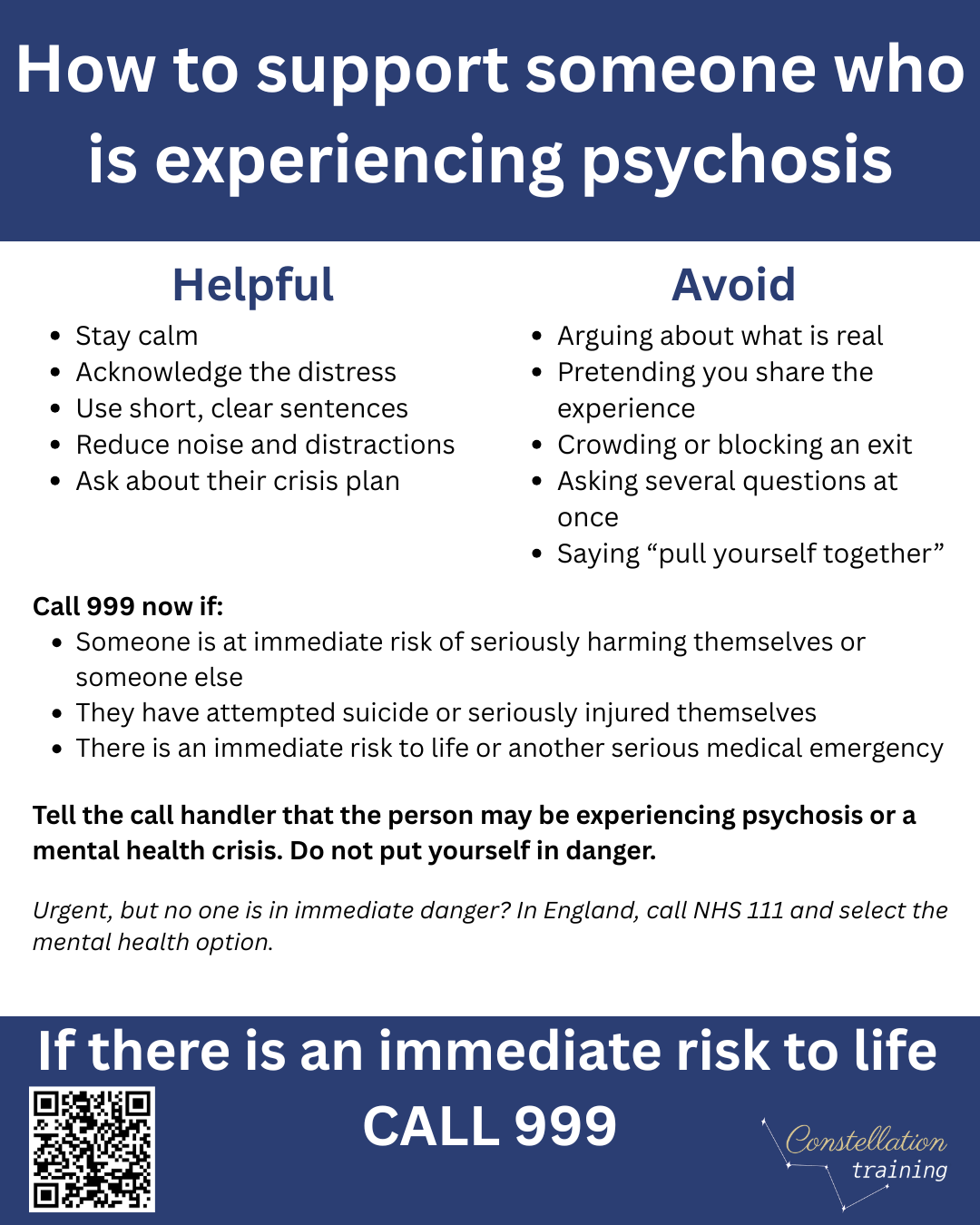
How to support someone who is experiencing psychosis
This is the section people actually need, and it is the one most articles skip. What follows applies whether you are a colleague, a friend, a family member or a trained mental health first aider.
Do not argue about whether the experience is real. Telling someone their voices are not real, or that nobody is following them, positions you as one more person who does not believe them, and it will not change the belief. The perception is genuinely happening as far as their brain is concerned.1
Do not pretend to share it either. Agreeing that you can also hear the voices is dishonest and tends to reinforce distress. The workable middle ground is to be truthful about your own experience while taking theirs seriously: you do not hear it yourself, you can see it is frightening, and you are staying with them.
Respond to the feeling rather than the content. Fear, exhaustion and isolation are real and can be addressed directly, whatever is causing them. Asking someone what would help right now is usually more productive than asking them to explain what they are experiencing.
Reduce the load on their attention. Turn down noise, reduce the number of people talking, use short sentences and plain language, and give them time to respond. Confused thinking makes complex conversation genuinely difficult.1 Standing too close or blocking an exit will increase fear rather than reduce it.
Ask about the crisis plan. Anyone under the care of a mental health service should have a care plan with a crisis section and emergency contact numbers.22 Asking whether they have a care coordinator, and offering to help them make the call, is one of the most useful things you can do.
Do not tell them to pull themselves together. The NHS explicitly advises against this, and against blaming the person or anyone else.22 Whatever it is intended to convey, it lands as contempt.
Look after yourself. Supporting someone through psychosis is genuinely hard, and carers have rights to assessment and support in their own right.6 Family therapy is part of the recommended treatment package and exists partly for your benefit, not only theirs.22
Do not underestimate the value of ordinary contact either. Isolation compounds every symptom on this list, and it is one of the few things that people around the person are uniquely well placed to address. We have written separately about loneliness and its effect on mental and physical health.
When to seek urgent help in England
Call 999 if someone’s life is at immediate risk, if they have seriously harmed themselves, or if there is an immediate risk of serious harm to another person. Ambulance services deal with mental health emergencies as a matter of routine.
For an urgent mental health crisis that is not immediately life-threatening, call NHS 111 and select the mental health option. Every area of England has a 24-hour urgent mental health helpline reachable this way. Arrangements differ in Wales, Scotland and Northern Ireland, so check your own nation’s crisis route in advance if you can. If the person is already under the care of a mental health team, their care plan will contain crisis contact details, and the crisis resolution and home treatment team is intended to be the single point of entry to acute services in the community.6
Suicide risk is raised in people with schizophrenia, and is higher after an acute episode or a hospital stay. The NHS lists a number of warning signs, including talking about death or suicide either directly or indirectly, making final arrangements such as giving away possessions or saying goodbye, self-harm, and a sudden unexplained lifting of mood after a period of being very low.22 If you see these, get professional help, tell the person they are not alone, and stay with them or arrange for someone else to.
Samaritans can be reached free on 116 123, at any time of day or night, from any phone.
Where mental health first aid fits, and where it does not
Mental health first aid is frequently oversold, and it is worth being blunt about its limits. A mental health first aider does not diagnose, does not provide therapy, does not manage medication, and is not a substitute for clinical care or for a functioning organisational support structure. Anyone selling it as any of those things is misrepresenting it.
What it does do is close a specific and consequential gap. Schizophrenia typically develops slowly, its early signs are ambiguous, and the people best positioned to notice a sustained change in someone are the people who see them regularly: colleagues, managers, friends and family. The interval between someone becoming unwell and someone acting is an important and potentially modifiable factor associated with outcome. Training gives people the confidence to notice, to open a conversation without making it worse, and to know where to escalate.
Constellation Training delivers the Ofqual-regulated FAA First Aid for Mental Health qualifications through Nuco Training. The awarding organisation is First Aid Awards Ltd, which is regulated by Ofqual and by SQA Accreditation, and the qualifications sit on the Regulated Qualifications Framework.29 These run at three levels. Level 1, delivered as a half-day awareness session, introduces common conditions, their signs and symptoms, and how to start a conversation. Level 2, delivered over one day, introduces the First Aid for Mental Health Action Plan and covers the effects of drugs and alcohol and how to support a positive mental health culture at work.30 Level 3, delivered over two days, is aimed at managers and supervisors and covers a wider range of conditions, including psychosis and schizophrenia specifically, along with the support pathways associated with them.31
Boundaries, confidentiality and escalation are core parts of the training rather than afterthoughts, and they are what keep both the first aider and the organisation safe. A first aider who does not know where their role ends is a risk to themselves and to the person they are trying to help.
If you want the longer view of how this discipline developed, and why the modern approach looks so different from what came before, we have written about the evolution of first aid for mental health, from asylums and institutionalisation to today’s evidence-based practice.
Where to get further information and support
● NHS – condition information, symptoms, treatment and self-care guidance at nhs.uk
● Rethink Mental Illness – information, advice, local services and a strong campaigning voice for people severely affected by mental illness, at rethink.org
● Mind – information and local Mind services across England and Wales, at mind.org.uk
● Hearing Voices Network – peer support groups for people who hear voices or have other unusual perceptions, at hearing-voices.org
● SANE – emotional support and specialist mental health information, at sane.org.uk
● Samaritans – free, 24 hours a day, on 116 123, at samaritans.org
The thing worth remembering
Schizophrenia is uncommon, treatable, and surrounded by a set of beliefs that are almost entirely wrong. The myths are not harmless. They contribute to people delaying seeking help, to people not telling their employer, and to a group of people with a treatable condition dying fifteen to twenty years early, largely from preventable physical illness rather than from psychosis itself.
Several practical ways of helping require no clinical expertise at all. Noticing that someone has gradually withdrawn. Saying something rather than waiting. Knowing that early intervention services exist and that the standard is for treatment to begin within two weeks of referral. Helping someone get to a physical health check. Not repeating the myths. These are ordinary acts, available to anyone, and they can materially improve the chance that someone gets timely, effective support.

Train your team to recognise and respond
Constellation Training delivers First Aid for Mental Health training in house, tailored to your workplace and the situations your people are realistically likely to face. Whether you need a half-day awareness session for a whole team, the one-day Level 2 qualification for designated first aiders, or the two-day Level 3 course for managers and supervisors, get in touch to discuss what would work for your organisation.
References
1. nhs.uk – Symptoms – Schizophrenia, NHS.
2. rethink.org – What is schizophrenia? Rethink Mental Illness.
3. psychiatryonline.org – Fusar-Poli P, Politi P. Paul Eugen Bleuler and the birth of schizophrenia (1908). American Journal of Psychiatry.
4. nice.org.uk – Psychosis and schizophrenia in adults: prevention and management (CG178), Context. NICE.
5. digital.nhs.uk – Adult Psychiatric Morbidity Survey, England 2023/4, Chapter 12: Psychotic Disorder. NHS England Digital.
6. nice.org.uk – Psychosis and schizophrenia in adults: prevention and management (CG178), Recommendations. NICE.
7. nhs.uk – Causes – Schizophrenia, NHS.
8. england.nhs.uk – Mental health access and waiting time standards. NHS England.
9. england.nhs.uk – Implementing the early intervention in psychosis access and waiting time standard. NHS England.
10. rcpsych.ac.uk – Clozapine for treatment-resistant schizophrenia: the case for timely and appropriate use (PS01/26). Royal College of Psychiatrists.
11. england.nhs.uk – Improving the physical health of people living with severe mental illness. NHS England.
12. kcl.ac.uk – Life expectancy gap for people with severe mental illness is a hidden health crisis, study finds. King’s College London.
13. digital.nhs.uk – Physical Health Checks for Severe Mental Illness: Supporting Information. NHS England Digital.
14. england.nhs.uk – NHS Oversight Framework 2026/27, Annex B, Domain 4. NHS England.
15. digital.nhs.uk – Physical Health Checks for People with Severe Mental Illness, Q4 2025-26. NHS England Digital.
16. digital.nhs.uk – Mental Health Act Statistics, Annual Figures 2024-25: Detentions, differences between groups of people. NHS England Digital.
17. cqc.org.uk – Monitoring the Mental Health Act in 2024/25: Inequalities. Care Quality Commission.
18. legislation.gov.uk – Mental Health Act 2025 (c. 33).
19. legislation.gov.uk – The Mental Health Act 2025 (Commencement No. 1) Regulations 2026 (SI 2026/385).
20. thelancet.com – People with severe mental illness as the perpetrators and victims of violence: time for a new public health approach. The Lancet Public Health.
21. manchester.ac.uk – Annual Report 2026: UK patient and general population data, 2013-2023. National Confidential Inquiry into Suicide and Safety in Mental Health, University of Manchester.
22. nhs.uk – Living with – Schizophrenia, NHS.
23. cambridge.org – Lally J et al. Remission and recovery from first-episode psychosis in adults: systematic review and meta-analysis of long-term outcome studies. British Journal of Psychiatry.
24. sciencedirect.com – The prognosis of schizophrenia: a systematic review and meta-analysis with meta-regression of 20-year follow-up studies. Schizophrenia Research.
25. nice.org.uk – Psychosis and schizophrenia in adults (QS80), Quality statement 5: Supported employment programmes. NICE.
26. england.nhs.uk – Individual placement and support for severe mental illness. NHS England.
27. legislation.gov.uk – Equality Act 2010, section 6: Disability.
28. legislation.gov.uk – Equality Act 2010, Schedule 1: Disability, supplementary provision.
29. firstaidawards.com – FAA qualifications, including the Awareness of First Aid for Mental Health, First Aid for Mental Health and Supervising First Aid for Mental Health awards. First Aid Awards Ltd.
30. nucotraining.com – Level 2 Award in First Aid for Mental Health. Nuco Training.
31. nucotraining.com – First Aid for Mental Health Instructor syllabus. Nuco Training.
About this article
This article is for general information and education. It is not medical advice and it is not a substitute for assessment, diagnosis or treatment by a qualified healthcare professional. If you are concerned about your own mental health or someone else's, speak to a GP or a mental health professional.
If someone's life is at immediate risk, call 999. For an urgent mental health crisis in England that is not immediately life-threatening, call NHS 111 and select the mental health option. Samaritans can be reached free on 116 123 at any hour, from any phone.
Constellation Training is a training provider, not a healthcare service. Our First Aid for Mental Health courses teach people to recognise signs, start a conversation and direct someone towards appropriate help. They do not qualify anyone to diagnose or treat a mental health condition.
Information was accurate at the date of publication. Clinical guidance and legislation change, and the sources cited carry the current position.