Sepsis: What Parents and Childcare Professionals Need to Know
Sepsis can develop rapidly in children following common infections. Here’s what parents and childcare professionals need to recognise, and when to seek urgent medical help

Sepsis can develop quickly in children, and its early signs look like ordinary illness. Here is what to watch for, and when to call 999.
Last updated 19 July 2026 using current NHS, NICE and NHS England guidance.
Important notice: This article is for general information only and does not constitute medical advice. It should not be used as a substitute for professional medical guidance, diagnosis or treatment. If you are concerned about symptoms, contact a qualified healthcare professional, call NHS 111, or in an emergency call 999.
Sepsis in children is uncommon, but when it happens, rapid recognition and treatment matter. A child can go from apparently mildly unwell to critically ill within hours, and the early signs look very like the everyday infections children pick up all the time.
The person who notices first is often not a doctor. It may be a parent, a childminder, a nursery practitioner or a teaching assistant: someone who knows how that child normally looks and behaves. This guide sets out what to look for, what to do, and what to say when you call for help.
This is the quick guide. For the full picture, including how sepsis is treated, who is most at risk and how Martha's Rule works, read our comprehensive guide to sepsis signs, symptoms and treatment.
What is sepsis?
Sepsis is the body's own response to an infection turning against it and beginning to damage its tissues and organs.1 It is not an infection in its own right. Sepsis itself is not contagious, although the infection that triggered it may be.
Almost any infection can trigger it: chest infections, urinary infections, infected cuts or insect bites, chickenpox, ear infections, and infections following surgery or birth. What matters is not how serious the original infection looked, but how the child's immune system responds to it. A previously healthy child can become critically ill from something that seemed minor.
Why is sepsis so hard to spot in children?
Because its early signs look almost identical to the ordinary illnesses children get every winter. Young children may not be able to describe their symptoms clearly, and babies cannot describe them at all.
Early sepsis can show up as tiredness, reduced appetite, being off their food, or simply not being themselves. None of that is unusual on its own, which is exactly why it gets missed.
The useful question is not whether the symptoms are common. It is whether this child is behaving in a way that worries you. If the illness feels out of proportion to what you would expect, act on that.
Does a child need a known infection before you act?
No. You do not need to know that a child has an infection before treating the warning signs below as an emergency.
Sepsis can follow an infection nobody has identified, or one that appeared to be clearing up. Waiting until you can point to a specific infection spends the time that matters most. If the signs are there, act on the signs.
When should you call 999 for a child?
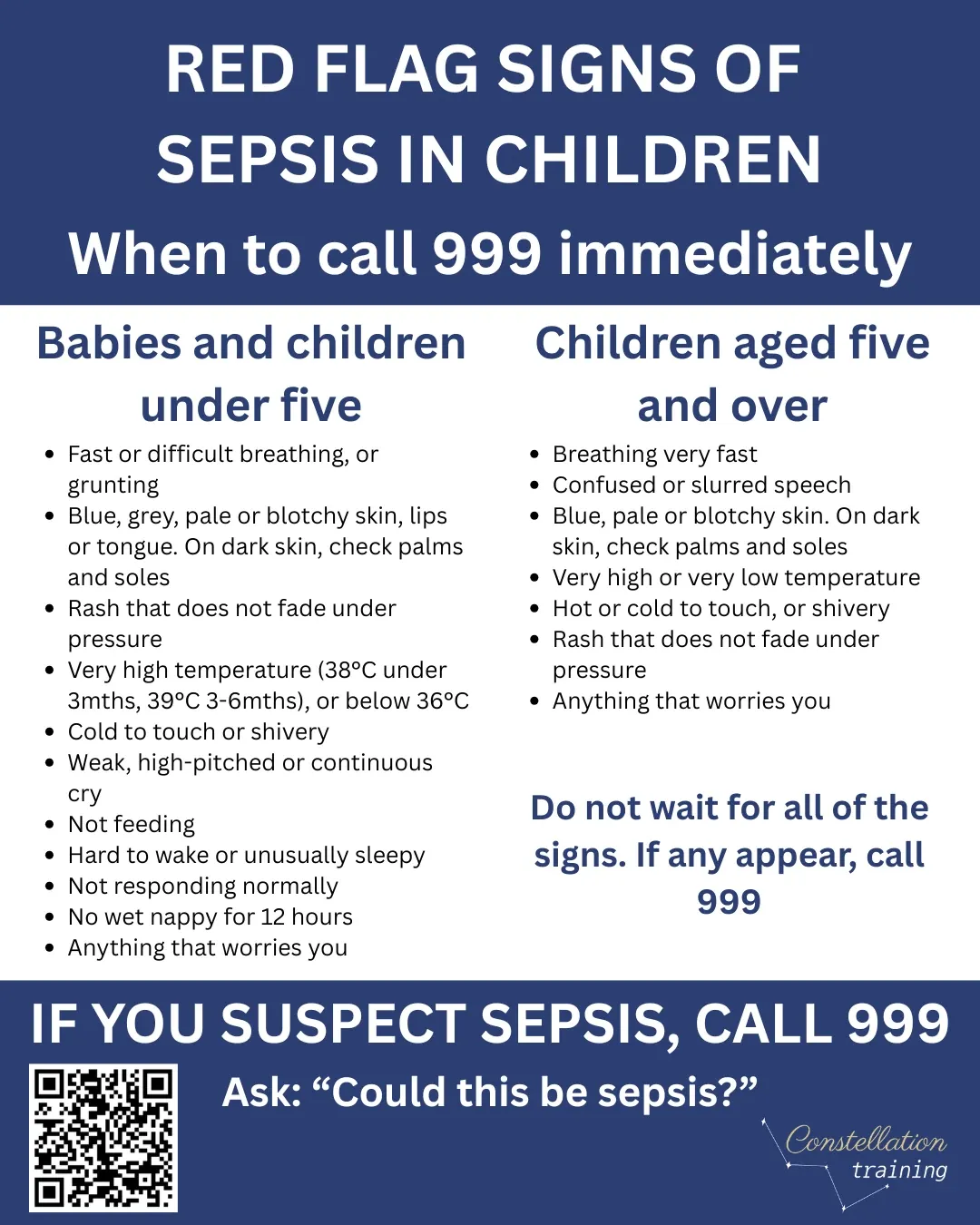
Call 999 or go straight to A&E if a child shows any one of the warning signs below. A child does not need to have all of them: one is enough.1
The NHS publishes two separate emergency lists, because sepsis presents differently in younger and older children.1
Babies and children under five
- Breathing very fast, or having difficulty breathing, which may show as grunting noises or the tummy sucking in under the ribcage
- Blue, grey, pale or blotchy skin, lips or tongue. On black or brown skin this may be easier to see on the palms of the hands and the soles of the feet
- A rash that does not fade when you press it
- A very high temperature (38°C or above in babies under three months, or 39°C or above at three to six months), or a very low temperature (below 36°C, or feeling cold to the touch or shivery)
- A weak, high-pitched or continuous cry
- Not responding as they normally would, not interested in feeding, difficult to wake, or more sleepy than usual
- No wet nappy, or not passing urine, for 12 hours
- Any symptom that makes you worried it could be sepsis
Children aged five and over
Older children are assessed against the same list the NHS uses for adults.1 Call 999 or go to A&E if the child:
- Is breathing very fast
- Is confused, has slurred speech, or is not making sense
- Has blue, pale or blotchy skin. On black or brown skin this may be easier to see on the palms of the hands and the soles of the feet
- Has a very high or very low temperature, or feels hot or cold to the touch or shivery
- Has a rash that does not fade when you press it
- Has any symptom that makes you worried it could be sepsis
The NHS also lists not passing urine all day as a possible symptom of sepsis in children aged five and over, though it does not appear on its emergency list for that age group.1 If the child is seriously unwell, or you are worried it could be sepsis, call 999 or go to A&E.
If you are on your own with a seriously unwell child, call 999 for an ambulance rather than driving them to A&E yourself. A child can deteriorate during the journey, and you cannot help them while you are driving.
Act now, not later
Do not wait to see whether the child improves overnight, and do not wait for a GP appointment. If any red-flag sign is present, get emergency help now: call 999 or go straight to A&E.
Can a child have sepsis without a high temperature?
Yes. Fever is common in sepsis but it is not universal, and some children with sepsis have a normal or an abnormally low temperature.1
A child who is abnormally cold is showing a red-flag sign rather than a reassuring one. For babies and children under five the NHS puts a figure on it, below 36°C; for children aged five and over it lists a very low temperature without giving a threshold. Relying on temperature alone will miss cases, and a temperature that comes down is not by itself evidence that a child is getting better.
Is a rash a reliable sign of sepsis?
No. A rash that does not fade under a glass is uncommon in sepsis, and a child can be seriously ill with sepsis and have no rash at all.1
The non-blanching rash most people associate with the glass test can be a sign of meningococcal disease, which is a medical emergency in its own right: if the marks stay visible through the glass, call 999. You can read more in our guide to meningitis, its symptoms and the vaccines that prevent it. A rash that does fade does not rule sepsis out, so do not wait for a rash before acting on the other warning signs.
What should you say when you call for help?
Say plainly that you are worried this could be sepsis, then describe what you have seen and how quickly it has changed.
The UK Sepsis Trust's public message is Just Ask: could it be sepsis?2 Naming your concern makes it explicit and helps staff understand why you are worried. It works alongside the detail rather than instead of it, so follow it with:
- What infection the child has, or recently had, if you know of one
- When the symptoms started
- How quickly they have changed
- Exactly what you have noticed
- Why this feels different from an ordinary illness
If you are caring for a child in a professional capacity, make sure you can reach their emergency contact details and any medical information your setting holds for them.
What should childcare staff do if a child deteriorates?
Recognise and escalate. You are not diagnosing sepsis, and you are not expected to.
Your role is to notice that a child is getting worse and to act on it:
- Act without delay rather than waiting to see whether things settle
- Call 999 as soon as any red-flag sign appears. This comes first
- Have a colleague contact the child's parents while the emergency call is being made, or contact them as soon as it is under way
- Escalate again if the child keeps deteriorating, even after they have been assessed
Do not wait to see whether a visibly deteriorating child settles. It is safer to seek emergency assessment and be reassured than to delay care for a child who turns out to be seriously ill. Recognising when a child is seriously unwell and knowing when to call 999 are core paediatric first aid skills, alongside the other emergencies childcare settings have to be ready for, such as anaphylaxis. In England, new statutory allergy-safety guidance now applies to state schools, and our guide sets out who it covers and what it requires.

Why early recognition matters
Prompt recognition and treatment are critical to surviving sepsis. In children, the people best placed to notice the change are the ones who see them every day.
A parent. A childminder. A nursery practitioner. A teaching assistant.
You do not need to work out whether it is sepsis. You need to notice that this child is more unwell than they ought to be, and to act on it without waiting.

Paediatric first aid, delivered in your setting
Constellation Training delivers accredited Paediatric and Early Years First Aid training in-house for nurseries, schools, childminders and other childcare settings, so staff have the confidence to recognise a seriously unwell child and act.
References
[1] NHS. Sepsis. nhs.uk Last reviewed 14 May 2026.
[2] UK Sepsis Trust. Spotting the Signs of Sepsis. sepsistrust.org Accessed 2026.
This article was written by Constellation Training, a UK provider of First Aid, Paediatric First Aid and Mental Health First Aid training.