
Supporting an Employee with Schizophrenia or Psychosis at Work
A practical guide for employers and managers on supporting an employee with schizophrenia or psychosis, including reasonable adjustments, absence, crisis response and return to work.

NICE estimates that only 5 to 15 per cent of people with schizophrenia are in employment.1 That is a severe employment gap, and it cannot be explained by capability alone. The gap reflects several factors: schizophrenia often begins in late adolescence or early adulthood and can disrupt education or an early career; symptoms may be misread as poor attitude; employees may not disclose because they fear different treatment; and employers may not understand their legal responsibilities.
This guide is for HR teams, line managers and anyone responsible for occupational health or absence management. It covers what the Equality Act actually requires, what adjustments work in practice, what to do if someone becomes acutely unwell at work, and where the common expensive mistakes are made.
It assumes some background. If you want the clinical picture first, our guide to schizophrenia symptoms, treatment and recovery covers symptoms, causes, treatment and recovery in depth.
Two notes on scope. This is general guidance, not legal advice, and disability discrimination cases turn heavily on their facts, so for any decision involving dismissal, capability proceedings or a settlement, take proper advice. And the legal framework described here is the position in Great Britain: the Equality Act 2010 does not extend to Northern Ireland, which has its own disability discrimination regime, while the clinical guidance and NHS services referred to are those in England.
Is schizophrenia a disability under the Equality Act 2010?
Often, but not automatically. The legal test is about the effect of the condition on the individual, not the diagnosis alone. Section 6 of the Equality Act 2010 defines a person as disabled if they have a physical or mental impairment that has a substantial and long-term adverse effect on their ability to carry out normal day-to-day activities.2 Schizophrenia will frequently satisfy that test, particularly once the recurrence and treatment provisions below are taken into account. Where it does, and a workplace arrangement places the employee at a substantial disadvantage, the employer may have a duty to make reasonable adjustments, subject to what it knew or could reasonably have been expected to know. Direct discrimination because of disability is unlawful, and employers must also avoid unjustified unfavourable treatment because of something arising from the disability, such as disability-related absence.
Substantial means more than minor or trivial. It is a low bar, not a high one. Long-term means the effect has lasted or is likely to last at least twelve months, or for the rest of the person's life.3
Note that the diagnosis itself is not the legal question. What matters is the effect of the impairment. A person with a formal diagnosis whose condition genuinely has no substantial effect may not be covered, and a person with no formal diagnosis at all may well be. ACAS advises employers to make adjustments even where the issue may not strictly amount to a disability, which is sensible risk management as well as decent practice.4
Does an employee whose symptoms are currently controlled still have protection?
Symptoms being controlled does not necessarily remove the employee's protection. Two rules in Schedule 1 to the Equality Act mean that someone may continue to meet the definition even when they are currently well.3
The recurrence rule. Where an impairment has had a substantial adverse effect and that effect stops, it is treated as continuing if it is likely to recur.3 Schizophrenia can be episodic or relapsing, although the pattern varies between individuals. An employee who has been well for several months may still be within the Act's protection, because the question is whether the substantial effect is likely to recur, not whether the person is symptomatic today.
The treatment rule. Where measures are being taken to treat or correct an impairment, the impairment is treated as having a substantial adverse effect if it would be likely to have that effect but for those measures.3 In plain terms, the effect of the medication is disregarded. An employee whose psychosis is well controlled by antipsychotics is assessed as though they were not taking them.
Taken together, these rules mean an employer should not assume that Equality Act protection has ended simply because an employee's symptoms are controlled or they are performing well. Consider the underlying and recurring effects of the condition, and take advice where the position is uncertain.
What the condition actually looks like at work
Managers should not focus only on acute symptoms such as hallucinations, delusions or obvious distress. At work, they may instead notice more gradual changes: withdrawal, reduced engagement, difficulty concentrating or a deterioration in self-care.
These gradual changes are what clinicians call negative symptoms: withdrawal from other people, taking no interest in everyday social interactions, appearing emotionless or flat, and a loss of interest in self-care.5 The NHS notes that they can sometimes be mistaken for deliberate laziness or rudeness.5
That is the failure mode to guard against. A manager watching an employee stop contributing in meetings, drop out of team social contact, become harder to reach and appear indifferent to feedback will, without training, usually reach for the performance management process. In some cases that is the right call. In others it is the beginning of a disability discrimination dispute and a missed opportunity to intervene before the situation escalates.
Concentration is also commonly affected. People with psychosis often struggle to hold a train of thought, follow complex conversation or read at length.5 Work that relies on sustained attention may be affected.
What warning signs should a manager actually notice?
A sustained and uncharacteristic change: a normally reliable person becoming withdrawn, a drop in work quality that does not respond to the usual support, increasing lateness or absence, visible changes in self-care, unusual suspiciousness about colleagues or about ordinary workplace processes, or an employee who seems distracted by something you cannot see or hear.
Two things make this list usable rather than alarming. First, the operative word is change. You are not looking for people who are quiet, or eccentric, or private. You are looking for a departure from that individual's usual baseline that is sustained, repeated or significant enough to cause concern. Second, none of this is diagnosis. A manager does not need to know whether they are seeing psychosis, depression, a bereavement or a divorce. The response at this stage is identical: notice, ask, and know where to refer.
Why employees do not disclose, and what that costs you
A 2021 Rethink Mental Illness survey of people severely affected by mental illness found that 86 per cent said fear of stigma or discrimination had stopped them doing things they wanted to do, including 61 per cent who had been deterred from applying for a job or a promotion. Eighty-eight per cent agreed that discrimination against people severely affected by mental illness is widespread in England.6
Those 2021 findings help explain why some employees may decide not to disclose a mental health condition at work. If you employ several hundred people, some of them may have a diagnosis you do not know about, and they may have concluded that telling you would cost them more than it gained them.
The less an employer understands about the difficulty, the harder it is to identify effective adjustments, intervene early and document appropriate support. The issue may otherwise emerge only during a crisis, a prolonged absence or an employment dispute, when the available options are narrower and the consequences more serious.
A policy document alone will not create disclosure. Employees also watch how the organisation treats people who have already spoken about their mental health.
Do we have to make adjustments if the employee has not told us?
Potentially, yes. The duty is engaged where the employer knows, or could reasonably be expected to know, that the person is disabled. An employer cannot rely on ignorance that reasonable enquiries would have removed.
That means where there are visible signs that an employee is struggling, the employer should follow up. ACAS guidance is clear that employers should remain observant and, where they suspect an individual may be experiencing a mental health problem, make enquiries about what difficulties they may have.4 An employee who does not consider themselves disabled, or who does not use that language, may still be covered.
This is precisely why manager training matters commercially and not just ethically. The knowledge test is applied to the organisation, and a manager who was never trained to notice is not a defence.
What reasonable adjustments can help an employee with schizophrenia?
Many useful adjustments are practical and relatively inexpensive, but they must be tailored to the individual. ACAS is explicit that there is no universal list, because every job, every person and every point in time is different, and mental health changes over time so an adjustment that works now may need revisiting.7 Some of the adjustments below, including reduced hours, paid appointment time and workplace changes, may carry a meaningful cost.
The ones that come up repeatedly in this context are:
- Predictable hours. Fixed shifts rather than rotating ones, and stable start times. Disrupted sleep is both a symptom and a trigger, and rotating shift patterns may make a regular sleep routine harder to maintain.
- Reduced or flexible hours. The NHS specifically identifies shorter or more flexible working as helpful, alongside avoiding excessive work-related stress.8
- A quieter working environment, a desk away from the busiest area, or, where safe and compatible with the role, permission to use noise-cancelling headphones. A quieter environment may help someone who finds background noise distracting or distressing, but this should be discussed with the individual rather than assumed.
- Written follow-ups to verbal instructions. Where concentration is affected, this removes a recurring failure point without costing anything.
- Flexibility for disability-related appointments. Antipsychotic treatment involves regular monitoring, and clozapine requires frequent blood tests. Requiring an employee to use annual leave for every disability-related appointment may place them at a disadvantage. Consider whether paid time off, disability leave or another arrangement would be reasonable in the circumstances.
- A named contact. One person who already knows the situation, so the employee does not have to re-explain themselves to a new manager every time something changes.
- A phased return after an episode, with a documented plan and review points rather than an open-ended arrangement nobody revisits.
- Adjusted absence triggers. Applying standard triggers without considering disability-related absence can create a discrimination risk.7
Record what you agreed, why, and when you will review it. An adjustment that is not recorded is harder to evidence, implement consistently and review.

Give your managers the confidence to have the conversation
Most of the failures described above are not policy failures. They are a line manager not knowing what to say. Constellation Training delivers Ofqual-regulated First Aid Awards (FAA) First Aid for Mental Health qualifications through the NUCO Training network, in-house, with scenarios contextualised to your workplace and risks so managers can apply what they learn. Request a training discussion.
Can we dismiss someone for absence caused by their condition?
It is possible but it is legally difficult.
Section 15 of the Equality Act creates a distinct form of unlawful treatment, discrimination arising from disability. It applies where a person is treated unfavourably because of something arising in consequence of their disability, and the employer cannot show the treatment to be a proportionate means of achieving a legitimate aim.9 Absence caused by a psychotic episode is a textbook example of something arising in consequence of a disability. So is reduced output during a period of illness.
Where section 15 applies, the employer must be able to show that the treatment was a proportionate means of achieving a legitimate aim. In practice that is far harder to establish where reasonable adjustments were never properly considered, where occupational health advice was not sought or was ignored, where absence triggers were applied mechanically, or where the process ran faster than the medical picture warranted.
The defensible position is a documented history of having identified the disability, considered adjustments seriously, implemented and reviewed them, obtained appropriate medical advice and considered it carefully (recording any reason for departing from it), and reached a proportionate decision only after all of that. The indefensible position is a manager applying a sickness absence policy to the letter without ever asking why the absences were happening.
Take advice before acting. This is the area where the cost of getting it wrong is highest.
Using occupational health properly
Occupational health is frequently misused in these cases, in two opposite directions.
The first misuse is treating an OH report as a verdict on whether the employee is disabled. It is not. Disability status under the Equality Act is a legal question for a tribunal, not a clinical one, and an OH adviser saying they do not consider the employee disabled will not protect you if a tribunal disagrees.
The second misuse is asking uselessly broad questions. “Is this employee fit to work?” produces an answer you cannot act on. Better questions are specific and functional: which duties are currently affected and how; what adjustments would allow those duties to be performed; what is the likely timescale; what should trigger a review; and is there anything about the working pattern that is making things worse.
Involve the employee in the process. Explain the purpose of the referral and the questions you intend to ask, invite their input, and be clear about how the report, their consent and confidentiality will be handled. They usually understand what helps them better than anyone in the room, and involving them turns a process that can feel like surveillance into one that feels like support.
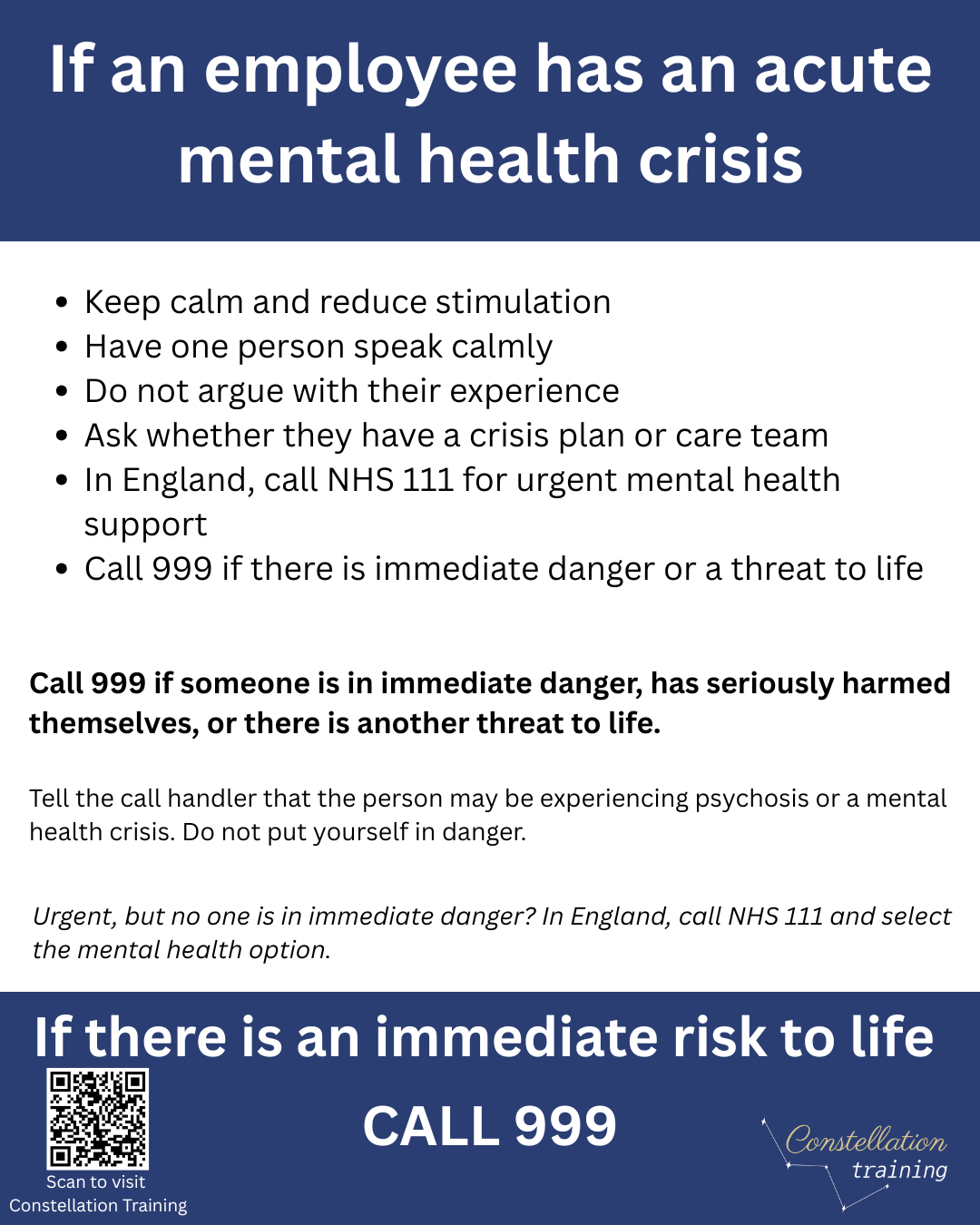
What should a manager do if an employee becomes acutely unwell at work?
Keep them safe, reduce the stimulation around them, stay calm, do not argue with what they are saying, and get clinical help involved rather than trying to manage it yourself.
In more detail:
- Move to a quieter space if the person is willing, but do not corner them or block an exit. Feeling trapped escalates fear.
- Have one person talk to them, not three. Use plain language and short sentences, and allow time for a response.10
- Do not tell them their experience is not real, and do not pretend to share it. Both can increase distress. Be honest that you do not hear or see it yourself, take their distress seriously, and stay with them.10
- Ask whether they are under the care of a mental health team and whether they have a crisis plan or a care coordinator. If they do, that is the fastest route to appropriate help.
- For an urgent crisis that is not immediately life-threatening, NHS 111 has a mental health option that connects to local 24-hour urgent mental health support in England.11
- Call 999 if there is an immediate risk to life or of serious harm.11
- Afterwards, offer appropriate support or an operational debrief to colleagues who witnessed the incident, while protecting the employee's confidentiality and sharing only what is necessary.
Treat the immediate incident first as a health and safety event, not as misconduct. Any later employment process must consider the medical evidence, the Equality Act and the individual circumstances.
Managing the return to work after an episode
Return to work is where good intentions most often unravel, usually because the plan is either too vague or too rigid.
A workable return-to-work conversation covers what the employee wants colleagues to know and what they want kept private, which duties they want to pick up first and which to defer, what hours they will start on and how they will build up, what the review points are and who owns them, and what the early warning signs are that things are slipping.
That last item is worth pressing on gently. Many people who have had a psychotic episode can describe their own relapse signature: the specific things that happen first when they are becoming unwell. Common ones include disturbed sleep, loss of appetite, rising anxiety, becoming suspicious or fearful, and difficulty concentrating.8 If an employee is willing to share theirs and to agree in advance what should happen if you notice it, you have something far more useful than any policy.
Resist the urge to protect someone by removing all their responsibility. Work is not the enemy here. For many people, suitable work can support recovery, routine and social connection, and being visibly side-lined after an episode is one of the surest ways to lose an employee you have already invested in.
External funding and specialist employment support
Two things exist that most employers do not use.
Access to Work is a government scheme that can fund practical support for disabled people and people with health conditions to get or stay in work, including support relating to mental health. It does not pay for reasonable adjustments you are already legally required to make, but it can contribute to additional costs beyond that duty.12 One caveat matters in practice: waiting times are long. In June 2026 the Public Accounts Committee reported that the Department for Work and Pensions was telling applicants they might wait up to 37 weeks for a decision, against a target of 25 working days.13 Apply early and do not build a return-to-work plan that depends on the funding arriving by a particular date.
Individual Placement and Support embeds employment specialists inside NHS community mental health teams. It works on the principle of getting people into real, competitive, paid work quickly and then supporting them in it, rather than a long pre-employment training phase. NICE recommends offering supported employment programmes to people with psychosis or schizophrenia who want to work.14 NHS England reports that research comparing IPS with other vocational services across six European countries found it achieved twice the rate of job outcomes, and that IPS clients have reduced relapse rates and spend fewer days in hospital.15
If you are recruiting, IPS services will work with employers directly. It is a route to candidates that most organisations never consider.
What about employees who are caring for someone with schizophrenia?
They have a day-one statutory right to a week of unpaid carer's leave in each rolling twelve-month period, under the Carer's Leave Act 2023 and the Carer's Leave Regulations 2024, which came into force on 6 April 2024. The leave can be taken in half days or full days, up to a whole week at once, and it carries the same protections as other forms of family-related leave, including protection from detriment and dismissal for taking it.16,17
This matters more than the headline suggests. Family members supporting someone with a psychotic illness are often coordinating appointments, attending assessments, managing crises and absorbing a great deal of stress, largely invisibly. In England, the Care Act 2014 also gives carers the right to request a carer's assessment from their local authority, which many do not know about.18
A week of unpaid leave is a floor, not a ceiling. Employers who add flexibility on top of it, whether through paid carer's leave, flexible working or simply not making people explain themselves twice, retain experienced staff that competitors lose.
How this connects to your health and safety duties
Mental health is not a separate wellbeing initiative sitting alongside health and safety. Under the Health and Safety at Work etc. Act 1974 and the Management of Health and Safety at Work Regulations 1999, employers have a legal duty to assess risks to workers' health, and the HSE is explicit that this includes assessing the risk of stress and its impact on mental and physical ill health in the same way as any other work-related risk.19
The HSE Management Standards set out six areas of work design that need to be actively managed: demands, control, support, relationships, role and change.20 Several of these bear directly on the situation described in this guide. Unpredictable demands and low control are precisely the conditions that make a fluctuating mental health condition harder to manage. Poor support and unclear role definition are what turn a manageable difficulty into an absence.
One line in the HSE's own guidance is worth putting to anyone who thinks this is optional: employers are advised to check that their first aid needs assessment considers mental health needs as well as physical ones.19 If your first aid needs assessment has never mentioned mental health, that is a gap worth reviewing and correcting.
We have covered this ground in more detail in our guide to the HSE Management Standards and workplace stress and in our practical guide to workplace stress for UK employers.
Where training fits
Trained mental health first aiders do not diagnose, treat or manage anyone's condition. What they do is notice change, open a conversation without making it worse, and know where to escalate, which is exactly the capability gap this guide describes. Constellation Training delivers the Level 3 Supervising First Aid for Mental Health qualification for managers and supervisors, covering psychosis and schizophrenia specifically, alongside Level 2 for designated first aiders and Level 1 awareness sessions for wider teams.
What good looks like
If you want a short checklist to test your own organisation against, an employer handling this well can answer yes to all of the following.
- Line managers have been trained to recognise a sustained change in an employee and to open a conversation about it.
- There is a written record of adjustments agreed, the reason for them, and a review date.
- Absence triggers are capable of being modified where absence is linked to a disability, and managers know they have that discretion.
- Occupational health referrals ask functional questions, and the employee is involved in framing them.
- Someone in the organisation knows what to do if an employee becomes acutely unwell on site, and that is not improvised on the day.
- The first aid needs assessment considers physical and mental health needs.
- Employees who have disclosed a mental health condition have not subsequently been quietly sidelined, and you could demonstrate that if asked.
The last one is the real test. Everything else is process. That one is culture, and it is the thing your workforce is actually assessing when they decide whether to tell you anything.
References
1. nice.org.uk. Psychosis and schizophrenia in adults (QS80), quality statement 5: supported employment programmes. NICE.
2. legislation.gov.uk. Equality Act 2010, section 6: disability.
3. legislation.gov.uk. Equality Act 2010, Schedule 1: disability, supplementary provision.
4. acas.org.uk. Mental health adjustments. ACAS.
5. nhs.uk. Symptoms, schizophrenia. NHS.
6. rethink.org. Survey on discrimination experienced by people severely affected by mental illness, 2021. Rethink Mental Illness.
7. acas.org.uk. Reasonable adjustments at work. ACAS.
8. nhs.uk. Living with, schizophrenia. NHS.
9. legislation.gov.uk. Equality Act 2010, section 15: discrimination arising from disability.
10. mind.org.uk. Helping someone who is experiencing psychosis. Mind.
11. nhs.uk. Where to get urgent help for mental health. NHS.
12. commonslibrary.parliament.uk. The Access to Work scheme for disabled people. House of Commons Library.
13. publications.parliament.uk. The Access to Work scheme. Committee of Public Accounts, June 2026.
14. nice.org.uk. Psychosis and schizophrenia in adults: prevention and management (CG178), recommendations. NICE.
15. england.nhs.uk. Individual placement and support for severe mental illness. NHS England.
16. legislation.gov.uk. Carer's Leave Act 2023 (c. 18).
17. legislation.gov.uk. The Carer's Leave Regulations 2024 (SI 2024/251).
18. scie.org.uk. Care Act factsheet 4: legal duties for a carer's assessment. SCIE.
19. hse.gov.uk. Work-related stress and how to manage it: stress risk assessment. Health and Safety Executive.
20. hse.gov.uk. What are the Management Standards? Health and Safety Executive.
About this article
This article is general guidance. It is not legal advice and it is not medical advice. Disability discrimination and employment cases turn heavily on their individual facts, and outcomes vary accordingly. Take professional advice before any decision involving dismissal, capability proceedings or settlement.
Constellation Training is a training provider. We are not a law firm and not a healthcare service.