Sepsis: Signs, Symptoms and What to Do (UK Guide for Parents and Carers)
Sepsis affects around 245,000 people in the UK each year and can become life-threatening within hours. This in-depth guide explains the signs in adults and children, when to call 999, and what action to take.
What it is, how to spot it, and what to do when every minute counts
Need the quick 'Red Flag' checklist for an emergency or childcare setting? View our Quick Guide to Sepsis Signs for Parents
Introduction
Sepsis is estimated to take around 48,000 lives a year in the United Kingdom, more than breast, bowel, and prostate cancer combined. [1] According to the UK Sepsis Trust, approximately 245,000 cases occur in the UK each year. [1] The UK Sepsis Trust and NHS materials have argued that thousands of these deaths are avoidable with faster recognition and treatment, with some estimates suggesting around 10,000 lives a year could be saved. [1][4] That figure represents thousands of people each year whose lives could be preserved if the people around them, family members, colleagues, childcare workers, members of the public, knew what to look for and acted quickly.
For parents and childcare professionals, this knowledge is not optional. Every year, around 25,000 children are admitted to hospital with sepsis in the UK. [7] The signs in babies and young children differ from those in adults and can be alarmingly easy to mistake for common childhood illnesses. A child with sepsis can deteriorate from appearing mildly unwell to being critically ill in a matter of hours.
This article provides a comprehensive guide to understanding sepsis: what it is, how it develops, the warning signs across different age groups, and the specific actions you should take if you suspect someone is developing sepsis. It also examines the tragic cases that have driven improvements in how the NHS responds to the condition, and what those changes mean for you as a parent, carer, or concerned member of the public.
What is Sepsis?
Sepsis is a life-threatening condition that occurs when the body’s immune system responds to an infection in a way that damages its own tissues and organs. [2] It is not an infection itself, it is the body’s catastrophic overreaction to an infection. Any infection can trigger sepsis, including common ones such as chest infections, urinary tract infections, wound infections, and even insect bites that become infected.
Under normal circumstances, when bacteria, viruses, or fungi enter the body, the immune system mounts a proportionate response: white blood cells are mobilised, inflammation occurs at the site of infection, and the immune system works to contain and destroy the invading organisms. In sepsis, this process goes disastrously wrong. The immune system essentially overreacts, releasing chemicals into the bloodstream that trigger widespread inflammation throughout the body rather than just at the site of infection.
This systemic inflammation damages blood vessels, causes blood pressure to drop, impairs blood flow to vital organs, and triggers abnormal clotting. Without treatment, this cascade leads to septic shock, dangerously low blood pressure that starves organs of oxygen, followed by organ failure and death.
It is critical to understand that sepsis is not contagious. You cannot “catch” sepsis from another person. However, the infections that can lead to sepsis are often contagious, which is why good hygiene and prompt treatment of infections remain essential preventive measures. [2]
The Distinction That Matters
The terms sepsis, septicaemia, and blood poisoning are often used interchangeably in everyday conversation, but they are not the same thing. Septicaemia refers specifically to bacteria multiplying in the bloodstream. Sepsis is broader; it describes the body’s overwhelming and damaging response to any infection, whether or not bacteria are present in the blood. This distinction matters because sepsis can develop from a localised infection that has not entered the bloodstream, and waiting for “blood poisoning” symptoms can mean waiting too long.
A Brief History of Sepsis
The word “sepsis” has ancient origins. It derives from the Greek sēpsis (σήψις), linked to sēpō, meaning “to make rotten,” and was first used in a medical context by Hippocrates around 400 BC. [8][9] In his Corpus Hippocraticum, Hippocrates described sepsis as a dangerous biological decay that could occur within the body. The term appears even earlier in Homer’s Iliad, making it one of the oldest medical concepts still in use today, over 2,700 years of recorded history. [8]
For centuries after Hippocrates, the understanding of sepsis advanced very little. The Roman physician Galen theorised that the formation of pus was actually beneficial to healing, an idea that persisted for roughly 1,500 years. [9] It was not until the 19th century that the true nature of sepsis began to be understood, driven by a series of ground-breaking and often tragic discoveries.
In 1847, the Hungarian obstetrician Ignaz Semmelweis made one of the most important observations in medical history. Working at the maternity clinic of Vienna General Hospital, he noticed that women delivered by medical students who had come directly from performing autopsies died of puerperal fever (childbed fever, a form of sepsis) at dramatically higher rates than those delivered by midwives. When Semmelweis introduced a policy requiring hand washing with chlorinated lime solutions, mortality from puerperal fever dropped from over 10% to below 3%. [9]
Semmelweis was ridiculed by the medical establishment for his findings. He was eventually dismissed from his position and died in a psychiatric institution in 1865, ironically, from a wound infection that progressed to sepsis. His work was only vindicated years later when Louis Pasteur’s germ theory and Joseph Lister’s antiseptic surgical techniques confirmed everything Semmelweis had observed. [9]
Lister, working at Glasgow Royal Infirmary in the 1860s, found that roughly half of all amputees in his surgical division died of sepsis. By using carbolic acid to sterilise surgical instruments and clean wounds, he dramatically reduced mortality. Unlike Semmelweis, Lister succeeded in persuading his peers, and antiseptic surgery became standard practice. [9] Alexander Fleming’s discovery of penicillin in 1928 provided the next major breakthrough, giving doctors a direct weapon against the bacterial infections that cause sepsis.
The modern clinical definition of sepsis has evolved through several consensus conferences. The most recent, Sepsis-3, published in 2016, defined sepsis as “life-threatening organ dysfunction caused by a dysregulated host response to infection.” [10] This definition shifted the emphasis from simply having an infection with inflammation to the presence of organ dysfunction, reflecting the understanding that it is the body’s own response, not just the infection, that makes sepsis lethal.
Who is at Risk?
Anyone can develop sepsis from any infection. However, certain groups face significantly higher risk:
- Babies under one year, particularly premature babies and new-borns, whose immune systems are immature
- Children under five years, especially those who have not completed their full vaccination schedule
- Adults over 75 years, ONS data shows the percentage of sepsis patients aged 75 and over has risen from 32.4% to 52.5% over recent decades [11]
- People with weakened immune systems, including those undergoing chemotherapy, taking immunosuppressant drugs, or living with conditions such as HIV
- People with chronic conditions such as diabetes, kidney disease, liver disease, or lung disease
- Anyone who has recently had surgery or has wounds, burns, or indwelling medical devices such as catheters or drips
- Pregnant women and those who have recently given birth, particularly after caesarean sections or prolonged labour
- People from socioeconomically deprived backgrounds, who research from the University of Manchester has shown are almost twice as likely to die from sepsis [4]
For parents of healthy children, it is essential to understand that sepsis does not only affect those with underlying conditions. A perfectly healthy child can develop sepsis from an ear infection, a case of chickenpox, or a cut that becomes infected. The key factor is not the severity of the initial infection but how the child’s immune system responds to it.
Common Infections That Can Lead to Sepsis
The NHS estimates that around 70% of sepsis cases originate in the community rather than in hospitals. [2][4] The infections that most commonly trigger sepsis include pneumonia and chest infections, urinary tract infections, abdominal infections (including appendicitis and peritonitis), skin and wound infections (including cellulitis and infected cuts or bites), meningitis, and bone or joint infections. In children, viral infections are extremely common and do not typically lead to sepsis. However, bacterial infections, which can sometimes develop secondary to a viral illness, can trigger a septic response.
Recognising Sepsis: The Signs That Demand Action
Sepsis is notoriously difficult to spot. Its symptoms can mimic common illnesses such as flu or chest infections, and there is no single definitive sign. This is precisely why awareness matters so much: recognising the pattern of symptoms and acting on instinct when something does not feel right can be the difference between life and death.
The UK Sepsis Trust and NHS have developed clear guidance on the warning signs. These differ between adults and children, and between older and younger children.
Signs of Sepsis in Adults
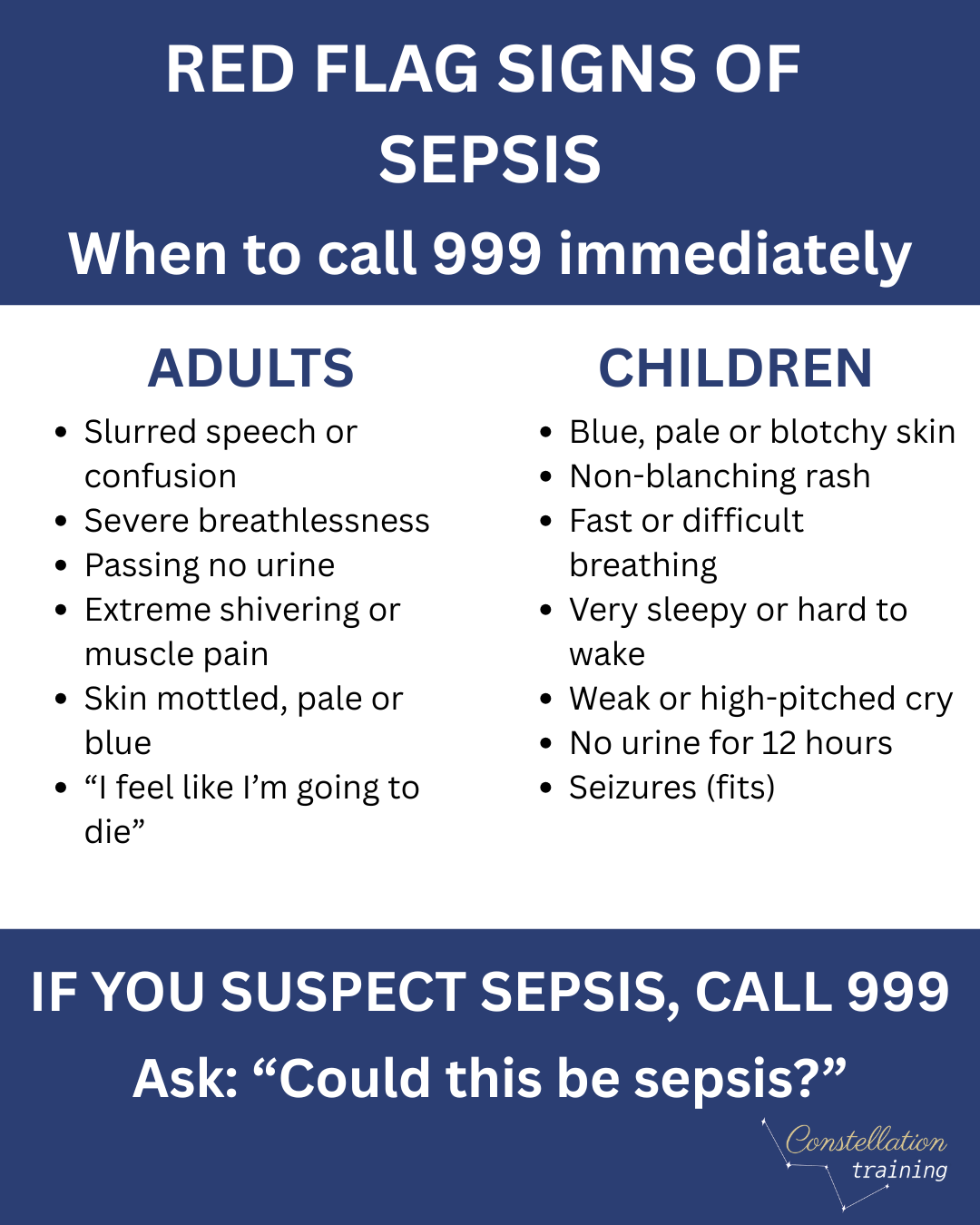
The UK Sepsis Trust uses the mnemonic SEPSIS to help the public remember the six red flag symptoms in adults. [1] If a person has an infection and develops one or more of the following, call 999 or go to A&E immediately:
• S, Slurred speech or confusion
• E, Extreme shivering or muscle pain
• P, Passing no urine (in a day)
• S, Severe breathlessness
• I, “It feels like I’m going to die”
• S, Skin mottled, ashen, blue, or very pale
That fifth item on the list, the subjective feeling of impending death, may sound vague, but it is clinically significant. People developing sepsis frequently describe an overwhelming sense that something is seriously, catastrophically wrong. If someone with an infection tells you they feel like they are dying, take it at face value. That instinct may be the most important diagnostic tool available.
On darker pigmented skin, colour changes such as mottling, pallor, or a bluish tinge may be easier to see on the palms of the hands, the soles of the feet, the inside of the forearms, or the inside of the lips and around the eyes. [1][2] This is an important consideration in any diverse setting.
Signs of Sepsis in Babies and Young Children
Recognising sepsis in babies and young children is harder than in adults because small children cannot articulate what they are feeling, and many sepsis symptoms overlap with common childhood illnesses. The NHS advises going straight to A&E or calling 999 if a baby or young child shows any of the following: [2]
• Blue, grey, pale, or blotchy skin, lips, or tongue, on brown or black skin, check the palms of the hands and soles of the feet
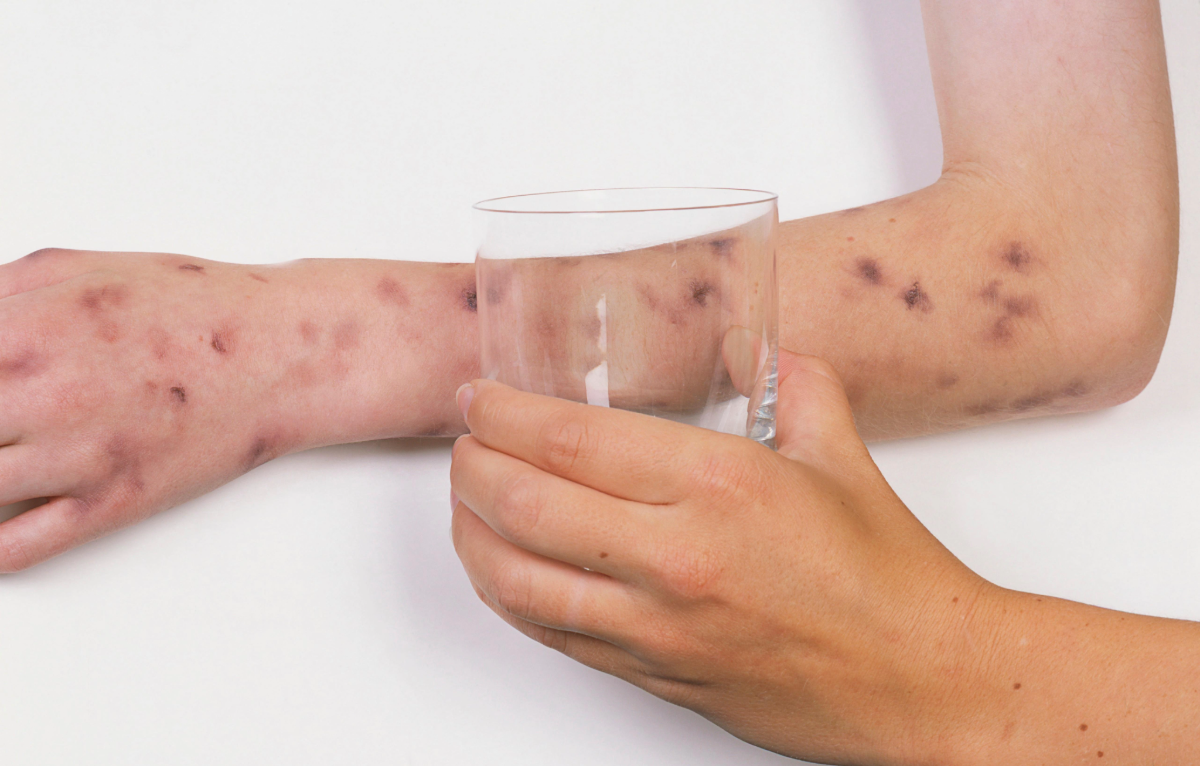
• A rash that does not fade when you roll a glass over it (the same glass test used for meningitis)
• Difficulty breathing, you may notice grunting noises, their stomach sucking in under their ribcage, or breathing that is much faster than normal
• A weak, high-pitched cry that is not like their normal cry
• Not responding as they normally would, or showing no interest in feeding or normal activities
• Being unusually sleepy or difficult to wake
• Feeling abnormally cold to the touch
• Appearing floppy or limp
• Not passing urine for 12 hours or more (no wet nappies)
A critically important point for childcare professionals: a child does not need to have all of these symptoms. A single red flag symptom in the context of an infection is enough to warrant emergency action.
If you are a nursery practitioner or childminder, we have a specialized checklist for childcare settings that covers these red flags in a condensed format.
Temperature: A Common Misconception
Many people associate sepsis exclusively with a very high temperature. While fever is common, it is not universal. Some people with sepsis, particularly the very young, the elderly, and those with compromised immune systems, may have a normal or even abnormally low temperature. In babies under three months, a temperature over 38°C should always prompt urgent medical assessment. In babies aged three to six months, a temperature over 39°C is a concern. But a child who is abnormally cold, with a temperature below 36°C, may also be showing signs of sepsis. [2][3] Relying on temperature alone will miss cases.
The Glass Test
The glass test (tumbler test) is well known as a check for meningitis, but it is equally relevant in suspected sepsis. Press the side of a clear glass firmly against the rash. If the rash does not fade under pressure and you can still see the spots through the glass, this is a non-blanching rash and requires immediate emergency action. However, in the early stages, a sepsis-related rash may still fade under pressure. If you are concerned about a rash alongside other symptoms, do not wait for it to become non-blanching before seeking help. [2]
What to Do If You Suspect Sepsis
Act immediately. Do not wait to see if things improve. Sepsis can progress from early symptoms to organ failure in a matter of hours.
Step 1: Call 999 or Go Directly to A&E
If you see any of the red flag symptoms described above in someone who has, or recently had, an infection, call 999 or take them straight to A&E. Do not call 111 for red flag symptoms. Do not wait for a GP appointment. Time is the critical factor in sepsis survival.
Step 2: Say the Words “Could This Be Sepsis?”
The UK Sepsis Trust’s campaign message is “Just Ask: Could it be Sepsis?” [1] This is not just a public awareness slogan. When you arrive at A&E or when the paramedics arrive, explicitly say: “I am concerned this could be sepsis.” These words act as a clinical trigger. NHS staff are trained to escalate suspected sepsis rapidly. [3] Simply describing individual symptoms without connecting them to sepsis may result in a slower response.
Step 3: Describe What You Have Observed
Provide as much specific information as you can about what infection the person has (or recently had), when symptoms began, how quickly they have changed, what specific symptoms you have noticed (refer to the lists above), and any relevant medical history, allergies, or current medications. For children in your care in a professional capacity, ensure you have access to their emergency contact details and any relevant medical information held by your setting.
Step 4: Do Not Leave Them Alone
Stay with the person while waiting for help. Sepsis can cause rapid deterioration, including loss of consciousness. Monitor their breathing, skin colour, and level of responsiveness. If they lose consciousness, place them in the recovery position. If they stop breathing, begin CPR.
If You Are Unsure
If a person has an infection but you are not seeing the red flag symptoms, yet something still does not feel right, call NHS 111 or contact your GP urgently. Explain your concerns clearly and mention sepsis specifically. Trust your instincts. The NHS guidance is unequivocal on this point: you know the person you are caring for better than anyone, and if you think they are more unwell than you would expect, act on that concern. [2]
For childcare workers, this means applying the same standard you would to your own children. If a child in your care is unwell with an infection and you notice changes in their behaviour, feeding, alertness, or appearance that concern you, contact the parents and seek medical advice simultaneously. Do not adopt a “wait and see” approach with a child who is visibly deteriorating.
Martha’s Rule: When Concerns Are Not Being Heard
In the summer of 2021, thirteen-year-old Martha Mills fell off her bicycle during a family holiday in Wales, sustaining a laceration to her pancreas. She was admitted to King’s College Hospital in London for treatment. During her hospital stay, Martha developed sepsis. Her parents, Merope Mills and Paul Laity, repeatedly raised concerns about Martha’s deteriorating condition, but their observations were dismissed by the clinical team. Martha’s mother expressly warned that she feared her daughter would die of septic shock. The liver team responsible for Martha’s care kept her on the ward rather than transferring her to intensive care. Martha died six days after developing sepsis. A coroner later ruled that she would probably have survived had she been moved to intensive care earlier. [6]
Martha’s parents campaigned relentlessly for change. NHS England began rolling out Martha’s Rule in 2024. Following results from the first year, it was expanded so that all 210 acute inpatient sites in England would offer it. [6] The rule gives patients, families, carers, and staff access to a rapid review from a critical care outreach team if they are concerned about a patient’s deteriorating condition, available 24 hours a day, seven days a week.
Martha’s Rule matters for anyone reading this article. If someone you care for is in hospital and you believe they are deteriorating, you have the right to escalate your concerns. In hospitals where Martha’s Rule is operating, you can contact the critical care outreach team directly. The message from Martha’s parents is clear: “Lives are saved when patients and families are given power to act on their suspicions when they feel doctors might have got it wrong.” [6]
In the first year of rollout (September 2024 to June 2025), there were 4,906 calls, most made by families. NHS England reported 241 potentially life-saving interventions, and wider reporting suggests hundreds more calls led to changes in care, such as new medications or escalation to a higher level of monitoring. [6]
How is Sepsis Treated?
Sepsis is treated as a medical emergency. The NHS and the UK Sepsis Trust advocate the “Sepsis Six”, a bundle of six evidence-based interventions that must be delivered within one hour of sepsis being suspected. [1][3] Compliance with the Sepsis Six has been associated with approximately a 46.6% relative reduction in the risk of death in some analyses, when delivered promptly. [4]
The Sepsis Six comprises three diagnostic measures (taking blood cultures, measuring blood lactate levels, and monitoring urine output) and three treatment measures (administering intravenous antibiotics, giving intravenous fluids, and providing supplemental oxygen if needed). [1][3] These are actions taken by clinical staff in hospital, they are not something the public can or should attempt. Your role is to get the patient to hospital as quickly as possible so that these interventions can begin.
In severe cases, patients may require admission to intensive care for organ support, including mechanical ventilation, vasopressor drugs to maintain blood pressure, and in some cases, dialysis for kidney failure. Recovery time varies enormously depending on the severity of the episode and the speed of treatment.
Post-Sepsis Syndrome
Survival is not the end of the story. Up to 40% of sepsis survivors experience ongoing physical, psychological, or cognitive effects known as post-sepsis syndrome. [1] Symptoms can include chronic fatigue, muscle weakness and joint pain, poor concentration and memory difficulties, anxiety, depression, and post-traumatic stress disorder, reduced organ function, and increased susceptibility to future infections. Research has noted overlaps in symptom patterns between post-sepsis syndrome and long COVID, including fatigue, muscle pain, poor sleep, and cognitive difficulties. [4]
Prevention
Sepsis cannot always be prevented, but the infections that trigger it often can be. Practical preventive measures include keeping up to date with vaccinations (for children and adults), practising good hand hygiene, cleaning and properly treating cuts, grazes, and wounds, seeking prompt medical treatment for infections rather than waiting to see if they resolve on their own, completing prescribed courses of antibiotics, and being aware that infections following surgery, childbirth, or invasive medical procedures carry particular risk. [2][3]
For childcare settings, this means maintaining rigorous hygiene standards, ensuring that children’s vaccination records are current, and having clear policies for when children who are unwell should be excluded from the setting and when parents should be advised to seek medical attention.
Why This Knowledge Matters
The statistics on sepsis tell a story of a condition that is both devastatingly common and consistently under-recognised. In England, the 2023–24 financial year saw 119,911 hospital admissions with a primary diagnosis of sepsis, the majority emergencies. [4] In England and Wales, deaths where sepsis was recorded as the underlying cause rose from 2,630 in 2018 to 4,276 in 2023. [5] The sepsis-coded hospital admission rate in England has increased 7.5-fold since 1998. [11]
Yet for all these numbers, the single most important factor in sepsis outcomes remains the same one that Semmelweis identified in 1847: human awareness and timely action. The difference between a good outcome and a catastrophic one is often measured in hours, and those hours are frequently in the hands of the people closest to the patient, parents, carers, childcare workers, colleagues, and friends.
If this article achieves one thing, let it be this: the next time someone you care for has an infection and something does not feel right, you will remember the signs, you will ask the question, “Could this be sepsis?”, and you will act without hesitation.
References
[1] UK Sepsis Trust, About Sepsis, Spotting the Signs, and References & Sources. Available at: sepsistrust.org/about-sepsis (accessed 2025).
[2] NHS, Sepsis: Symptoms, Treatment and Recovery. Available at: nhs.uk/conditions/sepsis (last reviewed June 2024).
[3] National Institute for Health and Care Excellence (NICE), Guideline NG51: Suspected Sepsis: Recognition, Diagnosis and Early Management. Published July 2016, last updated March 2024.
[4] House of Commons Library, Sepsis Awareness. Research Briefing CDP-2024-0122. Updated January 2025.
[5] Office for National Statistics, Deaths Involving Sepsis, England and Wales: 2001 to 2023. Published 3 June 2024.
[6] NHS England, Martha’s Rule. Available at: england.nhs.uk/patient-safety/marthas-rule. See also: NHS England, “Martha’s Rule Rolled Out to All Acute Hospitals,” September 2025.
[7] Sepsis Research FEAT, Sepsis in Children. Available at: sepsisresearch.org.uk/sepsis-in-children (accessed 2025).
[8] Geroulanos, S. and Douka, E.T. (2006) ‘Historical Perspective of the Word “Sepsis.”’ Intensive Care Medicine, 32(12), pp. 2077–2078.
[9] Funk, D.J., Parrillo, J.E. and Kumar, A. (2009) ‘Sepsis and Septic Shock: A History.’ Critical Care Clinics, 25(1), pp. 83–101.
[10] Singer, M. et al. (2016) ‘The Third International Consensus Definitions for Sepsis and Septic Shock (Sepsis-3).’ JAMA, 315(8), pp. 801–810.
[11] Rising Rates of Sepsis in England: An Ecological Study. Infection (2025). Available at: doi.org/10.1007/s15010-025-02601-0.
This article was written by Constellation Training, a UK provider of workplace First Aid and Mental Health First Aid training.