What to Do in an Emergency: A Simple First Aid Framework That Works Under Pressure
In an emergency, most people freeze not because they don’t care, but because they don’t know what to do first. This simple first aid framework explains how to assess the situation, make safe decisions, and take action when it matters most.

In an emergency, most people don’t freeze because they don’t care.
They freeze because they don’t know what to do first — and they’re afraid of getting it wrong.
The truth is this:
First aid isn’t about doing everything perfectly.
It’s about making a few good decisions, in the right order.
This guide gives you a simple, practical framework you can rely on when adrenaline is high and thinking feels difficult.
The First Rule: Stop. Breathe. Look.
Before you rush in, take one slow breath.
Emergencies feel chaotic, but they usually come down to answering a few key questions:
- Is it safe?
- Are they conscious?
- Are they breathing?
- Is there serious bleeding?
You don’t need a medical diagnosis.
You need priorities.
Step 1: Check for Danger
Before helping anyone, make sure you are not about to become the next casualty.
Otherwise, the next person has one more casualty to deal with.
Ask yourself:
- Is there traffic?
- Electricity?
- Fire, fumes, or unstable structures?
- Aggressive behaviour?
If it is not safe:
- Move away
- Call 999
- Give clear information to the emergency services
You cannot help if you’re injured.
Step 2: Check for Response
Approach calmly.
- Speak clearly: “Can you hear me? Open your eyes.”
- Gently shake their shoulders
- Look for movement, speech, or eye opening
If they respond:
- Reassure them
- Keep them still
- Assess what’s wrong
If they do not respond:
- Shout for help
- Move immediately to the next step
Step 3: Open the Airway
An unconscious person can lose control of their airway.
- Tilt the head back
- Lift the chin
- Look inside the mouth for obvious obstructions
Do not blindly sweep. Never put your fingers in someone’s mouth.
This step alone can be life-saving.
Step 4: Check Breathing
Place your ear close to their mouth and look, listen, and feel for normal breathing for up to 10 seconds.
You are checking for:
- Regular chest movement
- Normal breathing (not gasping or snoring)
If they are breathing:
- Roll them onto their side (place them into the recovery position)
- Call 999
- Monitor their breathing continuously
If someone is unconscious but breathing normally, place them on their side and monitor their breathing until help arrives.
If they are not breathing:
- Call 999 immediately
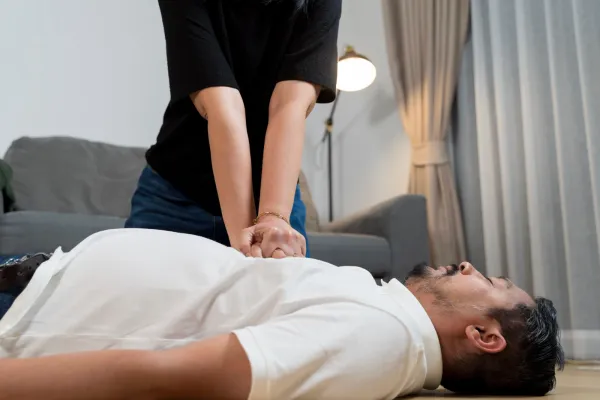
- Start CPR (hands in the middle of the chest and start pushing)
CPR deserves its own guide, but the key point is this: doing something is better than doing nothing.
For most adults who collapse suddenly, pushing hard and fast in the centre of the chest is the most important action you can take until help arrives.
Step 5: Control Catastrophic Bleeding
If there is heavy bleeding:
- Apply direct pressure
- Use whatever is available (gloves, cloth, clothing)
- Keep pressure firm and continuous
Bleeding kills faster than most people realise.
Stopping it is a top priority.
Step 6: Call for Help Early
In the UK:
- Dial 999
- Put the phone on speaker
- Follow the instructions you are given
Emergency call handlers are trained to guide you step by step.
Calling early is not failure, it is good first aid.
What First Aiders Are Not Expected to Do
You are not expected to:
- Diagnose medical conditions
- Perform advanced treatments
- Be perfect
- Replace emergency services
You are expected to:
- Act in good faith
- Use common sense
- Do what you reasonably can
Confidence matters more than complexity.
Why Simple Frameworks Save Lives
Under stress:
- Fine motor skills drop
- Memory narrows
- Complex instructions fail
That’s why first aid works best when it is:
- Simple
- Rehearsed
- Decision-based, not theory-heavy
This is exactly how effective first aid training is designed.
Final Thought: Readiness Beats Knowledge
Reading helps.
Training builds confidence.
Practice makes action automatic.
If you want to be ready to help; at work, at home, or in public, learning what to do is only the first step.
Want to Build Real Confidence?
Constellation Training delivers high-quality first aid and mental health training aligned to recognised UK frameworks, with a focus on:
- Clear decision-making
- Confidence under pressure
- Real-world scenarios
You’re not just attending a course.
You’re learning how to act when it matters most.
Build the confidence to act when it matters.
Practical, UK-aligned first aid training designed for real emergencies and real people.