If Someone Collapses: What to Do Before the Ambulance Arrives
When someone collapses, the minutes before the ambulance arrives can decide the outcome. This practical guide explains how to recognise cardiac arrest, start hands-only CPR, and use an AED with confidence.
Most cardiac arrests outside hospital happen in front of someone. That person is usually a family member, a colleague, or a stranger in a public place. They are rarely a trained medic. What happens in the first few minutes determines whether the person on the floor has a realistic chance of survival.
Bystander CPR can more than double the odds of survival from an out-of-hospital cardiac arrest. Yet surveys consistently show that most people hesitate, worry they will do something wrong, or wait for someone else to act. This post is about removing that hesitation.
The approach described here is grounded in the Resuscitation Council UK 2025 guidelines and reflects the hands-only CPR method recommended for untrained bystanders responding to adult cardiac arrest.
Emergency: If someone has collapsed and is unresponsive
Call 999 immediately or ask someone nearby to call while you start CPR, if they are not breathing normally. Push hard and fast in the centre of the chest at a rate of 100 to 120 compressions per minute. Do not stop until the emergency services arrive or the person recovers.
If an AED (automated defibrillator) is available, get it now or send someone to fetch it.
Do not leave the person alone unless there is absolutely no other option.
What Is Cardiac Arrest?
Cardiac arrest is not the same as a heart attack, though a heart attack can trigger one. In cardiac arrest, the heart stops pumping blood effectively. The person collapses, loses consciousness, and will stop breathing normally within seconds. Without intervention, brain damage begins within four to six minutes.
You can recognise cardiac arrest by two key signs: the person is unresponsive, and they are not breathing normally. That includes gasping, noisy, or infrequent breaths. If you are in any doubt, treat it as cardiac arrest, call 999 immediately, and start CPR. The 999 call handler can help you recognise what is happening, talk you through CPR step by step, and direct you to an AED if one is nearby.
If someone is unresponsive and not breathing normally, treat it as cardiac arrest, call 999 immediately, and start CPR.
Hands-Only CPR: What to Do
Hands-only CPR means chest compressions without rescue breaths. For an untrained bystander responding to an adult who has collapsed, it is an effective and well-supported approach. Full CPR with rescue breaths remains the ideal where someone is trained and confident to give them, but hands-only CPR is what matters when you are not.
What matters most is that you start.
- Call 999. Call 999, or ask someone nearby to call while you start. Put the phone on speaker so you can follow instructions hands-free.
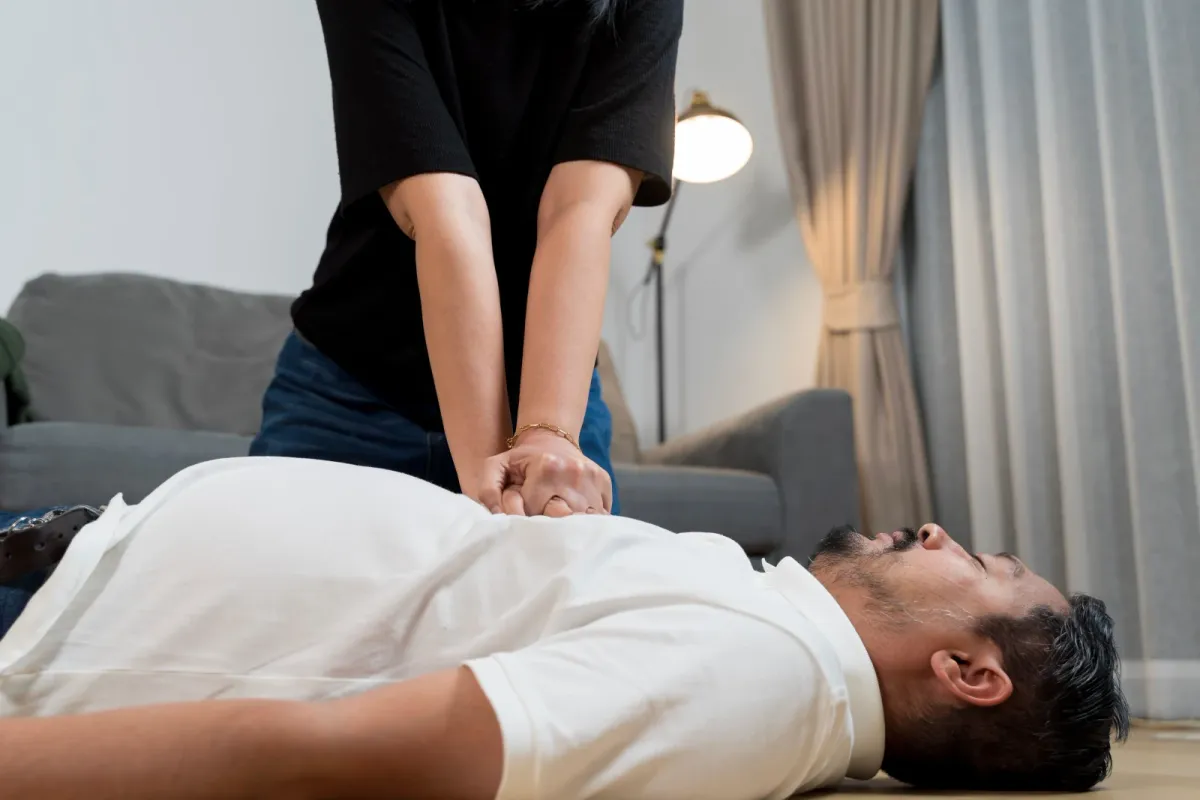
- Position yourself. Kneel beside the person. Place the heel of one hand in the centre of their chest, then place your other hand on top, fingers interlocked.
- Push hard and fast. Compress the chest 5 to 6 centimetres deep at a rate of 100 to 120 per minute. A useful mental reference point is the beat of 'Stayin' Alive' by the Bee Gees.
- Keep going. Allow the chest to fully rise after each compression. Do not stop unless the person starts breathing normally, an AED is ready to use, or emergency services take over.
A note on rescue breaths: if you are trained in full CPR and confident in giving rescue breaths, full CPR with a 30:2 ratio remains part of standard first aid practice.
For an untrained bystander dealing with an adult cardiac arrest, continuous compressions without breaths are effective: do not let uncertainty about rescue breaths stop you from starting.
For babies and children, rescue breaths are far more critical. Cardiac arrest in children is often caused by breathing problems rather than a primary heart event, which means oxygen delivery matters from the outset. Current paediatric guidance supports 5 initial rescue breaths followed by CPR. If you are dealing with a child, tell the 999 call handler immediately: they will guide you through it. This article focuses on adult hands-only CPR.
Using an AED
An automated external defibrillator (AED) is a device that analyses the heart's rhythm and delivers a controlled electric shock if one is needed. You do not need medical training to use one. AEDs are designed for use by members of the public, and the device will talk you through every step.
AEDs are increasingly common in public spaces: shopping centres, sports facilities, train stations, pharmacies, and many workplaces. The national Defib Finder tool at defibfinder.uk shows registered devices near any location in the UK.
How to use an AED:
- Turn it on. Most AEDs switch on when you open the case or press a button. The device will begin giving audio instructions immediately.
- Attach the pads. Follow the diagrams on the pads. One goes on the upper right chest, one on the lower left side. Dry the chest first if it is wet and remove clothing to get direct skin contact.
- Let it analyse. The AED will tell you not to touch the person while it checks the heart rhythm. Stand clear and do not touch them.
- Deliver the shock if advised. If a shock is needed, the device will tell you to press a button and warn you to stand clear first. If no shock is needed, it will tell you to continue CPR.
- Resume CPR. After the shock, restart chest compressions immediately unless the device or the emergency operator tells you otherwise. Continue until help arrives.
The device analyses the rhythm first and only advises a shock if it detects a rhythm that can be corrected this way. You cannot accidentally harm someone by attaching and using an AED. The risk of doing nothing is far greater.
Common Reasons People Hesitate and Why They Should Not
People who witness a cardiac arrest and do not act almost always explain it the same way afterwards: they were not sure it was a cardiac arrest, they worried about causing harm, they thought someone more qualified would step in, or they panicked. These responses are understandable. They are also, in most cases, the difference between life and death.
- If you push too hard, you will not cause the cardiac arrest. It has already happened.
- If you are wrong about the diagnosis, chest compressions on a person who is unconscious but not in cardiac arrest are very unlikely to cause serious harm, and the alternative is leaving someone in genuine arrest without help.
- Many people worry about legal consequences. In the UK, the law is not set up to punish people who step in and try to help in a genuine emergency. The far greater risk is doing nothing.
No CPR means zero chance. Imperfect CPR gives a chance. This is not a close comparison.
The Case for Formal Training
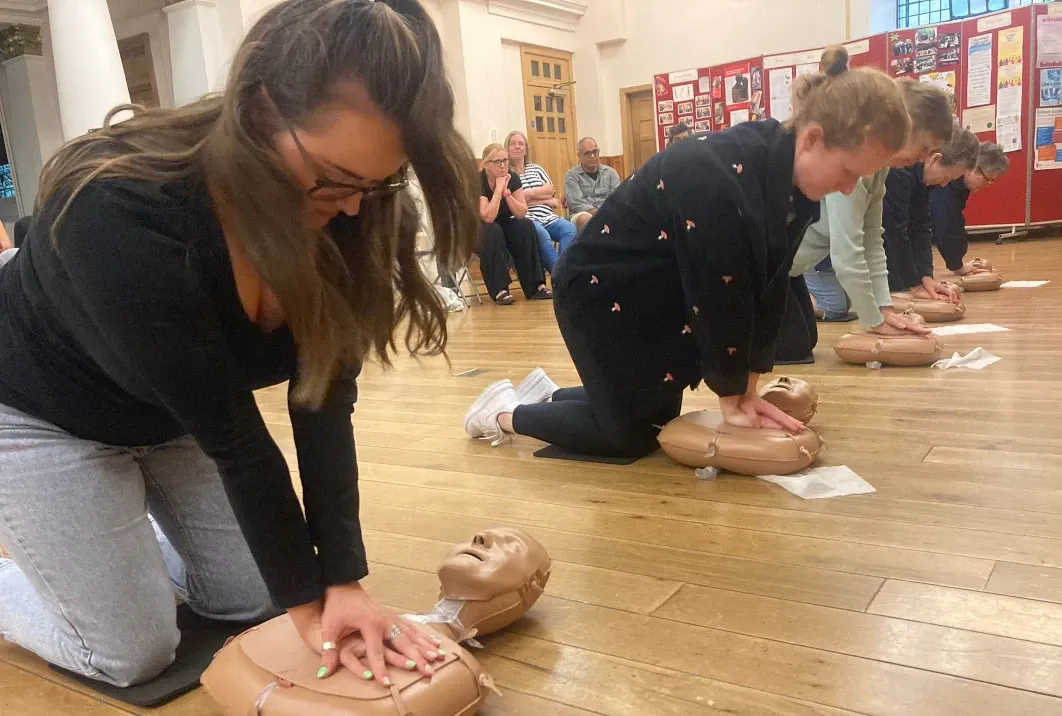
Reading about CPR and doing it are two different things. Hands-only CPR is straightforward enough that guidance alone can help someone act, but the confidence and muscle memory that come from practising on a manikin with an instructor make a material difference in a real emergency.
A basic first aid or CPR course typically runs for a few hours. It covers correct hand placement and compression depth, recognition of cardiac arrest, paediatric considerations, and AED use in a supervised practical setting. Refresher training every two to three years is recommended to keep skills current.

Constellation Training offers first aid courses accredited by the First Aid Industry Body (FAIB), covering CPR and AED use alongside a full range of first aid skills. If you would like to find out more, visit our courses page.
What This Comes Down To
When someone collapses, the minutes before the ambulance arrives are not a gap in care. They are the most important part of the response. Every minute without CPR and defibrillation reduces the chance of survival. What happens before the ambulance arrives matters enormously.
Calling 999, starting chest compressions, and using an AED if one is available: these three things, done by whoever happens to be there, save lives.
You do not need to be perfect.
You just need to start.
References and Further Reading
1. Resuscitation Council UK. Adult Basic Life Support Guidelines 2025. resus.org.uk
2. British Heart Foundation. CPR Guide. bhf.org.uk
3. Defib Finder. Find a Defibrillator Near You. defibfinder.uk
4. NHS. What to do in an emergency: CPR. nhs.uk